
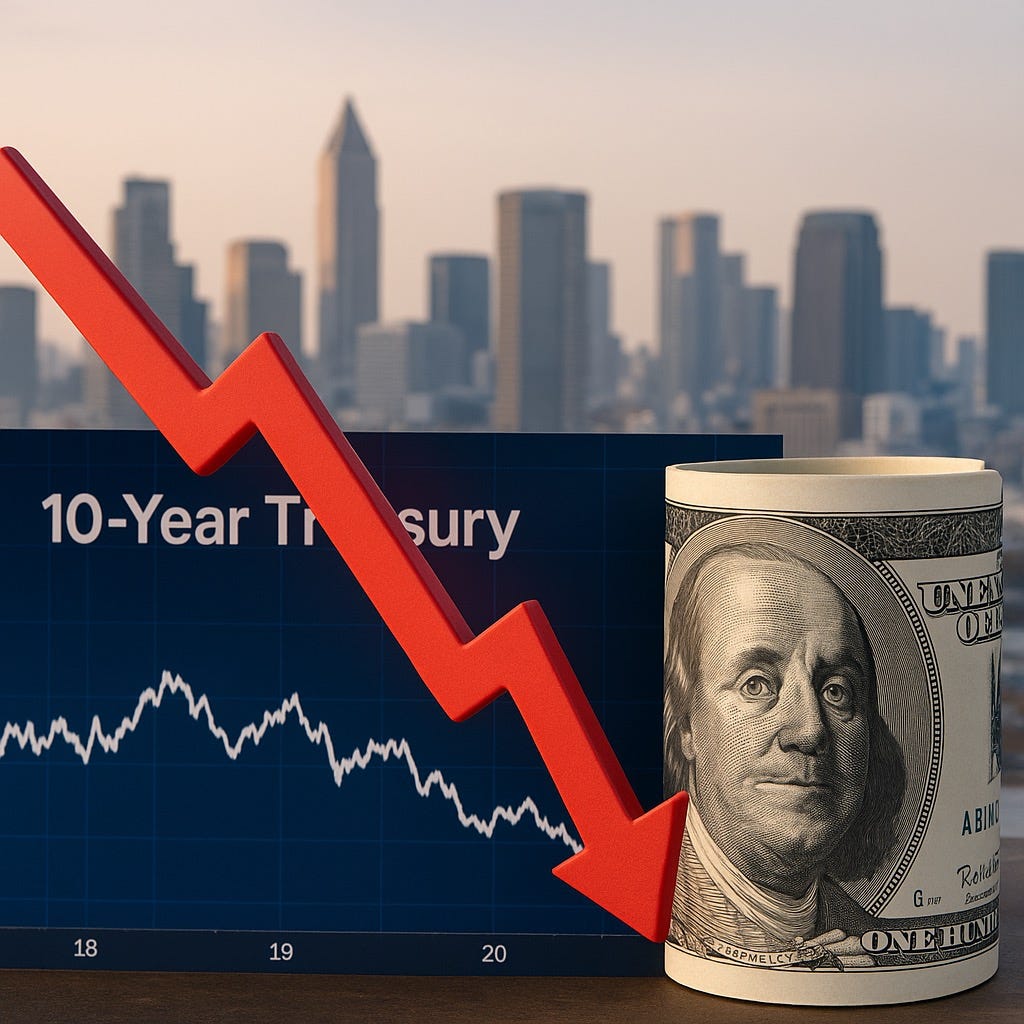
The Fed’s recent 25-basis-point rate cut may feel incremental, but in commercial real estate, even a quarter point can reshape the conversation. Beyond the headlines, the real story is what happens next with the 10-year Treasury. That’s the benchmark that determines how favorable—or challenging—financing looks for investors right now.
The Treasury as the New Compass
When the Fed moves, all eyes shift to the 10-year. If Treasury yields drift higher due to heavy government issuance, CRE capital markets could face renewed pressure. But if yields hover around 4%, that’s a different story. At that level, debt remains reasonably attractive, liquidity flows, and investors who have been waiting on the sidelines may step back into the market.
As Marcus & Millichap’s John Chang pointed out, we’re in a rare moment where financing terms are still relatively favorable despite broader market volatility. Debt markets remain active, spreads are tight, and lenders are showing steady appetite. That opens a short-term window for dealmakers who can move decisively.
Employment: A Quiet Swing Factor
The Fed’s cut wasn’t just about inflation—it was also about a cooling labor market. Job growth has slowed, and while we’re not staring down a 2008-style crash, a mild recession is possible. If that happens, it’s more likely to look like the early 2000s: softer hiring, less income growth, but not a systemic collapse.
Counterintuitively, weaker labor conditions may actually support office demand. Return-to-office momentum continues to build, and office absorption has now been positive for five straight quarters. Slower hiring reduces the pressure to shed space, while employers keep nudging employees back into physical offices.
Retail and Industrial: Still Holding Up
Even with economic headwinds, consumer spending hasn’t cracked. Adjusted for inflation, core retail sales are up 2.2% year-over-year. Categories like restaurants, apparel, and e-commerce remain strong, thanks to low household debt and elevated savings buffers.
That resilience flows directly into retail space demand. And industrial, which thrives on the back of e-commerce, remains a clear winner. Investors with logistics-heavy portfolios are still in a solid position, even if delivery timelines stretch.
Multifamily: A More Nuanced Picture
Multifamily has been one of the most reliable performers in CRE, but the signals here are mixed. Absorption has been strong over the past year, yet forward demand could soften. Lower Treasury yields could ease mortgage rates, nudging renters toward homeownership. On the flip side, rising unemployment among renters aged 20–24—now at 9.2%—threatens to slow new household formation.
The silver lining: developers are pulling back. Fewer apartment deliveries could balance supply with demand and prevent a deeper correction.
The Bottom Line
For CRE investors, everything comes back to the 10-year Treasury. If yields remain near 4%, capital remains available, financing is palatable, and deal activity can stabilize. Risks are still there—a cooling labor market, uneven sector demand, and global capital flows—but the backdrop is far from bleak.
In this moment, investors who understand sector-by-sector dynamics and move with precision will find opportunities. The market isn’t closing—it’s evolving.