
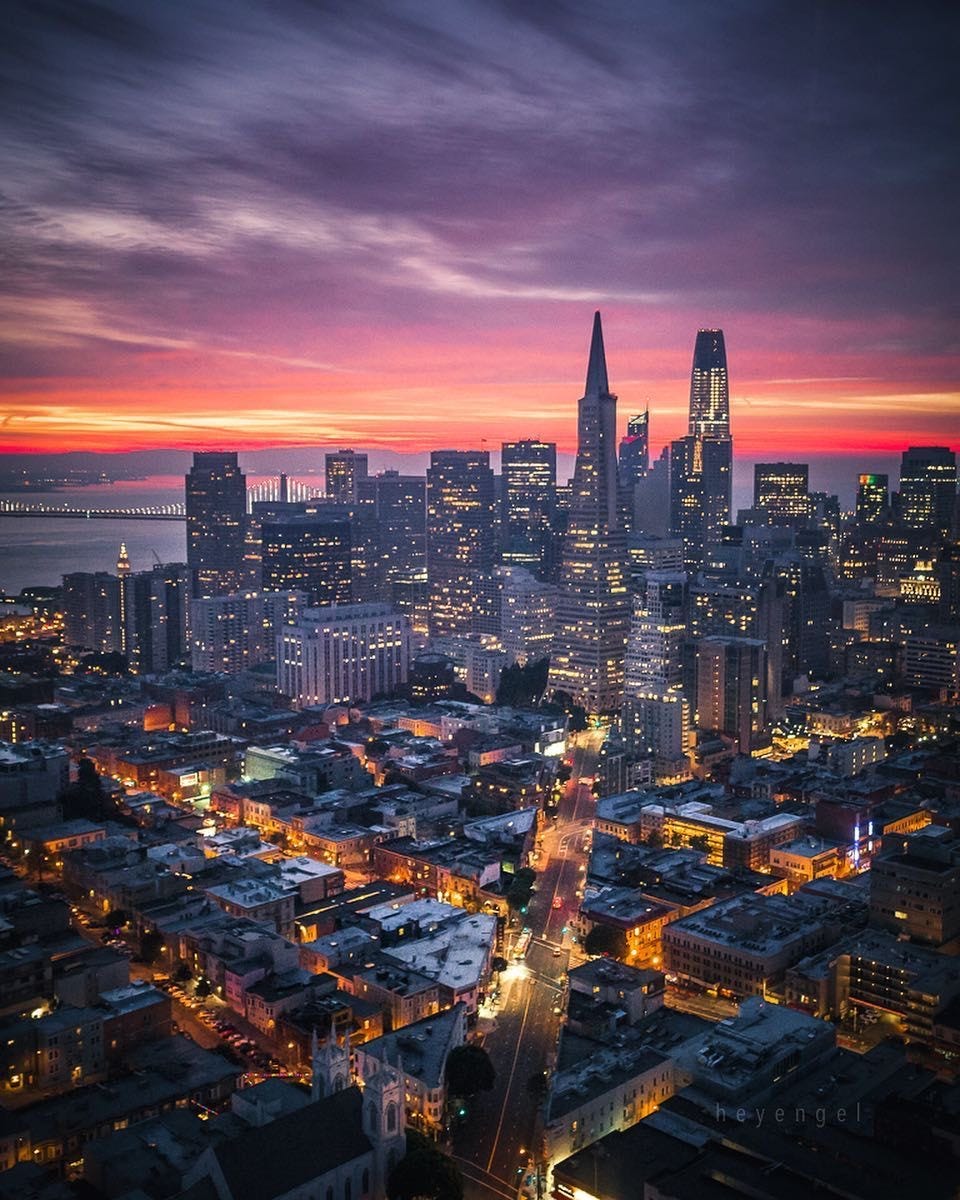
It’s not Miami.
It’s not New York City.
San Francisco is back — and it’s proving a lot of people wrong.
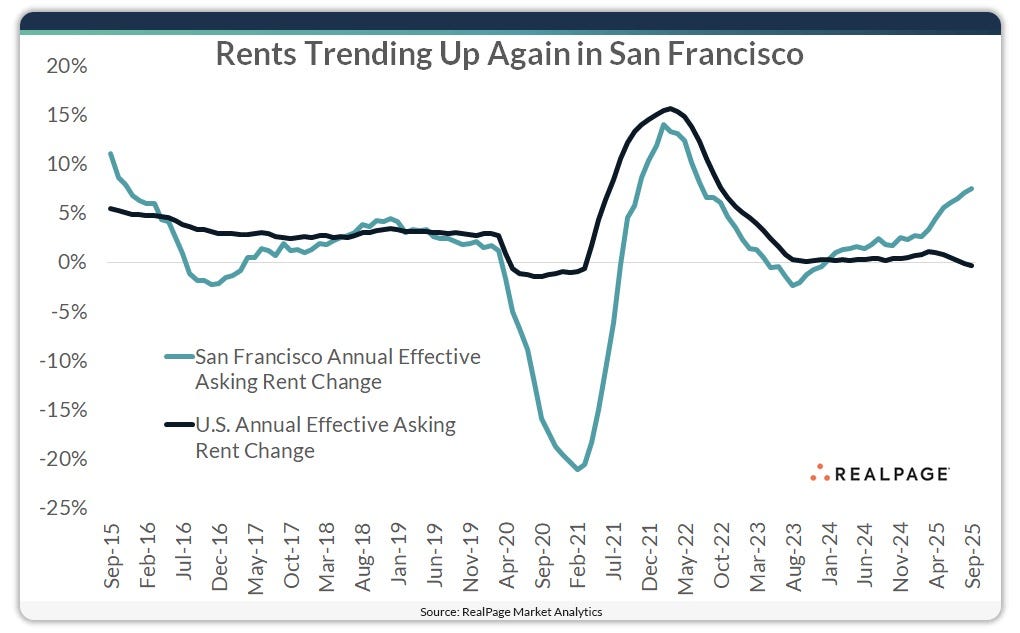
After years of being written off as the poster child for urban decline, San Francisco has quietly reclaimed the top spot for rent growth in the United States. According to RealPage Market Analytics, effective asking rents jumped 7.5% year-over-year through September, outpacing every other major metro in the country — and running far ahead of the national trend, where rents have largely flattened or fallen.
This isn’t just a bounce. It’s a reminder that you can’t bet against innovation-driven cities forever.
From Pandemic Collapse to Tech-Fueled Comeback
During the pandemic, San Francisco’s rental market fell harder and faster than almost anywhere else. Tech workers went remote, downtown emptied out, and the headlines screamed that the city was finished. But the narrative missed a core truth — markets built on intellectual and creative capital don’t stay down for long.
By 2022, rents had already rebounded into double-digit growth. And now, in late 2025, we’re seeing a sustained acceleration — one that rivals San Francisco’s 2011 surge, when annual rent growth hit nearly 14%.
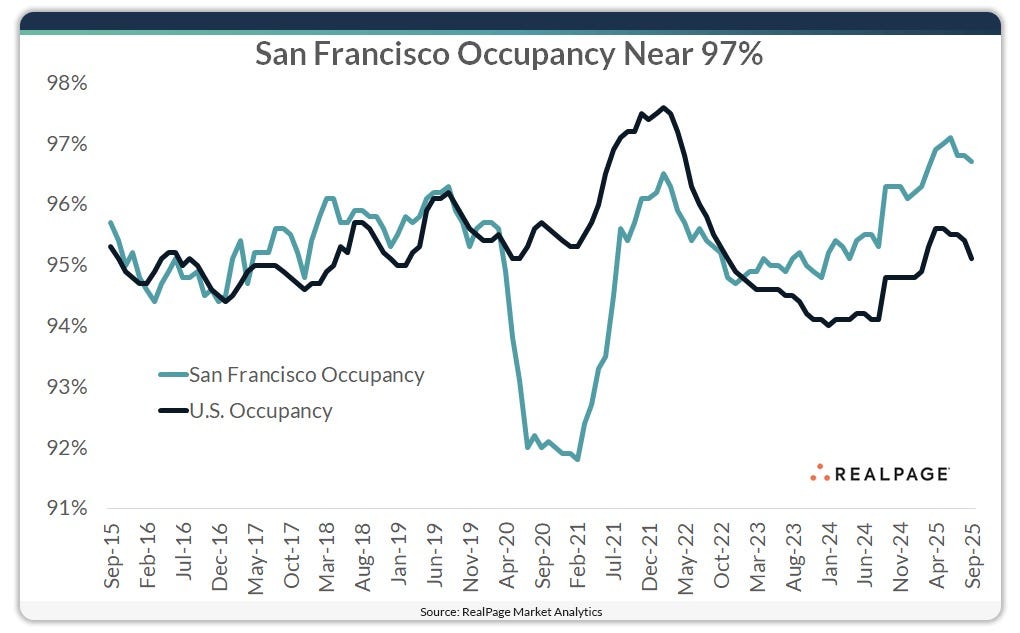
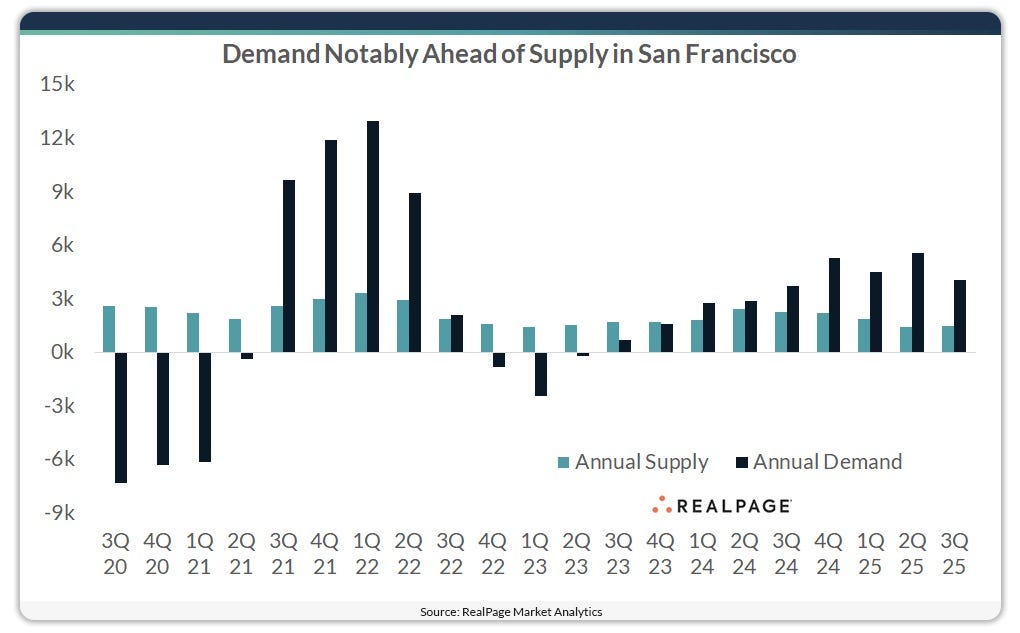
Today, the city’s occupancy rate sits near 97%, well above the national average of 95.1%. Only New York and Newark are tighter among large markets. Developers, meanwhile, are holding back — just 1,443 units were delivered in the past year, roughly half the city’s decade average. Annual absorption topped 4,000 units, nearly three times the pace of new supply.
That imbalance is the fuel behind San Francisco’s comeback story.
The AI Effect
If 2010s San Francisco was powered by social media and consumer tech, the 2020s version is powered by artificial intelligence. Optimism around AI has reignited the city’s economic core.
Job growth, once among the weakest, is now the highest in the nation. The population decline that defined the post-COVID years has stopped. And what’s even more telling — migration is reversing. People are moving to San Francisco again, not away from it. I’m seeing talent flow in from Miami, Dallas, and New York City, drawn by the gravitational pull of AI labs, venture capital, and a reborn innovation ecosystem.
This isn’t a speculative rebound; it’s fundamentals catching up to reality.
The Broader Signal
San Francisco’s turnaround challenges one of the biggest narratives of the past few years — that high-cost coastal cities were permanently losing their edge. But cities with deep innovation DNA and high barriers to entry tend to regenerate faster than people expect.
Rents don’t lie. Capital is returning, leasing is strong, and the same fundamentals that made San Francisco the most dynamic housing market of the 2010s are back in play.
It’s not Miami, and it’s not New York City.
It’s San Francisco — leading the nation again.