
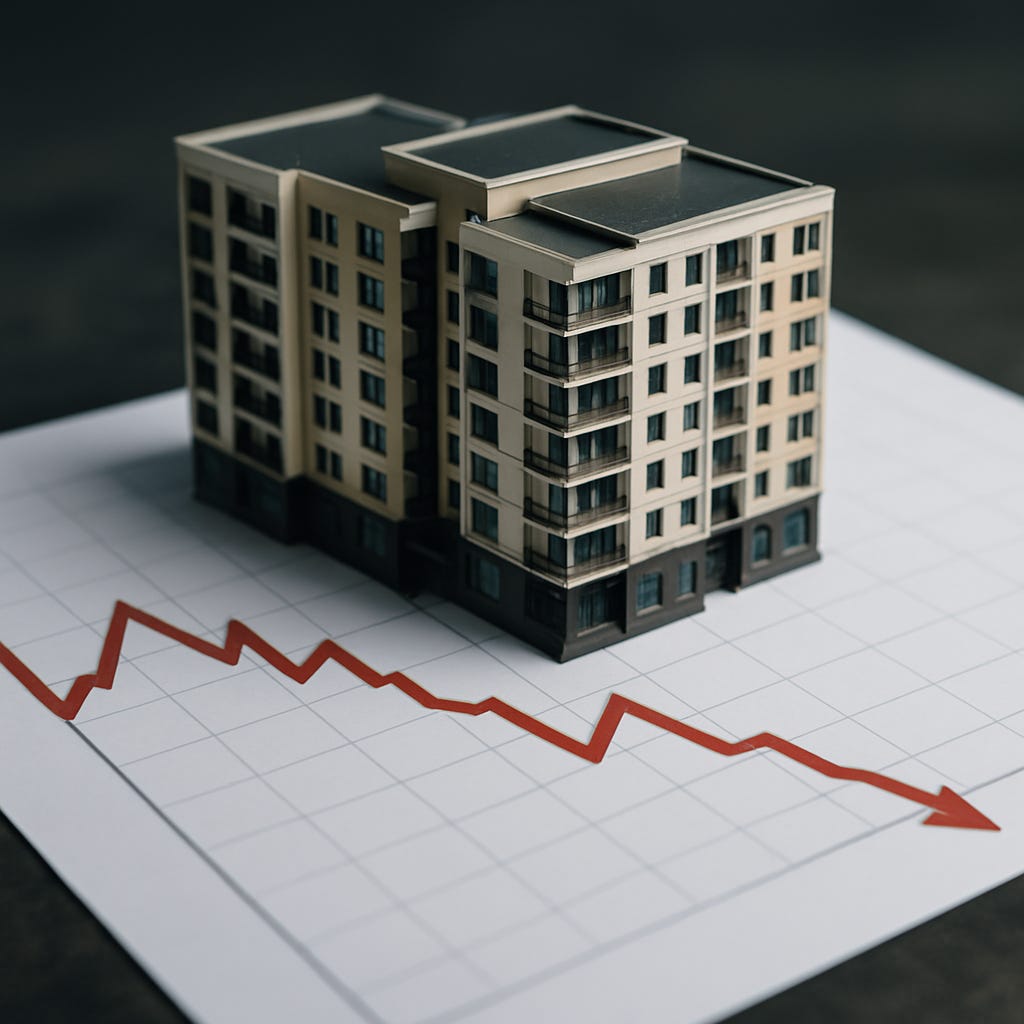
Why that matters for real estate, rent premiums, and the next phase of multifamily performance
The U.S. economy is still moving forward. Manufacturing and services remain expansionary, corporate profits are stabilizing, and households continue to spend—even if it’s increasingly concentrated among higher earners. But beneath the headline numbers, there is a labor market that is starting to feel tired: job openings are down, hiring is slowing, and the quits rate is stuck at post-COVID lows.
From a real estate investor’s perspective, this is where the narrative gets real. A slowing labor market doesn’t immediately kill demand, but it reshapes it. When renters feel less secure, they move less, double up more, and stretch budgets cautiously. That shows up in absorption, rent growth, and concessions long before it shows up in GDP revisions.
This is why the Federal Reserve, the bond market, and every serious multifamily operator I know are all watching the same thing:
Can the economy grow if the labor market loses momentum?
And if it can’t, how much pricing power do landlords really have in 2026?
The signals are mixed, and the confusion isn’t helped by Washington.
When Tariffs Become a Constitutional Question
The Supreme Court just heard a major case questioning whether a president can use emergency powers to impose tariffs without Congress. It’s a challenge to the Trump-era use of the International Emergency Economic Powers Act (IEEPA) and it has bipartisan attention, because tariffs—at their core—are a form of taxation. And taxation, by design, belongs to Congress.
For real estate developers, tariffs aren’t a theoretical debate.
Tariffs directly alter:
• the cost of lumber, steel, copper, and electrical gear
• the economics of modular manufacturing and prefabrication
• the viability of infrastructure-heavy data centers and industrial assets
If the Court limits unilateral tariff authority, it could restore more stability to construction pricing. If it upholds it, we continue in a world where material volatility is a feature, not a bug, and pro formas require even wider sensitivity bands.
Either way, it reinforces something I’ve said for years:
Real estate is no longer a local business. It is a macro trade with zoning.
New Multifamily Supply Is Still Commanding a Pricing Premium—For Now
Even as national rent growth cools, new lease-ups are still achieving higher rents than stabilized assets.
National averages:
Lease-up rent: $1,982
Stabilized stock: $1,871
Premium: +6% ($111/month)
This is happening for a simple reason: renters are still willing to pay for quality.
Rent-to-income ratios remain healthy at ~22%, and on-time payments have been above 95% since 2022. That’s not a market in distress—it’s a market making trade-offs in a world where housing is a product and a lifestyle choice.
Where the premium is strongest
Primary markets continue to outperform:
Washington DC, Chicago, Los Angeles, Dallas, Houston, Atlanta
Lease-up premiums routinely hit 20%–30% due to deep renter pools and diversified job bases.
Even secondary and tertiary markets are proving the thesis:
Memphis
>80% premium driven by riverfront mixed-use and lifestyle retail integration
Detroit
Downtown revitalization + design-forward product near jobs & cultural destinations
Tampa (Central)
Skyline views, high-rise identity vs. garden-style legacy stock
East Nashville
Cultural destination + walkability + music/food scene as identity multiplier
These markets show a powerful truth: Rent growth outside coastal hubs is not only possible, it is durable when it aligns with lifestyle, identity, and location scarcity.
Where premiums disappear
Not every submarket is a winner.
In Brooklyn and Downtown San Francisco, stabilized rents exceed lease-up levels due to affordability ceilings and heavy concessions. Premiums are not automatic. They are earned by site selection, design, and timing.
But the Market Is Cooling at the Edges
Here’s the other side of the story:
U.S. advertised multifamily rents fell $4 in October to $1,743—the third straight monthly decline. Absorption has decelerated sharply in several regions, particularly:
Midwest: Detroit, Twin Cities, Indianapolis
Sun Belt: Orlando, Nashville, Miami, Southwest FL, Dallas
Some operators are now offering 1–2 months free on renewals, something historically reserved for new leases only.
Meanwhile, consumer sentiment has weakened for three straight months and recent college graduate unemployment is at a nine-year high—a key signal for Class A absorption.
This is not collapse. But it is softness that must be respected.
Build-to-Rent (BTR) Is Steady, But Not Immune
Single-family BTR rents fell again:
Down $6 in October to $2,195
Year-over-year growth: 0.0%
Best YOY BTR performance:
Twin Cities, Chicago, Grand Rapids, Columbus, Kansas City (5%–7% growth)
Weakest:
Austin, Jacksonville, Nashville, Dallas, Las Vegas, Miami
Much of this weakness comes from accidental landlords renting homes they can’t sell because they’re locked into cheap 2020–2021 mortgages.
Where This Leaves Investors and Developers
The Headwinds
• Slowing labor market → softer absorption
• Tariff uncertainty → pricing volatility
• Consumer confidence down → upgrade hesitancy
• Supply still hitting in Sun Belt markets
The Tailwinds
• Construction starts down nearly 50% since 2023
• Deep leasing premiums for well-located new assets
• Continued household formation and immigration demand
• AI-driven productivity and data-center-linked job growth
Economists like Moody’s Mark Zandi argue the U.S. avoids recession and is in a transition economy—not shrinking, but recalibrating.
I agree. This is not a crisis. It is a sorting period—where capital that chases quality, timing, and submarket identity will outperform.
My View: Execution and Location Matter More Than Ever
If you develop or own multifamily today, the playbook is shifting:
You can’t compete with new supply on price—only on experience
Lease-up premiums are a signal, not a guarantee
Submarket identity is becoming a core underwriting variable
Tariff and labor uncertainty must be priced into every GMP
This part of the cycle rewards discipline, not volume
What I am prioritizing across my own pipeline:
Mixed-use placemaking where community identity does the leasing for you.
Waterfront, park-front, and trail-network adjacency that creates non-replicable value.
AI-enabled operations to reduce OpEx and resident friction.
Structured capital that respects longer lease-up velocity.
Focus on rent-to-income health and payment consistency over top-line rent.
Closing Thoughts
The economy is still growing. Real estate is still leasing. But the market is asking for better answers—better design, better community, better living. In a cycle where renters are willing to pay premiums, the industry must be worthy of that premium.
This moment is not a slowdown—it is a filter.
The next phase of multifamily leadership will belong to teams who treat housing as a service, not just a structure. Those who can deliver identity, convenience and belonging will own the next decade of returns.
— Daniel Kaufman
Real Estate Developer, Investor & Operator