
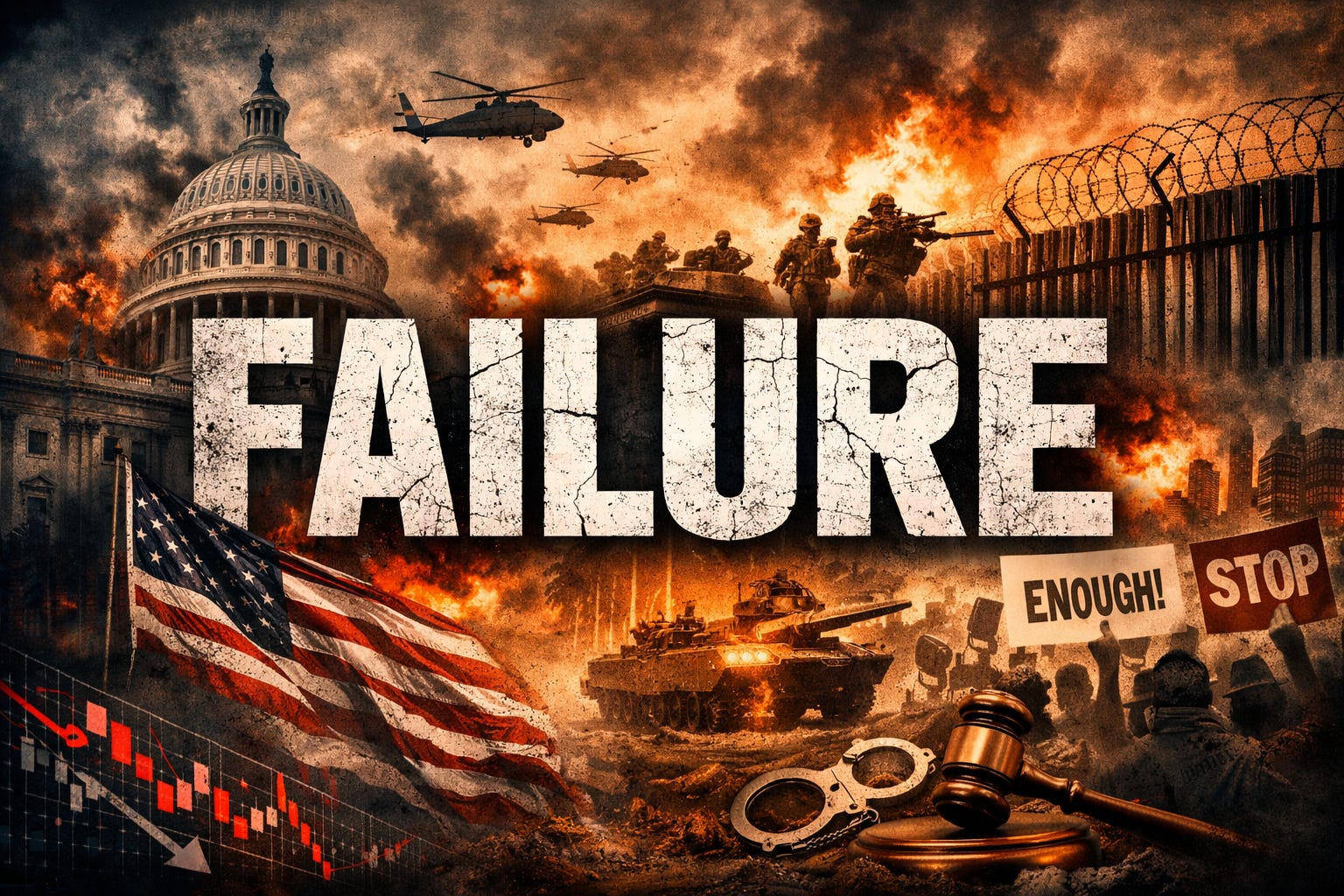
As 2025 draws to a close, it is worth stepping back from the daily noise and assessing the first year of Trump’s second term with some distance. This is precisely why I value taking a big-picture view. When you step away from the headlines and distractions, patterns emerge, and the connections between otherwise chaotic policies become clear.
What has become increasingly obvious is that we are not watching a functioning executive branch. Trump’s physical and cognitive decline is no longer speculative. As Jamelle Bouie recently observed, instead of a strong unitary executive, we now have something closer to a fragmented kingdom, divided into competing fiefdoms, with a deteriorating figure at the center.
The predictable result has been a power vacuum. Into that vacuum stepped ideologues, extremists, tech billionaires, conspiracy theorists, Christian nationalists, and white supremacists, all racing to advance their own agendas. That is the input. What the country is now dealing with every day is the output.
High inflation paired with rising unemployment. Soaring healthcare costs. Racially charged political violence. A looming hemispheric conflict. A Congress unable to govern. These outcomes were not accidental. They are the direct result of policy choices.
Despair has been widespread, but something else has been building as well: resistance. Voters across the spectrum, energized Democrats, disillusioned independents, and even regretful Republicans, have started to push back. We have seen it in repeated electoral defeats for the president’s party and in the growing willingness of GOP officials to reassess the cost of blind loyalty.
Poll numbers reflect this collapse. But the deeper story is not simply dissatisfaction with broad categories like the economy or immigration. It is that the administration’s policies are failing in a more fundamental way. They are not only ineffective, they are actively alienating the voters who once believed in them.
Let’s take a clear-eyed sweep across the landscape.
Economic Policy Failure
Trump promised lower prices on Day One. What Americans received instead was a sweeping tariff regime, first aimed at close trading partners and then expanded globally with the so-called “Liberation Day” tariffs in April.
Retailers initially masked the impact by stockpiling inventory. That cushion is now gone. The math is simple: tariffs either crush margins or get passed directly to consumers. Either way, prices rise.
Farmers, many of whom overwhelmingly supported Trump, have been left unable to sell crops abroad. The administration’s response has been billions in emergency subsidies, a socialized patch for a problem entirely of its own making. It does nothing to address the underlying damage.
Grocery prices continue to climb, driven by tariffs and labor shortages caused by aggressive immigration enforcement. Utility costs are also rising, exacerbated by cuts to green energy projects that were close to coming online, even as data centers consume ever more power. Eliminating future supply while demand accelerates guarantees higher bills.
Unsurprisingly, voter sentiment has turned sharply negative. A majority of Americans now disapprove of Trump’s handling of inflation and cost of living, and a meaningful share of his own voters say they regret their vote, primarily because of the economy.
There is no credible plan to reverse this trajectory. Denial and blame-shifting are not economic policy. They are symptoms of failure.
Healthcare Policy Failure
Healthcare costs are poised to eclipse even inflation as a political flashpoint. With pandemic-era ACA subsidies set to expire, premiums for millions of Americans could more than double.
This outcome is deliberate. Internal Republican divisions, driven by ideological opposition rather than practical solutions, have produced paralysis. As healthier individuals exit the insurance pool due to unaffordable premiums, costs rise further for those who remain. Preventive care declines. Emergency care spikes. The system becomes more expensive and more fragile.
This exact dynamic helped cost Republicans dozens of seats during Trump’s first term. The conditions for a repeat, or worse, are now firmly in place.
Immigration Policy Failure
Latino voters swung sharply toward Trump in 2024, largely driven by economic frustration. They were promised lower prices and targeted enforcement focused on criminals. Instead, they received neither.
The administration’s indiscriminate detention and deportation campaign has swept up lawful applicants and long-standing community members. Support among Latino voters has collapsed, while independent voters increasingly favor legal pathways to citizenship over mass deportation.
Cruelty as policy may energize a narrow base, but it is economically destabilizing and politically corrosive. This approach is failing on both fronts.
“America First” Failure
For many supporters, “America First” meant economic nationalism, reduced foreign entanglements, and limits on foreign labor. Instead, Trump has aligned himself with tech donors on visa expansion, defended foreign student pipelines, and openly floated military intervention abroad to seize oil assets.
This contradiction has fractured the movement. High-profile figures who once amplified Trump’s message are now openly breaking with him, creating space for broader dissent within the party.
Political Persecution Failure
Trump’s fixation on retribution has repeatedly collided with institutional reality. Courts, grand juries, and even Trump-appointed prosecutors have refused to advance legally unsound cases against political opponents.
Each failed prosecution reinforces the perception of overreach and incompetence. The attempt to investigate Senator Mark Kelly, a decorated veteran, has intensified backlash and underscored the administration’s poor judgment.
Military Policy Failure
The domestic deployment of federal troops and unauthorized military actions abroad have drawn bipartisan scrutiny. Courts have rejected many of these actions outright. Congressional pressure is mounting. Public support is fragile.
The administration has little to show for these efforts beyond legal defeats and political backlash. Escalation under these conditions would be reckless, both legally and strategically.
Redistricting Failure
Rather than adjusting policy in response to collapsing approval, the White House attempted to manipulate electoral maps. Instead of consolidating power, the effort mobilized Democratic countermeasures and exposed Republican resistance.
The defeat of Trump’s redistricting push in Indiana, despite intense pressure and direct intervention from party leadership, sent a clear signal: the threats no longer carry the weight they once did.
Epstein Files Failure
Perhaps the most damaging miscalculation has been the handling of the Epstein files. After years of elevating the issue to energize supporters, the administration’s failure to deliver transparency has enraged its own base.
Bipartisan legislative action forced the issue forward, publicly humiliating the White House and reigniting scrutiny that refuses to fade. Trust at the core of Trump’s coalition has been deeply eroded.
Failure Compounding Failure
Any one of these policy breakdowns would challenge a presidency. Taken together, they form a pattern of systemic failure.
Trump still has time to change course. But his instincts, doubling down, deflecting blame, and stoking grievance, are working against him. His cabinet is uneasy. GOP lawmakers are openly defying him. Former allies are peeling away.
What began the year as a seemingly unstoppable political machine now looks more like an aging engine, burning fuel inefficiently and shaking itself apart under its own weight. The failures are no longer isolated. They are compounding.
For investors, policymakers, and anyone paying attention to risk, this is the key takeaway. Systems that refuse to correct eventually break. The only remaining question is how much damage is done before that happens.