
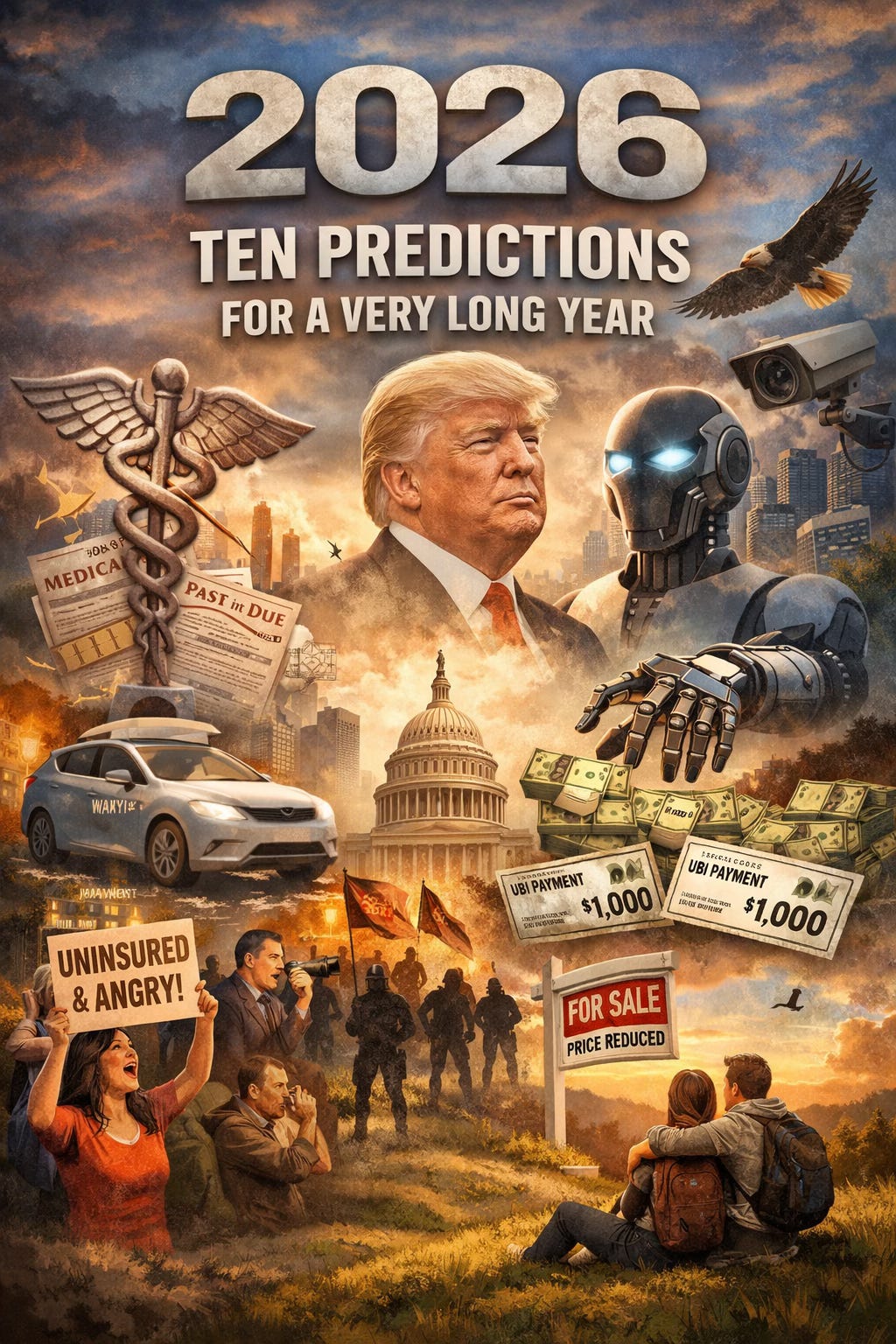
Every January I do this exercise, I stare into the crystal ball and try to make sense of where the currents are actually flowing, not where people say they’re flowing. 2026 feels different. Heavier. More unstable. More consequential.
Here’s what I see coming over the next twelve months.
The Healthcare Shock Is Real, and It’s Political Dynamite
Start with healthcare.
What would you do if your insurance premiums doubled? Or tripled? For millions of Americans, that question stopped being hypothetical this month as Covid-era ACA subsidies expired under the “Big Beautiful Bill.”
This is not a marginal policy tweak. Roughly 22 million people are affected. About 4 million are expected to lose coverage outright. A large share of them are middle-class voters who did everything “right” and suddenly can’t afford health insurance anymore.
In the U.S., having health insurance is still a proxy for stability. Losing it feels like falling through a trapdoor. It creates constant stress, vulnerability, and anger. And that anger is not going to dissipate quietly.
People will show up at town halls. They will film themselves confronting representatives. They will protest. This issue is going to dominate early-2026 politics, and under sustained pressure I would not be surprised to see the House attempt a subsidy extension with some Republican defections. Whether it survives the Senate is another matter.
Either way, this does not go away.
Trump Becomes a Lame Duck, Not an Autocrat
There is a very thin line between strongman and lame duck. 2026 is when Trump crosses it.
The healthcare debacle accelerates a dynamic that’s already underway. Many ACA subsidy recipients live in red states. A lot of Republican voters are now saying, “I voted for border control and lower prices, not to double my insurance bill.”
Add in tariff fatigue among farmers and manufacturers, and the coalition starts to fracture.
Defying Trump used to be career-ending. That’s no longer true. Republicans have already crossed him on issues like the Epstein files. Expect more. About half a dozen endangered House Republicans, plus a wave of retirements, means fewer people are afraid of him.
Trump is tired. He’s been at this since the summer of 2015. That’s a long time to sustain a movement built on grievance and chaos. Expect whispers about him stepping aside after the midterms, possibly handing things to J.D. Vance. The franchise is aging out.
The AI Backlash Starts to Take Shape
Here’s something remarkable: roughly 80 percent of Americans want more regulation of AI.
When Bernie Sanders and Ron DeSantis are both criticizing data centers, that’s not noise. That’s a signal.
For most people, AI doesn’t mean productivity gains. It means job insecurity, synthetic content, higher energy bills, and infrastructure they don’t benefit from. They are not getting hired at data centers. They are not seeing the upside.
Politicians are nervous. Democrats don’t have a coherent position yet. Some governors are selling AI as an economic engine. Most lawmakers don’t want to cross an industry with bottomless lobbying budgets that also controls the social platforms they rely on.
But 80 percent is a lot. Anti-AI sentiment becomes a real populist plank in 2026. Savvier politicians in both parties will lean into skepticism and be rewarded for it.
AI Actually Starts Taking Jobs, For Real
One reason people will turn on AI is simple: it’s getting very good, very fast.
Self-driving cars become normal in major cities. AI customer service replaces humans at scale. Banks, law firms, accounting firms, and large corporations re-architect operations around automation.
Writers, designers, and creatives get hit hard. Middle-aged middle managers lose roles. Entry-level hiring collapses. Software engineers, ironically, are among the most disrupted. When models can autonomously complete tasks that once took hundreds of human hours, the economics change overnight.
Expect a wave of “I studied computer science and now I do something completely different” stories. This will not be isolated. It will cut across professions.
The war on normal people has arrived, and this year the rubber meets the road.
Air Starts Coming Out of the AI Investment Bubble
Two things can be true at the same time.
AI will reshape the economy and create trillions in long-term value.
And current AI valuations are ahead of reality.
OpenAI talking about needing $1.4 trillion in infrastructure while doing roughly $20 billion in revenue should give anyone pause. That math requires repeated, rapid doubling at enormous scale. That’s hard.
Then you have cheaper substitutes emerging, including foreign models that are “good enough” at a fraction of the cost. When customers switch models easily and loyalty is low, pricing power evaporates.
At some point, conventional wisdom shifts. When enough people start saying “this feels bubbly,” prices follow. I don’t know when the correction hits, but I expect the process to begin in earnest this year.
Real Estate Prices Finally Start to Bend
Speaking of bubbles.
I know a young couple who bought a home in the New York suburbs in December. For the first time in years, they offered below asking and got it.
That matters.
National home prices nearly went negative in Q4. That’s not normal. Sellers are slowly accepting reality. What starts as mild price flexibility becomes momentum.
Housing will remain unaffordable for most people, and all markets are local. But if you’re a buyer, conditions improve in 2026. If you’re a seller, timing starts to matter again.
Democrats Win the House, Narrowly Lose the Senate
Midterms are not complicated. The party in power loses because people are unhappy.
Trump’s approval sits around 40 percent. Costs are still high. He’s not on the ballot. Democrats retake the House, though gerrymandering caps the upside.
The Senate stays narrowly Republican, likely 51-49. That sets the stage for 2028, with Gavin Newsom as the early Democratic standard-bearer and J.D. Vance looming large, possibly already President.
More Political Violence
This is the hardest one to write.
Political violence is a feature of societies coming apart. It doesn’t stop until the fever breaks. We’re not there yet.
The retirement wave in Congress, already historic, will grow. Death threats and harassment are constant. The system feels ornery, not orderly.
I wish I had better news.
Universal Basic Income Comes Back
If AI eats jobs at scale, what’s the policy response?
UBI returns. Not as a thought experiment, but as a necessity.
Ironically, Trump himself may push cash-transfer ideas. He understands that putting money in people’s hands buys time and goodwill. Stimulus politics never really left.
Money is one of the few tools we have to ease a painful transition. Expect UBI to re-enter the mainstream conversation, loudly.
Time Away From Screens Becomes the Ultimate Luxury
Finally, something personal.
I’m a parent. Screen time is the biggest issue in our household.
The affluent are already reacting. Tighter rules. More physical activity. More books. Disconnection becomes status. Screen time increasingly looks like an economically inferior good.
Reading the list above probably didn’t make you feel great. That’s the point.
The antidote is outside. Walking. Looking up. Realizing the birds don’t care about any of this.
Unplug. Look up. Touch grass.
Our rectangles of sadness are not doing us any favors. More people will figure that out this year.
And yes, we’ll find a way to brag about it anyway.