
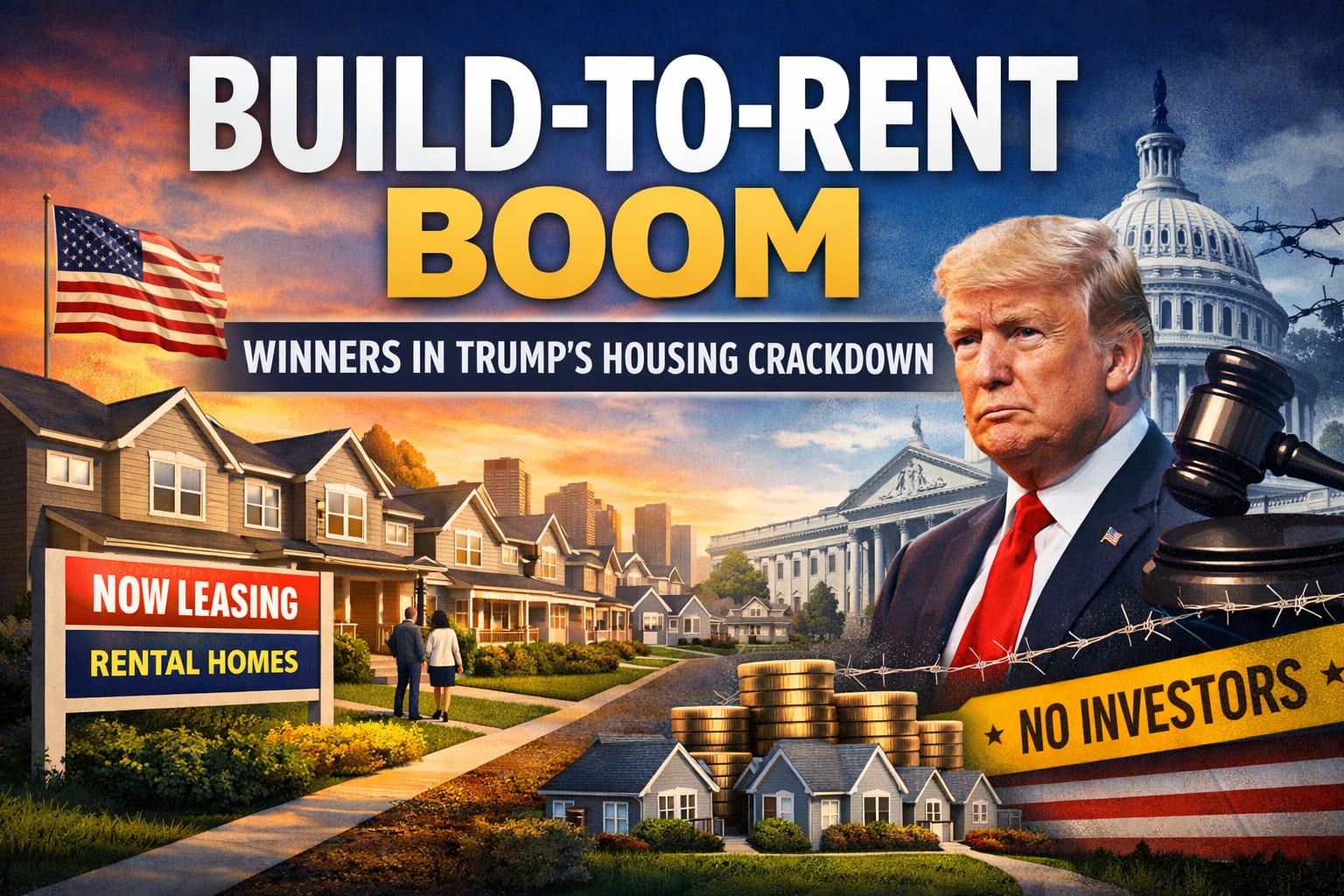
President Trump’s latest housing order is being framed as a crackdown on Wall Street buying up single-family homes, and in spirit, that’s exactly what it is. But buried inside the policy is a carve-out that matters far more than most headlines are acknowledging.
Build-to-rent is exempt.
And that changes the trajectory of this sector in a meaningful way.
The order targets institutional investors purchasing existing single-family homes, a move aimed squarely at affordability and the political optics of private equity competing with first-time buyers. But purpose-built rental communities, entire neighborhoods constructed from the ground up and operated as long-term rentals, are explicitly excluded.
From a developer’s point of view, that exemption is not a technicality, it’s a green light.
Build-to-rent doesn’t displace individual buyers. It doesn’t shrink the for-sale housing stock. It doesn’t trigger the same emotional or political backlash as a fund buying ten homes on a cul-de-sac. And now, it has regulatory shelter at the federal level.
If you are Invitation Homes, Pretium, Quinn Residences, or any of the institutional groups that have already been shifting away from scattered-site rentals toward ground-up rental communities, this policy doesn’t slow you down. It accelerates you.
This is the model Wall Street was already gravitating toward. The politics just caught up.
The suburban shift is already underway
Build-to-rent was not born out of this executive order. It was born out of math.
Since 2012, more than 321,000 build-to-rent homes have been constructed in the United States. Over 75 percent of that supply has come online in just the last five years. Rising mortgage rates, surging home prices, and tighter credit standards were already pushing both developers and renters toward a purpose-built rental product.
Major homebuilders like D.R. Horton and Lennar didn’t pivot into rental communities by accident. They did it because demand moved there first.
What this new policy does is reinforce the trend. It tells capital markets that build-to-rent is not only economically viable, it is politically safer than buying existing homes. That matters when you are underwriting ten-year holds and deploying institutional capital.
Expect more suburban land to convert into rental neighborhoods, especially in high-growth metros and school districts where homeownership has simply moved out of reach for most families. The traditional owner-to-renter mix in these markets is going to keep shifting.
Not because people don’t want to buy.
Because they can’t.
And because build-to-rent fills a gap the for-sale market no longer can.
From my seat, this isn’t about ideology. It’s about capital flow.
Investors don’t like regulatory risk. They like clarity. An exemption that explicitly protects build-to-rent from political crossfire does exactly what you’d expect, it channels more money into the model.
There are still open questions
There are real ambiguities in how this policy ultimately gets interpreted.
Does pre-construction bulk sales to investors qualify for the exemption. What happens if a build-to-rent project is partially sold off to a fund before completion. How does this interact with potential Senate action that could tighten or redefine the scope of the order.
Those questions matter for structuring deals, not for the direction of travel.
And right now, the direction is clear.
Build-to-rent just became the path of least political resistance for large-scale rental housing.
The bigger shift no one is saying out loud
This order quietly acknowledges something uncomfortable.
The American Dream is changing.
For a growing share of households, the future is not a 30-year mortgage. It’s a long-term lease in a professionally managed rental community that looks and feels like homeownership, without the capital burden.
Build-to-rent isn’t a temporary workaround. It’s becoming a permanent layer of the housing market.
Trump’s crackdown was meant to rein in institutional buyers of existing homes. Instead, it may end up turbocharging a development model that reshapes suburbs and normalizes renting as a long-term lifestyle.
From where I sit as a developer and investor, the takeaway is simple.
Build-to-rent was already rising.
Now it’s politically protected.
And that combination is powerful.