
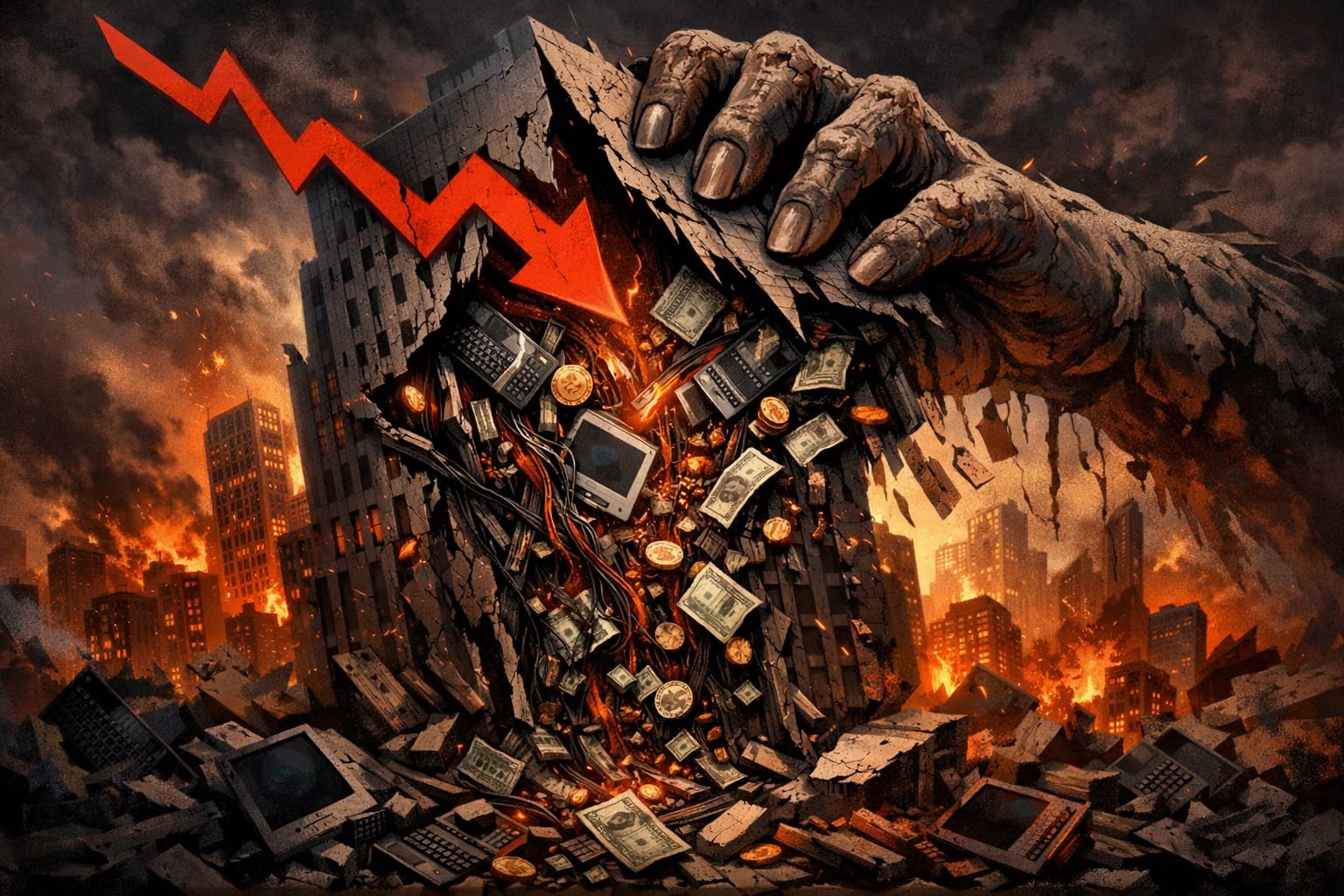
I write this not just with sadness, but with the conflicted perspective of someone who’s built both buildings and software, who’s raised capital and deployed it, who’s been both disruptor and disrupted.
Last week, I wrote about how AI is now replacing white-collar workers in earnest as Claude’s Co-work released plug-ins for legal, financial and marketing functions. Social media is filled with accounts from long-time software developers declaring themselves obsolete based on AI’s capabilities right now. Physicists report the same.
Someone I know, had AI program an app for them this week. It completed in minutes what used to take a designer or a firm days of work.
As someone who’s paid those firms, I felt both relief and revulsion.
How many roles essentially consist of processing information and then presenting it to someone to make a decision? Now not only the process and report will be automated, but perhaps the decision as well.
This will result in the great disemboweling of white-collar jobs.
The Great Displacement Begins
This automation wave will kick millions of white-collar workers to the curb in the next 12-18 months. As one company starts to streamline, all of their competitors will follow suit. It will become a competition because the stock market will reward you if you cut headcount and punish you if you don’t. As one investor put it, “Sell anything that consists of people sitting at a desk looking at a computer.”
I’ve started to call this displacement wave the Great Displacement because it captures the scale and permanence of what’s coming.
From my vantage point in real estate development, I’m watching this with horror and, I’ll admit, calculation. Every mixed-use project I’ve done has relied on predictable commuter patterns, coffee shop traffic, lunch crowds. That economic engine is about to seize up.
Do you sit at a desk and look at a computer much of the day? Take this very seriously.
Five Immediate Impacts (And What They Mean for Capital Deployment)
1. Mid-Career Office Workers Will Be Fired in Droves
Right now, there are about 70 million white-collar workers in the United States. Expect that number to be reduced substantially, by 20–50% in the next several years. Even a reduction of several million would be tectonic, and I fully expect it to go well beyond that level. Major firms are firing people right now. I spoke to the CEO of a publicly traded tech company. He said, “We’re firing 15% of workers right now. We’ll probably do another 20% 2 years from now. And then another 20% 2 years later. After that, who knows?”
Millions of workers are about to be given their pink slip.
The most vulnerable are middle managers who have become more expensive. What will they do next? They’ll look for another job. Good luck with that as job search times have already been climbing and corporations are going to be loathe to hire. Many will find something part-time to pass the time. One friend of mine who lost his job began volunteering with a local non-profit that now might want to pay him to manage their IT infrastructure. The pay would be 80% less than what he used to make, but he might wind up taking it. There will be a ton of similar downgrades ahead.
Expect the Starbucks in your local suburb to become occupied with middle-aged former office workers who want to get out of the house. That’s a benign portrait, but a lot of these families still owe mortgages on their houses that they won’t be able to maintain. If I were a homeowner, I might consider putting my house up for sale to see what I could get because there’s going to be downward pressure on these communities. It might not feel great being first, but you don’t want to be last.
Here’s where my developer brain kicks in: Those suburban office parks I’ve invested in? The ones anchored by corporate tenants with 10-year leases? Those leases won’t renew. The companies will either fold the function into AI or consolidate into smaller footprints. I’m already having conversations about converting Class B office space into something—anything—else. Medical facilities, light industrial, last-mile logistics. The math is brutal, but sitting on vacant office space is worse.
The opportunity, if you can call it that: Affordable housing conversions where the economics work. Not downtown towers—those are nearly impossible to convert—but suburban low-rise office buildings with parking. The displaced white-collar workers will need somewhere to downsize to. Buy distressed office assets at 30-40 cents on the dollar, convert to affordable multi-family. It’s not sexy, but it’s reality.
It won’t just be the managers. It will be the call-center workers, the marketers, the coders, the financial forecasting team, and on and on; business functions are going to get compressed into a handful of key employees supplemented by AI.
2. Personal Bankruptcies Will Surge
Americans are in general already on unsteady ground financially, but that’s going to get much much worse. Millions of Americans of every walk of life are about to see their way of life threatened. If you lose your job, you typically can get by for a little while on savings, but then it gets rocky pretty quickly. Mortgage delinquency rates are already on the rise.
Even if you’re not an office worker, you may be affected. Let’s say you’re a drycleaner or a dog walker or a hairstylist. If people in your community stop going to the office, your business is going to suffer because there are fewer business shirts to launder, people will walk their dogs themselves and cut back on trips to the salon.
The amount of money getting paid to human labor is about to go down. The value is going to get soaked up into the cloud. The K-shaped economy, where the rich enjoy the growth and keep spending while the bottom 80% or so are trying to tread water, will become all the more dramatic.
People and families are going to be left behind in large numbers.
From an investment standpoint: This means pulling back on consumer discretionary retail, especially in suburban markets dependent on office workers. But it also means opportunities in discount retail, self-storage (people downsizing), and bankruptcy services. I hate typing that, but capital doesn’t care about my feelings.
The secondary effects matter too. Every development deal I’ve done has involved sophisticated financial modeling by analysts. That’s now a $200/month software subscription. Every legal review that cost $50,000? Now it’s $5,000 plus an AI tool. I’m complicit in this. I’ll use these tools because my competitors will, and if I don’t, I’ll lose deals.
3. College Grads Won’t Be able to Find Jobs
Already, the proportion of seniors who find a job in their field has dropped to 30% and underemployment of recent grads is up to 52%. Enterprises that used to need an annual flow of whippersnappers are now firing some of last year’s whippersnappers. A ton of people will be moving home with Mom and Dad or trying to hide out in graduate school.
School loans will become all the more burdensome without the ability to get a high-paying job. Many young people will be faced with getting a job that doesn’t require a degree while paying for the one that they got at great expense.
Basically, the education premium is going to be sharply reduced with AI’s arrival; many degrees will become devalued. Dozens, perhaps hundreds, of marginal colleges are going to close over a number of years. The ones that remain will be asked to prove their value in various ways, with the elite doing fine and the others struggling or evolving.
If you’re weighing going back to school or sending your child in this direction, question the cost of the degree heavily, as the cost-benefit is changing—for the worse—in real time. If it’s low-cost, vocational or top-tier, you’re fine. If it’s expensive and doesn’t lead to a concrete opportunity . . . maybe re-examine it.
Investment thesis: Short private student housing near mid-tier universities. Long trade schools and vocational training centers. The plumber, the electrician, the HVAC tech—you can’t automate that with current technology. We need physical infrastructure built and maintained. I’m looking at partnerships with trade programs, potentially building dedicated housing near these facilities.
Where the jobs will actually be: Skilled trades, healthcare (especially hands-on care), construction, renewable energy installation, data center construction and maintenance, robotics maintenance, agricultural technology, elder care. Anything that requires physical presence, dexterity, and real-world problem-solving in unstructured environments.
4. Downtowns and Office Parks Will Empty Out
What to do with all of this office space? Many commercial districts struggled through COVID and work-from-home. This will get considerably worse. Commercial buildings are generally very difficult to convert to some other purpose (i.e. residential) because of the floor plans, plumbing and the like.
This will become an overhang in Miami, New York, Chicago, Los Angeles, San Francisco and other cities with significant office districts. Not that long ago, these offices were a source of significant tax revenue. Their devaluation will hurt municipal balance sheets for years and make cities less able to provide services in other neighborhoods. Major urban centers will become less central and vital with AI, and empty office blocks will become the norm. Think urban wasteland and eerie downtowns leading to municipal tax hikes and declining services.
This is where my real estate background screams in agony. I’ve developed office buildings. I understand the brutal economics of conversion. A typical downtown office tower has:
∙ 40-foot floor plates designed for open plans
∙ Core bathrooms serving hundreds of people per floor
∙ HVAC systems designed for 9-to-5 occupancy
∙ No individual kitchens or adequate plumbing for residential
∙ Structures that can’t easily be modified
The cost to convert often exceeds the cost to demolish and rebuild. But you can’t demolish in a down market—there’s no exit.
The plays I’m considering:
∙ Data centers: These buildings have robust power infrastructure and are often located near fiber nodes. Converting to edge computing facilities or AI training centers could work for certain buildings. The power requirements are insane, but so is the demand.
∙ Vertical farms: Controlled environment agriculture in urban cores. Crazy? Maybe. But food production near population centers, using AI-optimized growing systems, could be viable.
∙ Medical campuses: Consolidate multiple healthcare functions. Dialysis, imaging, outpatient surgery, urgent care. The aging population needs this, and healthcare is somewhat recession-resistant.
∙ Mixed-use experiential: Ground floors become entertainment, upper floors become residential or hotel. Only works in prime locations with significant capital for reconstruction.
The real opportunity: Secondary cities that never over-built office space. Places like Boise, Nashville, Raleigh, Austin. They have lower vacancy rates and more flexible building stock. That’s where I’d deploy new capital.
5. Pessimism and Anger Will Rise Up
I saw a note on social media that said, “Do you really think politicians will let millions lose their jobs? They’ll ban AI first.”
Has this person been paying attention? Go talk to the manufacturing workers or the journalists and see how it worked out. Hundreds of billions of dollars have not been spent on this technology for corporate juggernauts to stop now, and most officials have been cheerleading what they see as progress. The genie is out of the bottle.
But yes, people are going to be pissed.
The social contract of ‘study hard, go to school, get a good job, live a decent life’ is about to be vaporized to smithereens. Upward mobility for most will be a thing of the past.
People are not going to take it well. Particularly educated people who think that they deserve better. That’s an ingredient for revolt.
There’s been a lot of talk this past year about how young people are lurching to the left, the growing popularity of socialism in the Democratic Party, and figures like Zohran Mamdani as emblematic of the next wave of leaders.
Imagine what people are going to think when we all feel like serfs to AI overlords that have soaked up the white-collar work?
Everything that has preceded this will be tame compared to what’s coming in terms of anger, despair and unrest. It won’t be very clear or organized, but people increasingly will feel like they have less to lose.
From a technologist’s perspective: We built this. I’ve invested in AI companies. I’ve used these tools to make my businesses more efficient. And now I’m watching the second- and third-order effects ripple out, and they’re terrifying.
The social instability this creates is the biggest risk to every investment thesis. You can’t underwrite a deal if civil unrest makes the asset uninsurable or if tax bases collapse so badly that municipal services fail.
Where Do We Build? Where Do We Invest? Where Are the Jobs?
Here’s my framework as both a developer and an investor:
Build:
∙ Essential physical infrastructure: Data centers (AI needs compute), power generation (especially renewable), grid upgrades, water systems, domestic semiconductor fabs
∙ Trade school facilities and workforce housing: Partner with community colleges, trade unions, create live-work campuses for skilled workers
∙ Healthcare real estate: Ambulatory surgical centers, dialysis centers, medical office buildings near growing population centers—especially senior-focused
∙ Logistics and last-mile: Warehouses, distribution centers. Goods still need to move. AI can’t (yet) drive the truck or stock the shelf
∙ Climate adaptation infrastructure: Seawalls, water treatment, fire-resistant communities. This work is shovel-ready and essential
Invest:
∙ AI infrastructure companies: NVIDIA was the obvious play. Now it’s the picks-and-shovels around AI implementation—security, governance, integration, custom training
∙ Automation and robotics: Not just software, but physical automation. Agricultural robots, construction automation, warehouse robotics
∙ Skilled trades platforms: Companies that connect tradespeople with work, or that provide training and certification
∙ Healthcare technology: AI-assisted diagnosis, remote monitoring, elder care technology
∙ Energy transformation: Solar installation, battery storage, grid management, small modular reactors
∙ Water technology: Desalination, treatment, conservation systems
The jobs that survive and grow:
∙ Physical trades: Electrician, plumber, HVAC, carpenter, heavy equipment operator. These require situational awareness, dexterity, problem-solving in chaotic real-world environments. AI isn’t close.
∙ Healthcare hands-on roles: Nurses, physical therapists, home health aides, dental hygienists. The aging population is a demographic certainty.
∙ Specialty construction: Green building specialists, data center technicians, renewable energy installers
∙ AI implementation and governance: Companies will need people who understand both the business and the AI tools. Prompt engineers, AI ethics officers, system integrators.
∙ Creative and strategic roles: The highest-level strategy, true creative vision, relationship-based work. Though this is a much, much smaller pool than currently exists.
∙ Regulatory and compliance: As AI grows, so does the need for people who can navigate the regulatory environment, manage risk, ensure compliance
∙ Education transformation: We’ll need educators who can teach people to work alongside AI, to retrain mid-career, to develop the skills that remain human-centric
The Uncomfortable Truth
I’m going to make money on this transition. I hate that, but it’s true. I know how to read trends, deploy capital, and position assets. The tools that are destroying millions of jobs will make my remaining investments more profitable. I’ll use AI to analyze deals faster, model scenarios more comprehensively, manage properties more efficiently.
But I’m also deeply afraid. Not for myself—I’ve got the resources and flexibility to adapt. I’m afraid for the social fabric. I’m afraid of what happens when an entire educated class gets economically castrated. I’m afraid of the political instability. I’m afraid of what my kids will inherit.
The optimistic take—the one VCs and tech CEOs push—is that this will free humans for higher-order work, that new jobs we can’t imagine will emerge, that we’ll have a renaissance of creativity and innovation.
Maybe. History suggests technological revolutions eventually create more prosperity. But “eventually” can be a generation. And the people losing their jobs in 2026 don’t have a generation to wait.
So here’s my advice, from someone in the arena:
If you’re an office worker: Develop a skill that requires physical presence or deep human relationships. Learn to use AI tools so you’re the person who manages them, not the person they replace. Cut your expenses now. Build your network. Consider a geographic move to lower cost-of-living areas.
If you’re investing: Rotate out of anything dependent on office worker spending. Move into essential services, physical infrastructure, AI tooling, domestic production, skilled trades. Accept lower returns on safer, inflation-protected assets.
If you’re developing real estate: Pivot away from office and traditional retail. Focus on industrial, healthcare, affordable housing, infrastructure. Partner with government on essential projects. Get comfortable with longer hold periods and lower yields.
If you’re young: Learn a trade or go into healthcare. If you pursue a traditional degree, make sure it’s from a top-tier institution with strong alumni networks, or that it’s in a field with hands-on requirements. Avoid debt like poison.
Expect it to get incredibly, intergenerationally rough out there. Batten down the hatches, and do what you can for yourself and those around you.
I’ll be here documenting what I see, making the investments I think will survive, and advocating for solutions that might actually help the millions who will be displaced by this transformation.
The Great Displacement is here. Plan accordingly.