
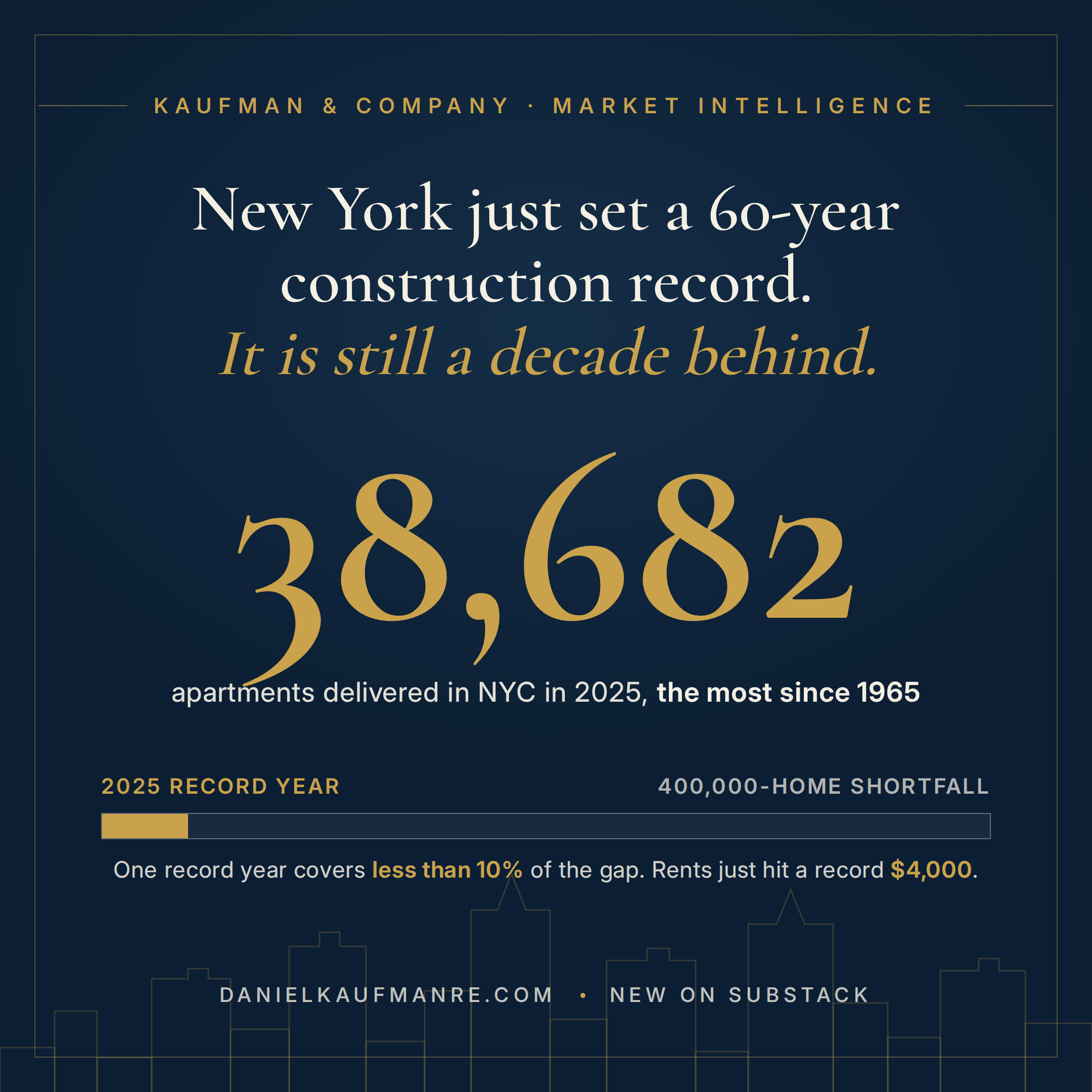
Everyone is celebrating the wrong number. Yes, New York built 38,682 apartments in 2025, its strongest year since 1965. But a record year that covers less than 10 percent of a 400,000-home shortfall is not a victory. It is a measurement of how deep the hole really is.
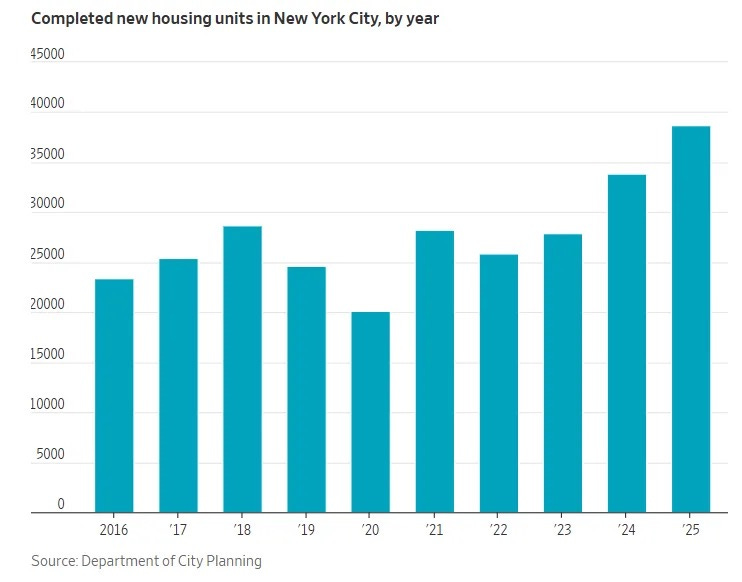
New York City delivered 38,682 housing units in 2025. That is the strongest year for apartment completions since 1965, and it happened while multifamily construction across the rest of the country fell to a 15-year low. As someone who has spent 25 years underwriting, financing, and building housing, I want to be clear about two things at once. This is a genuine achievement. And it is nowhere near enough.
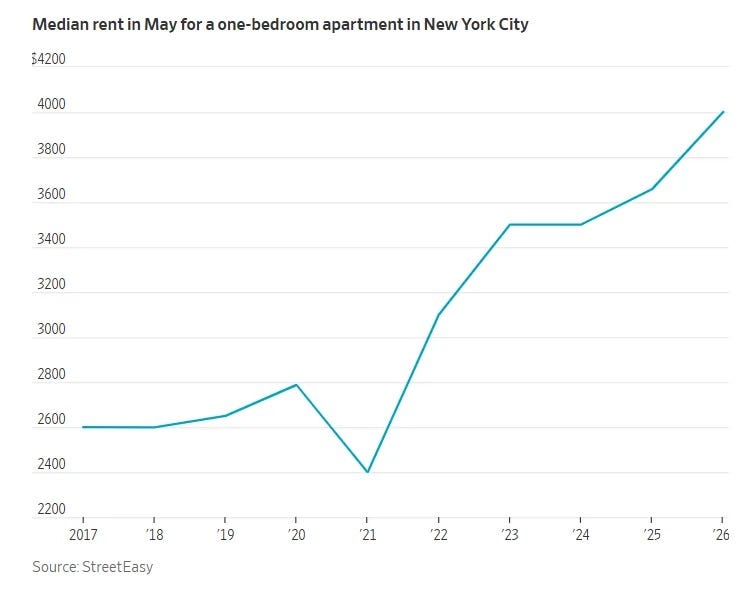
The metro is still short roughly 400,000 homes by Zillow’s estimate. The median one-bedroom rent just hit a record $4,000. A $1,500 monthly budget rents 210 square feet in Manhattan, the smallest footprint of the 200 markets RentCafe tracks. At 2025’s pace, and that pace was a six-decade record, it would take about a decade of sustained near-record production just to close the existing gap. Not to get ahead of demand. Just to catch up.
Why New York Is Building While Everyone Else Pulled Back
The national story is a pullback. Higher borrowing costs, rising construction expenses, and softening rents in overbuilt Sun Belt submarkets have rolled starts and completions over. New York resisted, and the reasons are instructive because they are not magic. They are policy and math.
On the math side, rents high enough to absorb elevated financing and construction costs keep projects penciling, particularly outside the rent-stabilized stock and in neighborhoods tied to finance and tech employment.
On the policy side, two tools did the heavy lifting. Rezonings in Gowanus, Mott Haven, and Long Island City opened land and density in a market where both are scarce. Domain Companies alone completed 360 units in Gowanus and 499 in Long Island City, with 30 percent of the LIC units set aside as affordable. And the new 485-x tax abatement, which took effect in 2024 after 421-a expired, revived filings. REBNY reports 16,815 proposed units across 281 buildings in Q1 2026 alone, the strongest quarter since the 2022 spike.
That is the formula. Density on the land-use side, tax relief on the capital stack side. Remove either one and New York looks like the rest of the country.
The Contrast With the Southeast Tells the Real Story
Here is where I think the national conversation gets lazy. People treat New York and the Sun Belt as opposite housing stories. Expensive coastal city that cannot build versus affordable Southern metros that build freely. That framing is about five years out of date.
I have written extensively about what I call the Southern Squeeze. Austin, Nashville, Charlotte, Tampa, and Jacksonville built aggressively through 2021 and 2023, delivered a historic wave of supply, and rents softened. Developers and capital read that softness as saturation and pulled back hard. That is a large part of why national multifamily starts sit at a 15-year low today.
But the pullback is a trap. The in-migration to those markets has not stopped. The jobs have not stopped. Insurance costs, land prices, and property taxes in the Southeast have climbed sharply, and the affordability advantage that fueled the migration is eroding in real time. The supply wave that suppressed rents in 2024 and 2025 is being absorbed, and the pipeline behind it is thin. The Southeast is setting up for its own affordability crunch in 2027 and 2028, arriving just as the temporary rent relief burns off.
So the real lesson is not New York versus the Sun Belt. It is that every high-demand market in this country eventually runs into the same wall: production that responds to short-term rent signals rather than long-term household formation. New York hit the wall decades ago. The Southeast is hitting it now, just with better weather and a lag.
Where the Current Model Falls Short
Even New York’s record year exposes the structural shortfalls I see in market after market.
First, the production model only works at the top of the market. Rents high enough to offset today’s costs means new supply concentrates in luxury product. Households earning 80 to 120 percent of area median income, the teachers, nurses, first responders, and service workers every economy runs on, are the segment almost no new construction serves. Home prices are up more than 40 percent since 2020, more than double wage growth, and nearly half of renters are cost-burdened. Building luxury towers and waiting for filtering to trickle down is a 30-year answer to a right-now problem.
Second, the model is incentive-dependent and cyclical. Part of New York’s 2025 surge, as NYU’s Furman Center has noted, was developers racing to qualify for expiring tax benefits. When incentives lapse, filings crater. That is not a housing system. That is a series of gold rushes.
Third, we build too slowly and too expensively. Conventional stick-built and high-rise construction in high-cost markets carries timelines and cost structures that make workforce-level rents mathematically impossible without subsidy.
What Actually Closes the Gap
At Oldivai, where I serve as President, we have spent the last several years building an answer to exactly these shortfalls, and I think the framework applies well beyond our own pipeline.
Start with employers, not just entitlements. Housing is a workforce problem before it is a real estate problem. Hospitals, school districts, and large employers depend on a stable in-person workforce, and many of them sit on underutilized land in their own portfolios. Partnering with employers to unlock that land for workforce housing solves site acquisition, the single hardest input in a high-cost market, while giving the employer a retention and recruitment advantage. Our work begins with market analytics, we built the Oldivai Index for this, to assess local affordability and identify whether the right answer is employee housing support programs, land activation, or ground-up development.
Industrialize the construction process. Our Project Zero pilot in Spokane validated a standardized modular template: modules built in a factory with finished interiors while site work runs in parallel, then trucked in and craned onto foundations. Total construction time was eight months. A repeatable kit-of-parts approach, grounded in Lean Six Sigma manufacturing discipline, lets you stack and configure standardized modules into one, two, and three bedroom mixes based on what each market needs. Speed is not a vanity metric. Every month you cut from a construction timeline is carry cost you remove from the rent.
Target the missing middle deliberately. The 80 to 120 percent AMI band is not a charity case. It is a critical, undersupplied market segment with deep, durable demand and almost no dedicated production. Mission-aligned capital can earn sustainable market returns here precisely because nobody else is competing for the tenant.
And make the incentives permanent and predictable. New York’s own data proves the point. When 421-a lapsed, filings collapsed. When 485-x arrived, they recovered. Developers do not need generosity, they need certainty. A stable, long-duration incentive framework tied to real affordability requirements would smooth the boom-bust filing cycles that make production so volatile.
The Bottom Line
New York’s record year deserves credit. It proves that when a city pairs density with predictable incentives, capital shows up even in a brutal rate environment. But a record year that still leaves you a decade behind demand is not a victory lap, it is a diagnostic. The same diagnosis applies to the Southeast, where today’s supply glut is masking tomorrow’s shortage.
The markets that win the next decade will be the ones that stop treating housing production as a cyclical trade and start treating it as infrastructure: employer-anchored, industrially built, targeted at the workers who actually run the economy, and supported by policy that does not expire every election cycle.
That is what we are building toward. The record is nice. The system is the goal.

Daniel Kaufman is the founder and principal of Kaufman & Company, a private investment firm spanning real estate, private credit, and infrastructure, and President of Oldivai, a workforce housing platform. He has spent 25 years developing housing across the country, and he writes as an operator, not an observer.
If this analysis was useful, subscribe for weekly breakdowns of the deals, data, and policy shifts moving American real estate, written from inside the market, not above it. And if you are an investor, employer, or municipality wrestling with the housing math in your own market, reach out at danielkaufmanre.com. This is the work we do every day.