
I have spent more than 25 years building, lending, and investing across housing markets, from my start in Detroit in 1992 to the work my firms are doing today in Vermont, Nashville, Philadelphia, Steamboat, and Texas. When you have been through this many cycles, you learn that the data does not surprise you if your framework is right. The June numbers did not surprise me. They confirmed almost everything we have been telling readers, partners, and investors.
Let me walk you through what just happened, and why it matters for where capital should go next.
The Headline: Rent Growth Just Hit Its Fastest Pace of 2026
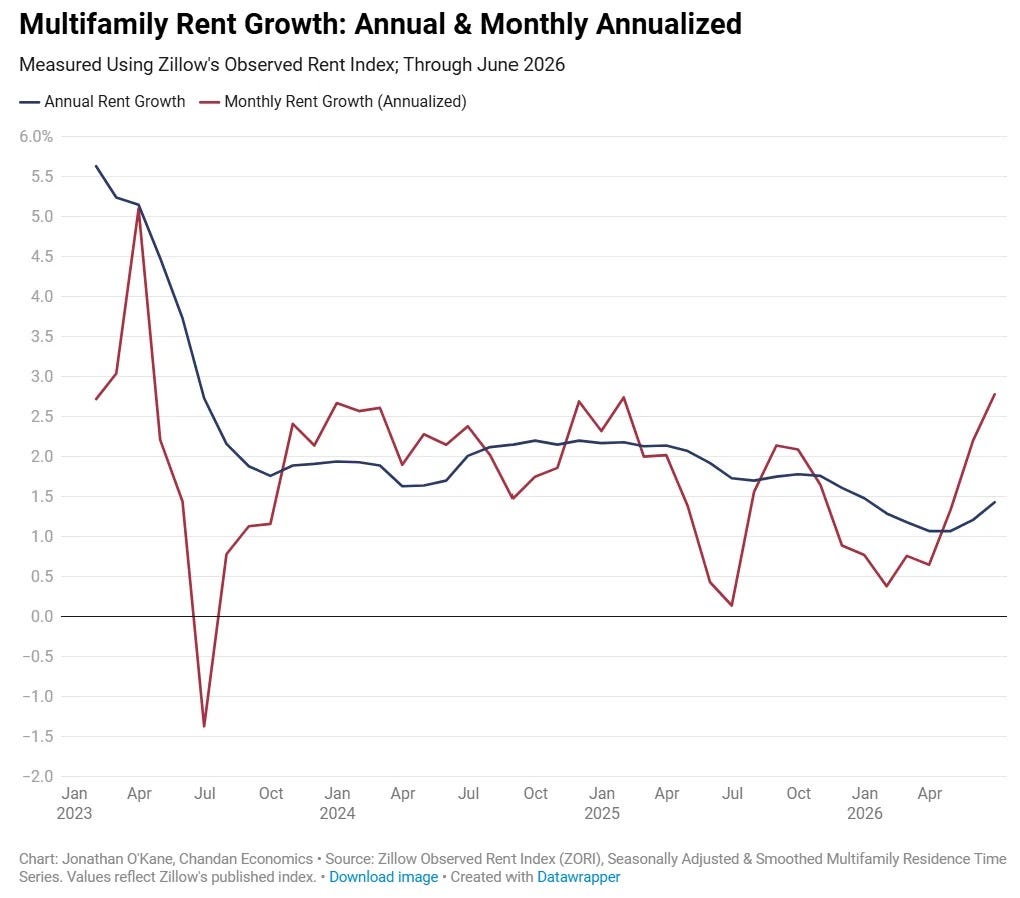
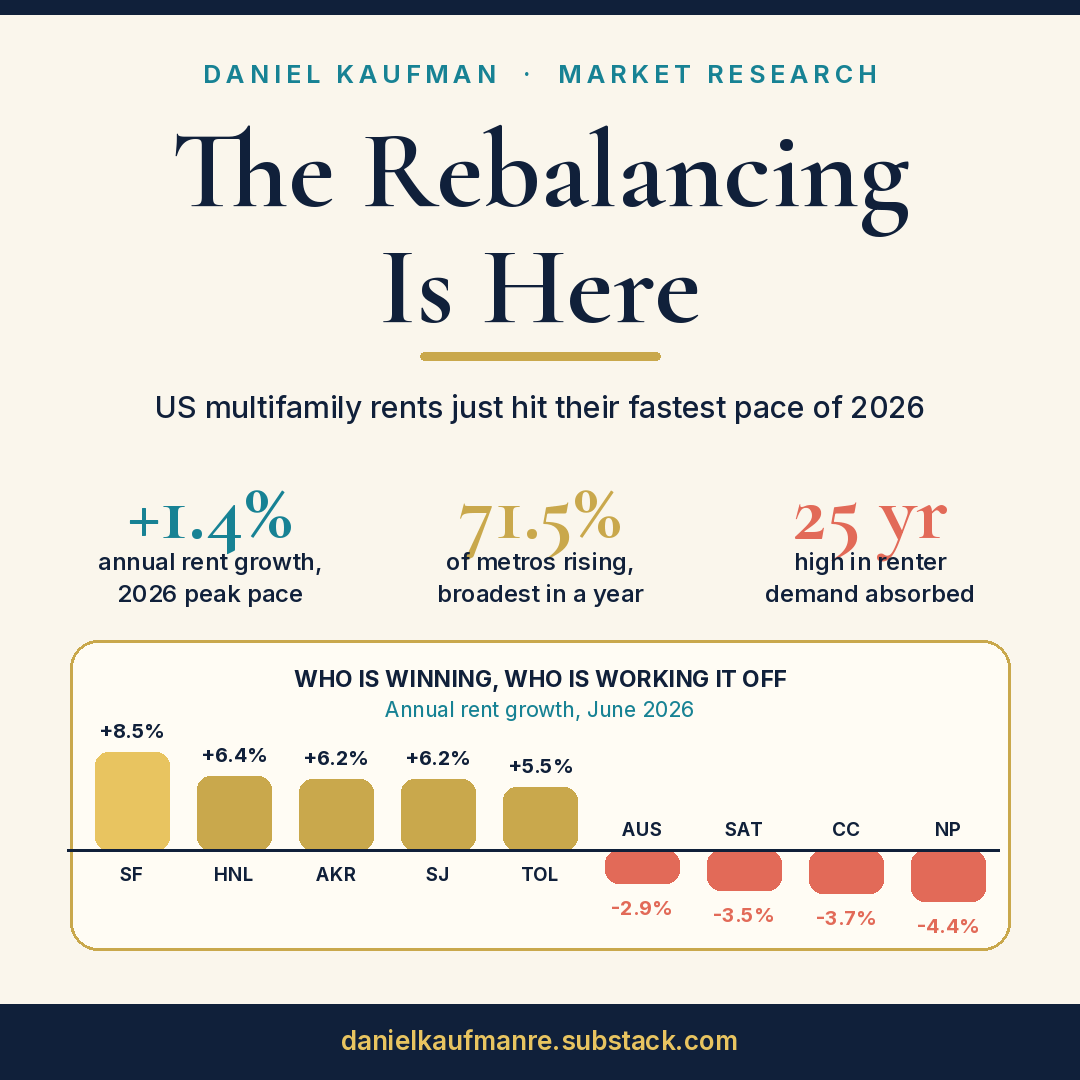
Per the June Zillow Observed Rent Index, national multifamily rents rose 1.4% year over year, up from 1.2% in May, the strongest reading of the year. The month over month picture is even more telling. Seasonally adjusted annualized growth climbed to 2.8%, the healthiest monthly figure since March 2023.
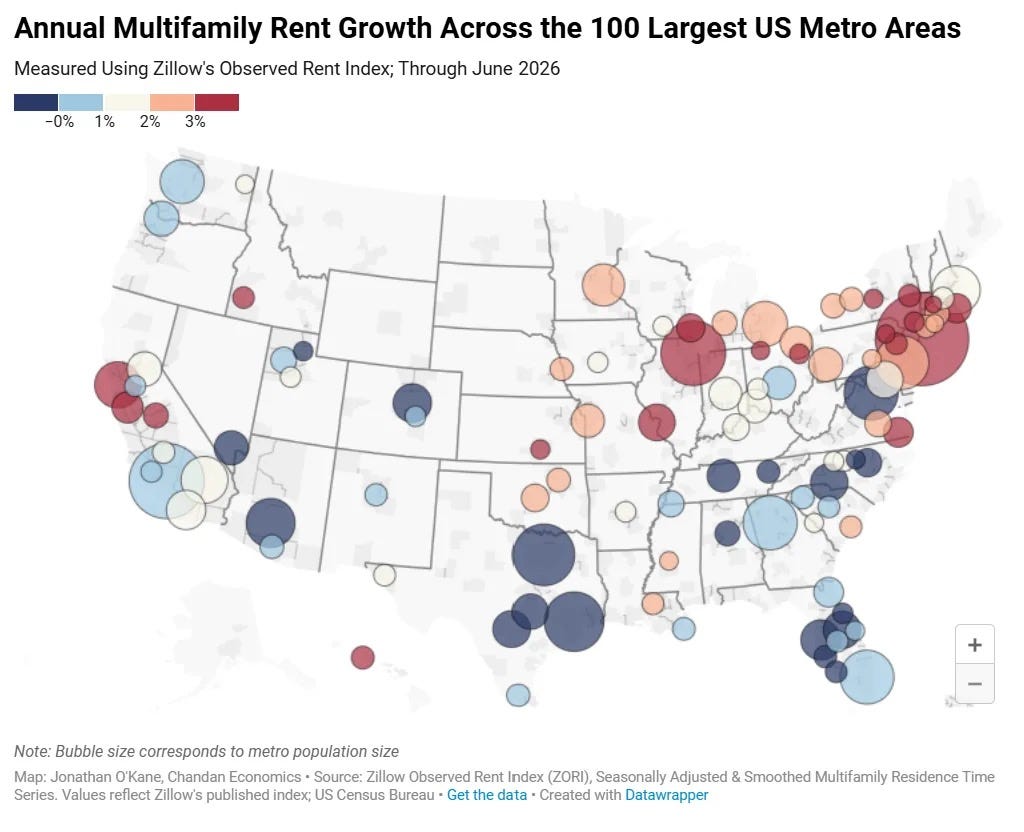
Here is the number I care about most, though. About 71.5% of US metros posted rent gains from May to June, the broadest participation in nearly a year, and almost nine out of ten markets posted annual gains. Breadth matters more than headline pace. When growth is narrow, it is a story about a few hot markets. When growth is broad, it is a story about the cycle turning. This is the cycle turning.
The Winners Are Not Random. They Are Supply Disciplined.
Look at where the strongest annual rent growth clustered: Northern California, the Northeast, and the Midwest.
San Francisco led the nation at 8.5%. Urban Honolulu came in at 6.4%. Akron and San Jose each posted 6.2%. Toledo, yes Toledo, put up 5.5%.
If you have been reading my work, none of this is news to you. These are the markets where the development pipeline stayed disciplined, where entitlement is hard, where nobody flooded the zone with new deliveries during the cheap money years. Demand did not have to be spectacular in these places. It just had to show up, because supply never got ahead of it.
This is why I have kept building and lending in the Northeast when it was unfashionable. Our Vermont projects, our Philadelphia work, our conviction on secondary Northeast and Midwest markets, all of it rests on the same thesis. Constrained supply plus durable demand equals pricing power. It is not complicated. It just requires patience, and most capital does not have any.
The Losers Are Not Random Either. This Is the Southern Squeeze Playing Out.
Now flip the map. North Port fell 4.4%. Cape Coral declined 3.7%. San Antonio dropped 3.5%. Austin fell 2.9%. Denver rounded out the steepest decliners.
I wrote about the Southern Squeeze before it had a name in the trade press. The pandemic migration wave sent developers sprinting into the Sun Belt, and they built like the music would never stop. It stopped. Those markets are now working through the heaviest delivery pipelines in the country, and renters have all the leverage. Florida’s southwest coast and central Texas were the poster children for undisciplined supply, and they are paying for it in the rent roll.
Here is the honest caveat, because I am an operator, not a cheerleader. Several of these pressured Sun Belt markets stabilized on a monthly basis in June. Dallas, Houston, Orlando, Tampa, and Jacksonville are flat or moving higher month over month. The worst of the oversupply pressure is starting to ease in some places. I am active in Jacksonville and Texas myself, so I say this with real money on the line: the Sun Belt is not broken, it is digesting. The question is timing, and timing is everything in this business.
The Demand Side Is the Real Story
Cushman & Wakefield’s Q2 report is the piece of data I keep coming back to. Net absorption hit 124,600 units in the quarter, up 8% year over year, one of the five strongest quarters in nearly 25 years. Vacancy compressed 35 basis points to 8.9%, the first sub 9% reading since 2024.
Think about what that absorption number is fighting through. Slower job creation. Tepid immigration. Modest population growth. Every macro model said apartment demand should be soft. Instead, trailing 12 month absorption reached 362,000 units against 358,000 deliveries, the first time demand has outpaced new supply in more than two years.
Why? Household formation is resilient, and renting has become a structural preference, not just a waystation to ownership. Median asking rents across the 50 largest metros sit around $1,700 per Realtor.com, down 1.5% year over year but still roughly 16% above pre pandemic levels. For sale affordability remains brutal, so the renter pool keeps deepening. As a builder of workforce and attainable housing, I see this on the ground every single week. The demand for well located, well built rental housing at accessible price points is not a cycle. It is a decade.
The Setup for 2027: Watch the Permits
Here is where the forward looking money should be paying attention. While Sun Belt metros led absorption, Dallas Fort Worth at 18,600 units in the first half with Phoenix, Atlanta, and Austin each over 10,000, the supply spigot in the gateway markets is closing hard.
New York City permitted just 1.6 new multifamily units per 1,000 residents in 2025. Boston permitted 1.1. Both are at their lowest permitting rates since 2019, near decade lows.
I have built through enough cycles to know exactly how this movie ends. Permits pulled today are deliveries in 2027 and 2028. When the pipeline thins this dramatically in markets where demand is structurally sticky, you get a supply crunch, and supply crunches produce the kind of rent growth that makes vintages. The 2026 and 2027 acquisition and development window in supply constrained Northeast and coastal markets is setting up to be one of the better entry points I have seen in a long time.
Studios remain soft, down 2.2%, and any market still choking on unabsorbed deliveries could stay sluggish into 2027. A full national rebound is not guaranteed, and it depends on the macro staying manageable. I am not promising anyone a straight line. I never do.
What I Am Actually Doing With This Information
Research is only worth something if it changes behavior. Here is how this data maps to how we are deploying:
We stay long supply discipline. Northeast, select Midwest, and supply constrained coastal markets remain our core conviction for rent growth. The June data is the strongest confirmation yet.
We watch the Sun Belt for the turn, we do not guess at it. Monthly stabilization in Dallas, Houston, Orlando, Tampa, and Jacksonville is a genuine early signal. When absorption keeps running ahead of a tapering pipeline, those markets will reprice. We want to be early, not first. There is a difference, and it is expensive to confuse the two.
We keep building workforce housing. Absorption crushing expectations despite weak macro drivers tells you the renter base is broader and stickier than the models assume. Attainable rental product in the right locations is the most durable demand story in American real estate.
We track permits like a hawk. Migration, employment, and development pipelines are the three dials. Permitting near decade lows in New York and Boston is tomorrow’s rent growth, printed in today’s data.
The market spent two years punishing the undisciplined and rewarding nobody. Now it is starting to reward the disciplined. That is the phase of the cycle where operators like us do our best work, because the easy money crowd has gone home and the fundamentals are doing the talking.
We told you the rebalancing was coming. It is here. Position accordingly.
Daniel

If you are a developer, investor, landowner, or operator working through what this cycle means for your portfolio, reach out. This is what we do every day.