
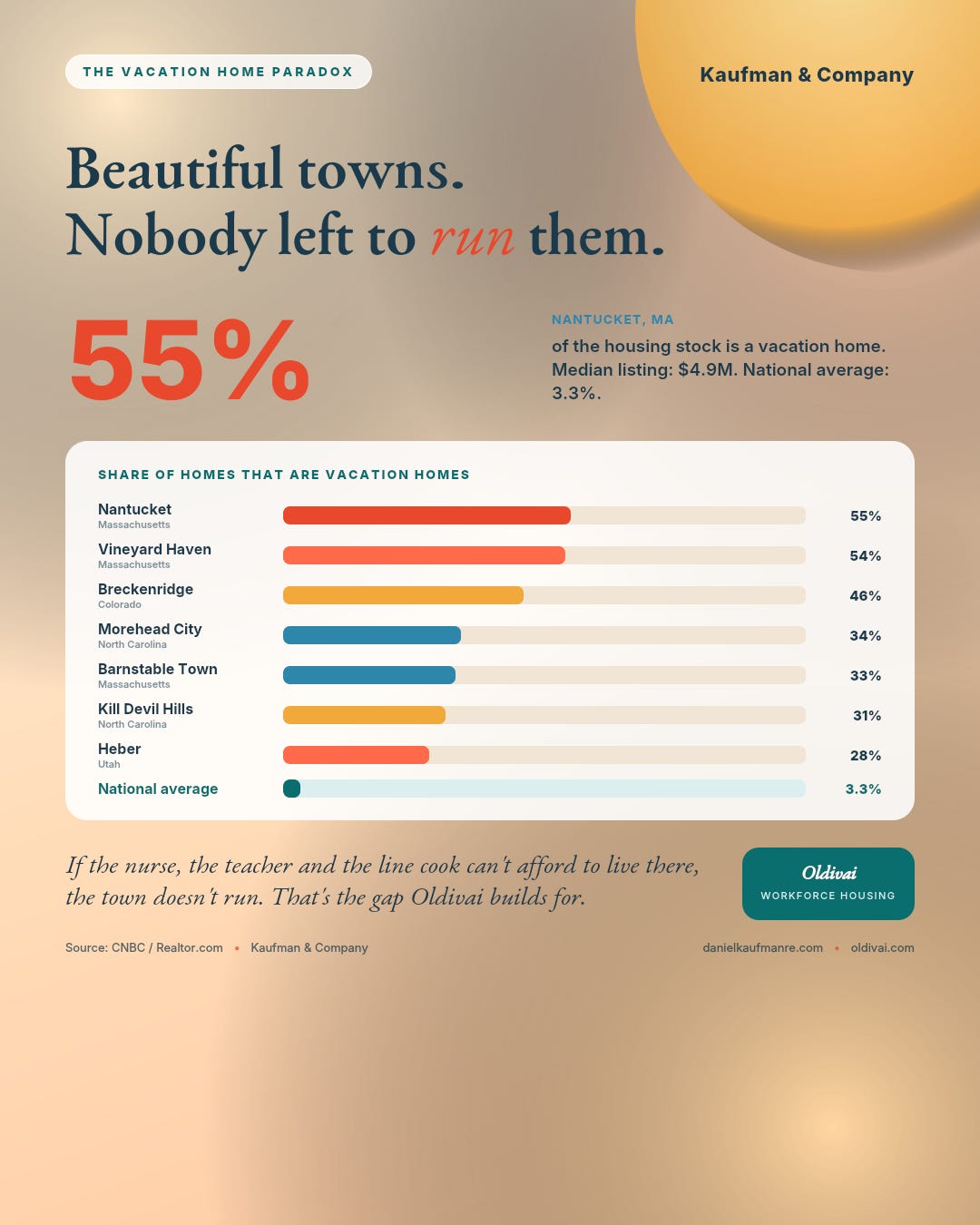
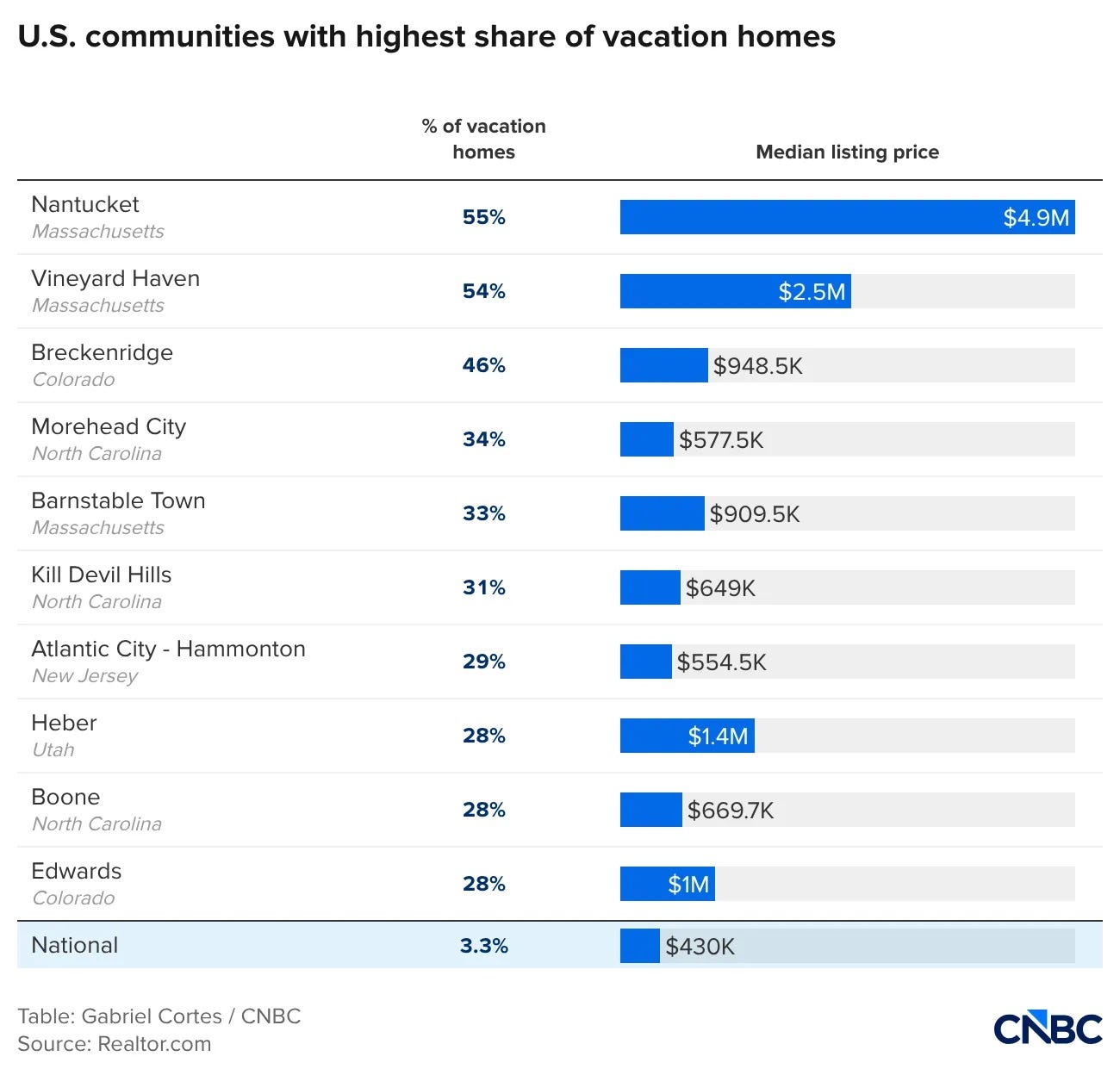
Nantucket just posted a 55% vacation home share. Half the housing stock on that island sits empty most of the year, waiting for a few weeks of use each summer. The median listing price is $4.9 million. Down the road in Vineyard Haven, it’s 54% and $2.5 million. In Breckenridge, 46% and just under $1 million.
I look at data like this and I don’t see a luxury real estate story. I see a supply chain problem, and the supply chain in question is people.
Here’s the list, straight from CNBC’s analysis of Realtor.com data on the U.S. communities with the highest share of vacation homes:
The town can’t run on second homes alone
A vacation community isn’t just the houses. It’s the restaurant that stays open past nine, the nurse who covers the night shift, the teacher, the line cook, the ski patroller, the sheriff’s deputy, the guy who fixes your furnace in January. Those are the people who make a place worth visiting in the first place. The beach, the mountain, the harbor, that’s the setting. The culture, the service, the safety, that’s the town.
And that workforce has to live somewhere within a reasonable commute, on a wage that has nothing to do with a $4.9 million median.
Nantucket is the clearest case study in the country right now. Homeownership is out of reach for 90% of year round residents. A recent study by the town’s own housing director found a family would need to earn roughly $530,000 a year to afford the median home. The island’s only hospital, Nantucket Cottage Hospital, now cites housing as the top reason candidates decline job offers and current staff leave. A Select Board member put it plainly this spring: without workforce housing, “we don’t have an operational town.”
Breckenridge is telling the same story in a different accent. Local officials report a steady drain of teachers, first responders, and nurses who simply cannot compete with buyers who treat the mountain as a second address. The town’s Housing Helps program has preserved 64 deed restricted units since it started, modeled after a similar program in Vail. When Gorman & Co. opened an 80 unit net zero affordable complex called Alta Verde, they received more than 400 applications. That ratio, 400 applicants for 80 homes, is the workforce housing shortage expressed as a single number.
Zoom out and the pattern holds across every entry on this list. Vineyard Haven, Barnstable, Kill Devil Hills, Morehead City, Heber, Boone, Edwards. Different coastlines, different mountains, same underlying constraint: the housing stock got captured by second home demand faster than local wages could keep pace, and nobody built the other half of the supply, the part reserved for the people who actually staff the place.
This is not a charity problem, it’s a mispriced market
Here’s where I think most of the conversation about workforce housing goes wrong. It gets framed as a subsidy ask, a nonprofit cause, a line item for the town budget. That framing misses the opportunity sitting right underneath it.
The workforce segment in these markets, generally households earning 80% to 120% of area median income, is the most underbuilt price point in American housing. It’s too high earning for most federal housing tax credit programs and too low earning to compete for market rate product in a vacation economy. Developers chase the luxury comp because the luxury comp is loud. Meanwhile vacancy in the workforce band, in market after market, sits near zero, because almost nobody is building for it.
That’s not a charity case. That’s a mispriced market with structural demand and almost no competition. There’s real money to be made serving it, and there’s a real community outcome attached to making that money. Those two things are not in tension. I’d argue they’re the same trade.
What we’re building at Oldivai
This is the exact thesis behind Oldivai, the workforce housing platform I run alongside the rest of the Kaufman & Company companies. We build specifically for the 80% to 120% AMI band, the missing middle: teachers, nurses, first responders, tradespeople, hospital staff, the people every one of the towns on that CNBC list is quietly losing.
We’re not chasing tax credits. We’re not waiting on a federal program. The model works because the demand is real and the vacancy in that price band is near zero in the markets we target. We use climate controlled modular construction and a highly efficient, templated design to compress both cost and timeline, which is the only way to hit a price point that a nurse or a teacher can actually carry.
Our Spokane, Washington pilot proved the construction side of the thesis. Factory built modules were crane set on site in four days with interiors fully completed, and the project is now in its stabilization phase, moving into employer partnerships and resident financial education. That pilot is the template we’re scaling nationally.
We’re now underway in Winooski and Shelburne, Vermont, and in Jacksonville, Florida, each targeting the missing middle around the region’s institutional employers. And we just launched a Maine expansion in the greater Portland and Lewiston to Auburn corridor, built specifically to support hospital systems, universities, trades, and the seasonal to year round workforce, which is precisely the population under pressure in places like Boone, Kill Devil Hills, and Morehead City.
Look at that Maine project next to the Nantucket and Breckenridge data above and the pattern is obvious. Same workforce, same squeeze, same underlying economics, different zip code. That’s what a replicable national model looks like. We’re not solving Nantucket’s housing crisis specifically. We’re solving the mechanism that causes it, wherever that mechanism shows up.
The opportunity in front of every town on this list
If you’re an investor, a developer, or a town official looking at that CNBC table, I’d read it as a map, not a warning. Every one of those ten communities has the same gap, and the gap is investable. Land near the resort core, at a price point built for the workforce instead of the second homeowner, with a construction approach that gets the cost basis low enough to pencil without a subsidy. That’s a real strategy, not a talking point, and it’s one we’re running today.
The towns that figure this out keep their restaurants staffed, their hospitals covered, their fire departments full, and their culture intact. The towns that don’t will keep looking like Nantucket: beautiful, expensive, and quietly running out of the people who make it work.
There’s money to be made doing the right thing here. That’s the whole point.
I’m Daniel Kaufman, founder and CEO of Kaufman & Company. Oldivai is our national workforce housing platform. If you’re a landowner, employer, or municipal partner in a market like the ones above, reach out at Daniel@kaufmanredev.com or find out more at www.danielkaufmanre.com

Sources: CNBC/Realtor.com vacation home data; NYU Urban Lab and Housing Nantucket; SummitDaily, KUNC, and Rocky Mountain PBS reporting on Breckenridge workforce housing; Kaufman & Company and Oldivai project announcements.