
I’m Gen X. I was on Myspace before most people even knew what it was, back when AIM away messages were still doing most of the heavy lifting for how you presented yourself online. I customized my profile with HTML I half understood, copied off someone else’s page. I picked a song to autoplay every time a friend clicked through. I agonized over my Top 8 more than I want to admit, and I definitely rearranged it more than once after a falling out with someone who noticed they’d been bumped to number 9.
So when I saw that the guys who own Myspace are talking about bringing it back, I paid attention in a way I probably wouldn’t have for most tech news.
In a recent documentary called “Myspace,” the cofounders of Viant Technology, the company that bought Myspace alongside Justin Timberlake back in 2011 when it was still trading as Specific Media, said it plainly. “We are stewards of the Myspace brand at this point, and we are going to relaunch Myspace. We’re just waiting for the right time to do it.” Then they added something that stuck with me more than the first part. “And if that one doesn’t work, we’ll do it again.”
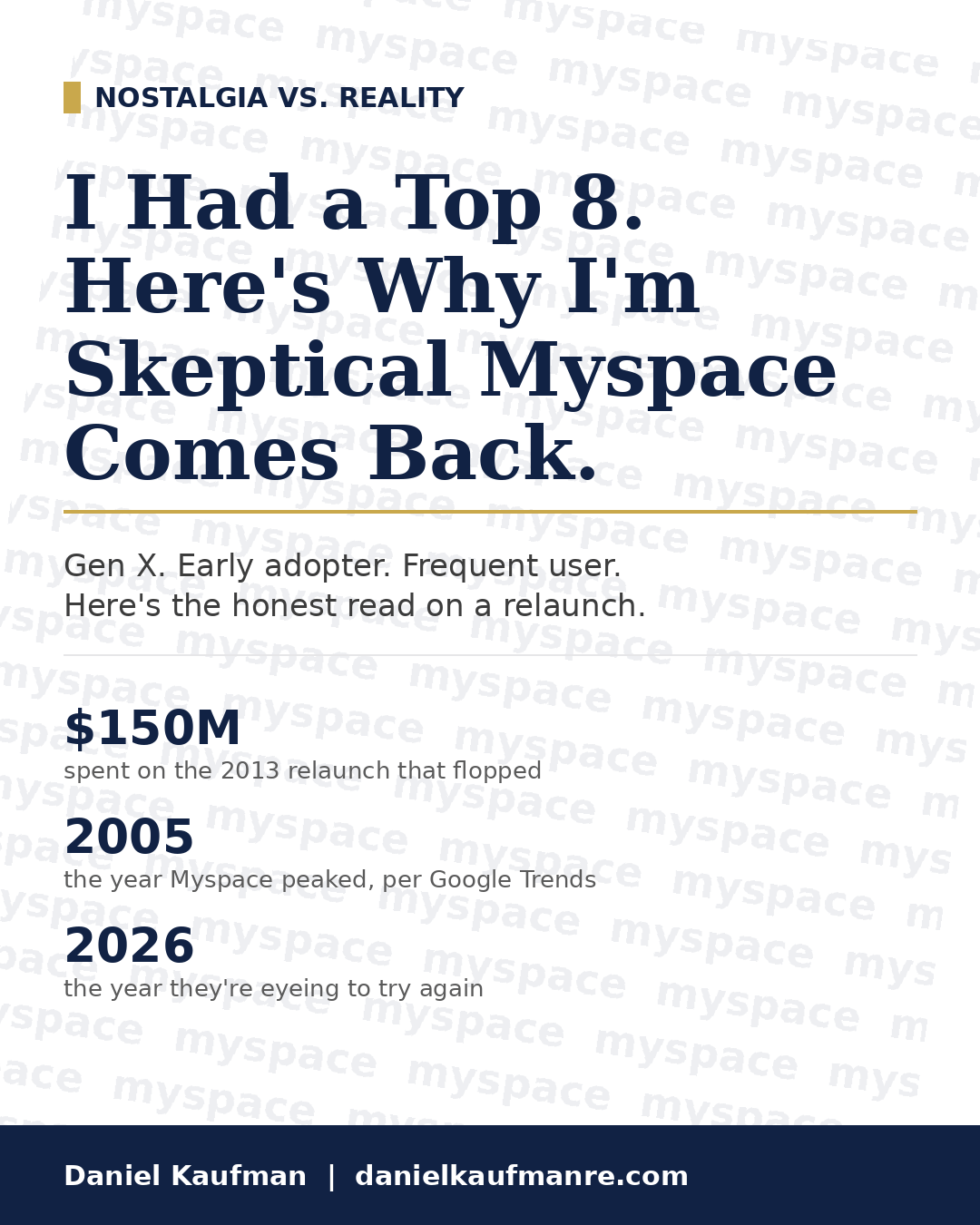
That line is the whole story. These are people who already tried this once. Back in 2013 they spent something like $150 million rebuilding Myspace around music, trying to turn it into a Spotify competitor with a social layer bolted on. It flopped. Anyone who was actually there in 2005 could have told them why. Myspace wasn’t a music app. It was a place where you built a version of yourself, glitter graphics, terrible autoplay songs and all, and showed it to your friends. Once Facebook offered something cleaner and less chaotic, people left, and they didn’t come back for a better music player.
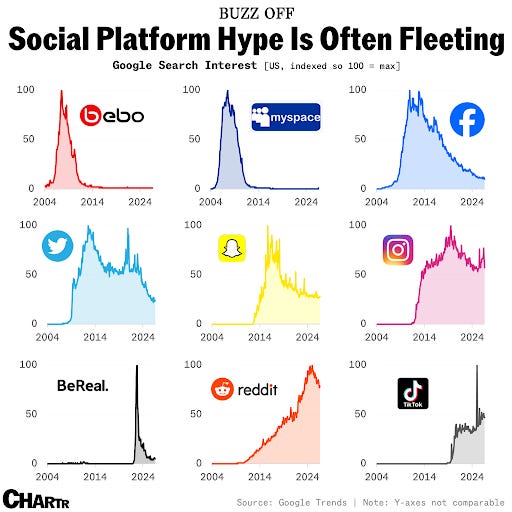
Here’s the pattern I keep seeing, in tech and honestly in real estate too. Everyone assumes the thing that made something popular the first time is a fixed asset you can just relaunch. It isn’t. The moment passes. The Google Trends chart on this makes it obvious. Bebo, Myspace, even Facebook itself, they all show the same shape. A sharp climb, a peak, a long fade. Nobody has figured out how to reverse that curve once it’s already bending down. Snapchat, Instagram and TikTok are still riding their climb. Myspace finished its curve almost two decades ago.
I get the emotional pull here. There’s a very specific kind of nostalgia only Gen X and early millennials carry for that platform, because we were there before social media had rules, before it had brands attached, before your mom was on it. It felt like ours. I’d probably click through a relaunch out of curiosity alone, just to see if my old profile somehow still exists somewhere in a server rack.
But curiosity isn’t the same as a comeback. A few hundred thousand of us logging in for old time’s sake doesn’t rebuild a platform. It doesn’t compete with Instagram or TikTok for daily attention, and it definitely doesn’t justify whatever number they eventually put behind this relaunch.
My take: the Viant guys are smart to be cautious. They got burned once already and they know it. If they do bring Myspace back, the winning move isn’t chasing what Instagram or TikTok already do well. It’s leaning all the way into what made Myspace weird and personal in the first place, HTML profiles, autoplay songs, the Top 8, the whole chaotic mess of it. Go niche and authentic instead of trying to be a mainstream platform again. That’s a business I could see working at a small scale. A true second act as a cultural force, competing with the platforms that already own 2026 attention, that’s a much harder trade, and I wouldn’t bet on it.
So no, I’m not dusting off my Top 8 yet. But I’d be lying if I said some part of me doesn’t want to see who’d make the cut.