
I’ve spent years in this business, and if there’s one thing I’ve learned, it’s that the number on the tariff announcement is never the real number. The real number shows up 18 months later, buried in a bid you already signed.
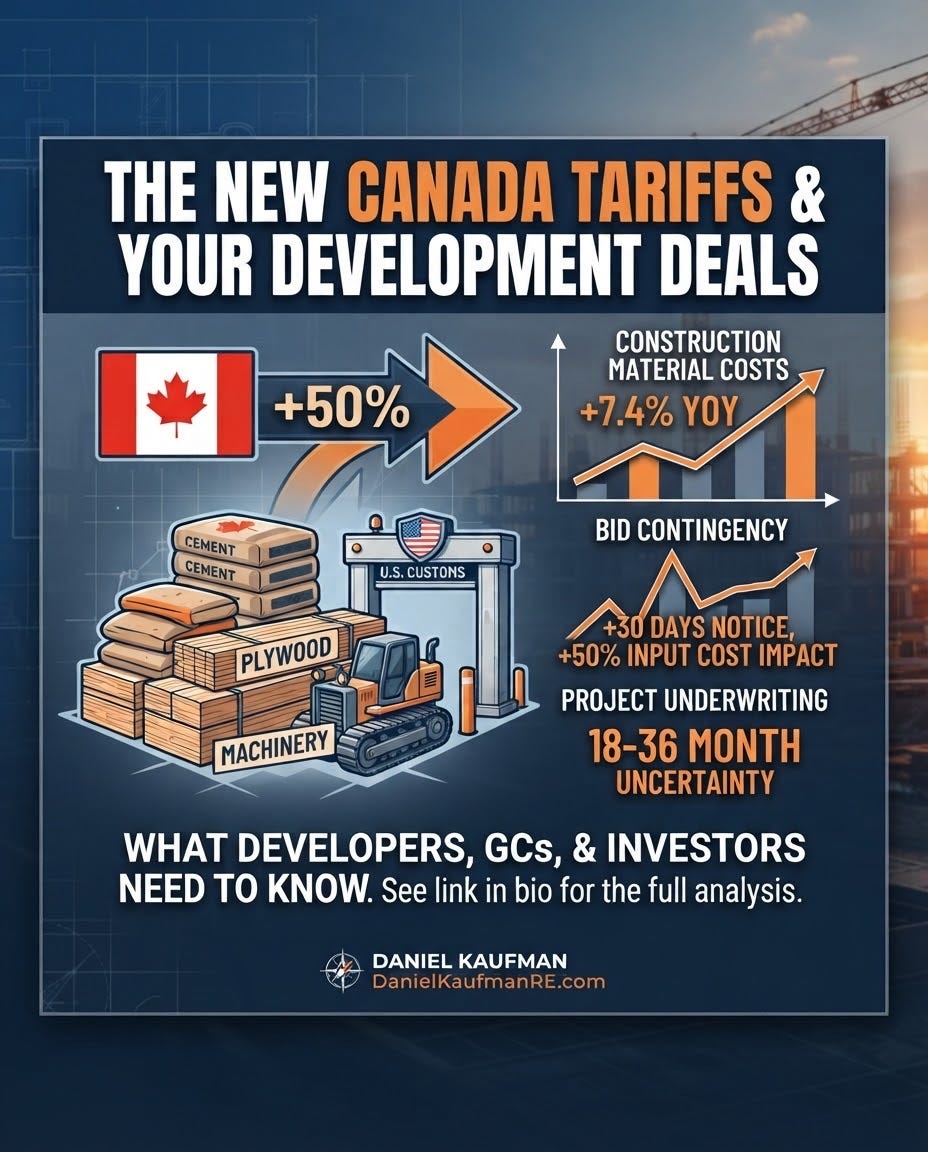
Over the weekend, the Trump administration imposed a fresh round of 50% tariffs on Canadian imports, this time hitting cement, plywood, and certain machinery and tools. This comes after nearly a month of trade talks with Canada that went nowhere. It stacks on top of the 50% tariffs already in place on Canadian steel and aluminum, and the lumber tariffs the administration raised last year. Trade policy has been aggressive throughout this administration, and after the Supreme Court struck down the president’s preferred tariff mechanism in February, the White House has leaned on a set of older, less familiar statutes to keep the pressure on. This latest round comes under Section 338 of the Smoot Hawley Tariff Act, a provision from 1930 that has never been used this way before. Legal challenges are likely. That won’t slow down what’s happening on job sites right now.
Here’s what I want every developer, GC, and investor reading this to internalize. Construction materials are already up 7.4% year over year. Copper wire and cable are up nearly 18%. Iron and steel are up over 17%. Softwood lumber is up 15%. None of that includes what happens next.
Why This Round Is Different
Every prior round of tariffs hit inputs the industry had already adjusted for. Steel, aluminum, lumber, we’ve been pricing contingency for those since 2025. This round reaches into categories that hadn’t been touched yet, cement, wood and paper products, machinery and tools. That matters because cement is a good example of how these things ripple. Cement is bought regionally, but it’s priced nationally. Canada and Mexico supply about 27% of U.S. cement imports and roughly 7% of total domestic consumption. When Canadian cement gets more expensive, domestic producers don’t just protect their margin on the affected regions, they gain pricing leverage everywhere. A tariff aimed at Canada becomes a national cost increase.
I’ve built enough pro formas to know the real damage isn’t the line item, it’s the uncertainty. Build to rent and production homebuilding get underwritten 18 to 36 months out. When you add 50% to an input category with 30 days notice, that risk doesn’t disappear, it gets baked into every bid as contingency. Multiply that across every GC pricing a job right now, and you get a market where costs rise even on projects that never touch a Canadian import directly.
What I’m Watching
Right now, I’m tracking cement, glass, plywood and panel products, and HVAC equipment as the categories most exposed to near term cost impacts. It’s early, only a few days in, so I’m not going to pretend we have clean data yet. But I’ve seen this movie before. Country of origin tracking is about to become a real part of how we estimate jobs, not a compliance afterthought.
Canada isn’t sitting still either. Prime Minister Mark Carney has said Canada will impose dollar for dollar retaliatory tariffs starting in early September. That’s a second wave most people aren’t pricing in yet. Cross border supply chains for building products don’t reroute overnight, and any disruption on that side compounds what’s already happening here.
The Bigger Picture
Construction activity looks healthy on paper, up year over year, but that’s almost entirely data center driven. Contractors working on data centers are carrying an average backlog of 11.4 months. Everyone else is sitting closer to 7.5 months. That gap tells you where the real strength in this market is, and it isn’t broad based. Add rising material costs on top of an already uneven demand picture, and I expect to see construction starts soften further, particularly in multifamily and production housing where margins are already thin.
None of this means stop building. It means build with your eyes open. Lock in materials pricing earlier than you’re used to. Build bigger contingencies into fixed price bids. Know your country of origin exposure on every major input before you submit a number, not after. And if you’re underwriting anything with an 18 to 36 month horizon, stress test it against another 10 to 20% move in materials costs, because at this point, that’s not a worst case scenario, it’s a plausible one.
I’ll keep watching this and share what I’m seeing as the picture gets clearer.

Daniel
Daniel@kaufmanredev.com |