
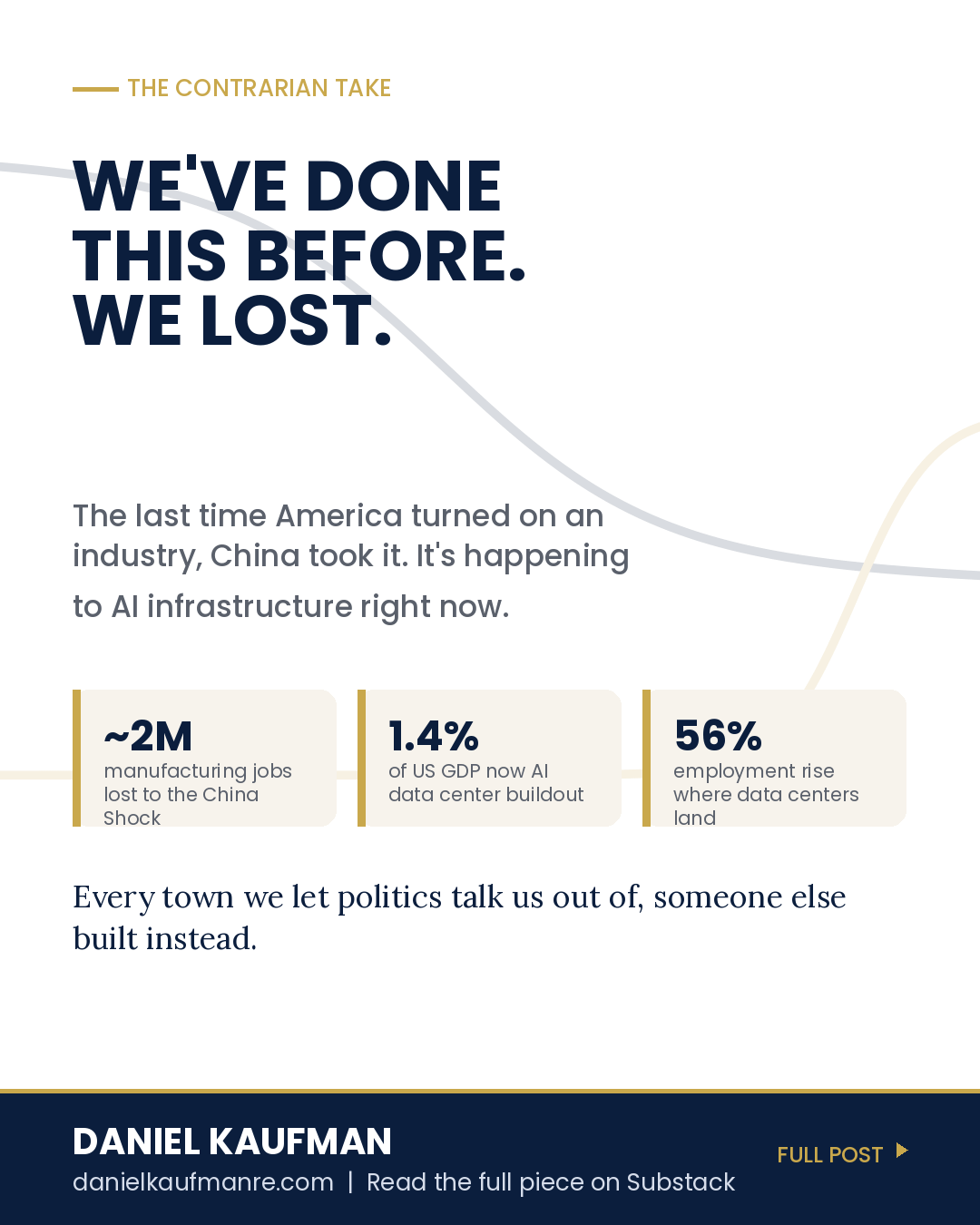
There is a comfortable story America tells itself about the 1970s and 1980s, that our factories left for China because of cheap labor and unfair trade. That’s part of it. But it leaves out the part we don’t like to admit, that we also pushed a lot of that industry out the door ourselves, one permit denial, one lawsuit, one “not in my backyard” campaign at a time. Environmental review boards, local zoning fights, and a public that had grown tired of smokestacks all played a role in making it easier to build a plant in Shenzhen than in Ohio.
We are doing it again right now, this time to AI infrastructure, and I think it is going to cost us just as much.
The First Time We Did This to Ourselves
The scale of what economists call the “China Shock” is not in dispute, even if the exact number is argued over. The most cited research, from MIT economist David Autor and his coauthors, put direct and indirect manufacturing job losses tied to Chinese import competition between 1999 and 2011 at somewhere around one million manufacturing jobs and closer to two million jobs across the broader economy. Other estimates, including a Census Bureau working paper, put the China Shock’s share of all US manufacturing job losses between 2001 and 2019 at close to sixty percent.
Youngstown, Ohio is the case study everyone reaches for, and for good reason. On September 19, 1977, a day locals still call Black Monday, Youngstown Sheet and Tube announced it was cutting five thousand jobs effective immediately. The city never recovered its footing. Decades later, Brookings Institution research found Youngstown had the highest rate of concentrated poverty of any of the top one hundred US metro areas. That is not a temporary dip. That is a permanent scar on a place that once anchored American steel production.
What gets left out of the Youngstown story, and the broader Rust Belt story, is how much of the underlying shift was not purely a trade story. Manufacturing had already become politically unpopular in a lot of American towns well before China joined the WTO in 2001. Environmental concerns about air and water quality, lawsuits over pollution, and organized local opposition to expansion made it harder and more expensive to keep heavy industry running domestically. Companies did not need much of a push to look overseas once the cost of building or expanding at home kept climbing for reasons that had nothing to do with the product itself.
The Pattern Didn’t Stop, It Just Changed Targets
Fast forward to today and the same playbook is still running, just aimed at different industries.
In central Pennsylvania, a company called Encina spent two years and planned a $1.1 billion chemical recycling facility along the Susquehanna River, only to cancel the project after sustained community opposition and permitting trouble. In Louisiana, Shintech abandoned plans for a polyvinyl chloride plant in Convent after intense pressure from local and international activist groups, and simply relocated to a nearby community instead of leaving the country, but the underlying dynamic, local resistance overriding a major industrial investment, was identical to what happened decades earlier. And right now in Inola, Oklahoma, a proposed aluminum smelting plant is caught in exactly this fight, with the state attorney general trying to halt it and a community coalition organizing against it on environmental and agricultural grounds, even as the governor argues it would restore real domestic manufacturing capacity.
None of this is new. It is the same fight, decade after decade, dressed in the concerns of the moment. In the seventies it was smokestacks and acid rain. Today it is water usage and grid strain. The specifics shift, the mechanism does not.
Now Watch the Same Fight Aim at AI
Every argument being raised against AI data centers today, that they will destroy jobs, strain the environment, and hollow out communities, is the same argument that got used against manufacturing for fifty years. And just like before, a lot of it does not hold up well against the numbers.
AI infrastructure investment is not a marginal story in the economy right now, it is arguably the story. Data on AI related capital investment, including computers, peripheral equipment, and software, has been running at over a percentage point of contribution to quarterly GDP growth through 2025 and into 2026, according to Federal Reserve research notes and the St. Louis Fed. Epoch AI’s analysis found that spending on AI data centers, hardware, and networking together jumped from 0.7 percent to 1.4 percent of US GDP in a single year. One market research estimate this year found that the dollar value AI data center buildout contributed to GDP growth had actually surpassed consumer spending’s contribution for the first time in modern history.
I will be straight with you on the employment side, because the honest case is stronger than an oversold one. Data centers are not big direct employers relative to their capital cost, and some analyses, including one using Virginia state economic data, have pegged it at roughly one permanent job for every thirteen million dollars invested. But Brookings research on markets receiving their first large data center found data processing sector employment rising fifty six percent over the following decade, and the broader construction, engineering, and supply chain activity around these builds is real, even if it concentrates most heavily in metro areas with existing labor market depth. That regional imbalance is a genuine policy problem worth solving. It is not a reason to stop building.
What Losing This One Actually Costs Us
Here is the stakes that I do not think enough people are sitting with. We already ran this experiment with manufacturing and we know how the story ends when American communities successfully organize against a critical industry building at scale inside our own borders. The industry does not disappear. It goes somewhere else. China absorbed the manufacturing capacity we made too expensive and too slow to build here, and thirty years later we are dependent on them for products, from steel to solar panels to semiconductors, that we used to make ourselves.
AI infrastructure is the current version of that fork in the road. China is not waiting for our permitting fights to resolve. Every data center we slow walk or block here is capacity that gets built somewhere else, by someone else, running on someone else’s technology stack. The compute, the models trained on it, and the industries built on top of both do not pause while a county board debates a zoning variance.
I am not arguing that every concern raised about AI infrastructure is fake or that communities should have no say in what gets built near them. Some of the concerns are legitimate and deserve real engineering solutions, particularly around water use and grid capacity. What I am arguing is that we have direct historical evidence of what happens when legitimate local concerns get weaponized into blanket opposition against an entire technological transition, and the answer is that the jobs, the tax base, and the technical leadership move somewhere else, permanently. Youngstown never got its jobs back. The towns that lose the AI infrastructure fight in the next ten years will not get a second chance either.
We built the modern American economy once by out building everyone else. We are being handed the opportunity to do it again. The only question is whether we learned anything from the last time we let politics talk us out of it.