
I read a lot of headlines like that. I also read the actual data behind them, because that’s the job. And three years of regional business survey data just told a very different story than the one everyone’s sharing.
Here’s what the feed isn’t telling you, AI adoption is exploding, and layoffs are not.
How We Got Here
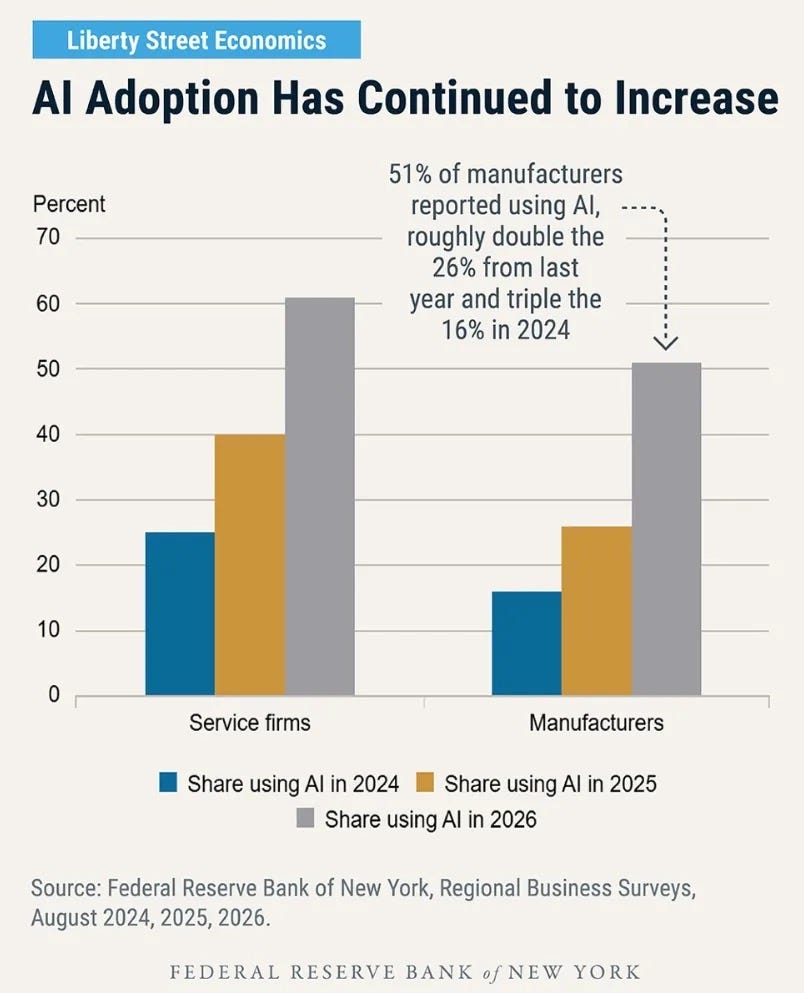
Every August, businesses across the New York and Northern New Jersey region get asked the same question, are you using AI in your operations. This year’s answers should stop the doom scrolling cold.
Sixty one percent of service firms now use AI, up from 40 percent last year and 25 percent in 2024. Manufacturers jumped to 51 percent, roughly double last year’s 26 percent and triple the 16 percent from 2024. Knowledge heavy sectors, information, business services, finance, are leading the pack.
That’s not a slow creep. That’s a technology going from niche to standard practice in three years flat.
The Part The Panic Narrative Skips
If AI adoption is everywhere, the layoffs should be everywhere too. They’re not.
Three quarters of service firms and more than 90 percent of manufacturers describe their AI investment as minimal to modest, think free tools or a small slice of the budget. Just 15 percent of service firms call it a significant investment. Only 5 percent call it a major strategic bet. No manufacturers are betting big at all.
Even where firms have adopted AI, usage inside the company is thin. The median share of workers actually using it is 17 percent at service firms and 7 percent at manufacturers.
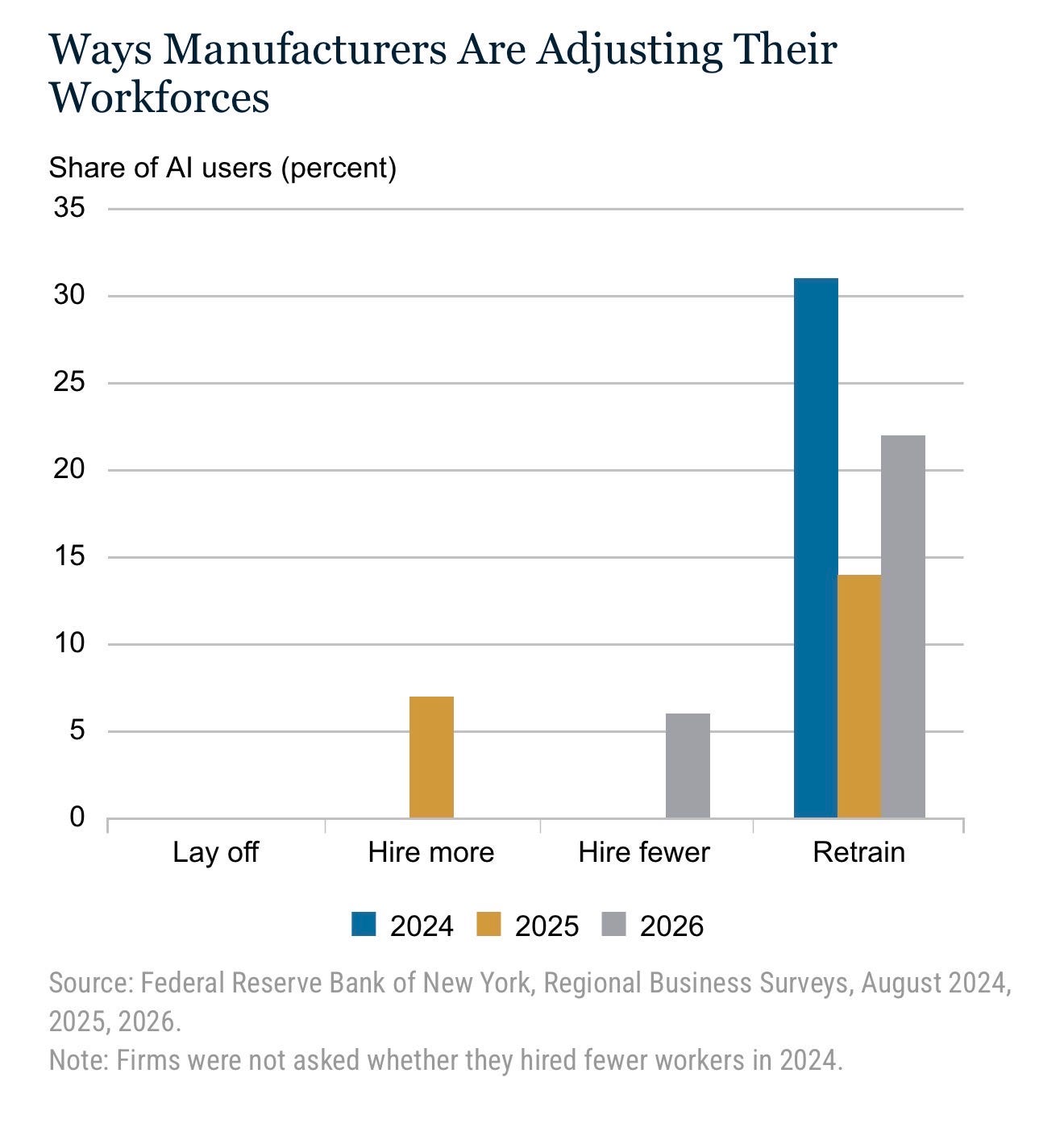
Widespread adoption. Shallow investment. Concentrated usage. That combination does not produce mass layoffs, and the numbers back that up. Four percent of service firms reported layoffs tied to AI this year, up from 1 percent last year. Zero manufacturers, both years. About 15 percent of service firms hired fewer people than they otherwise would have. But 13 percent hired more people specifically to help them use the technology.
Run the math and the hiring picture is closer to a wash than a wipeout.
Retraining, Not Replacing
Here’s the pattern that actually matters, and it’s the one nobody’s putting in a headline. Firms are retraining people, not replacing them.
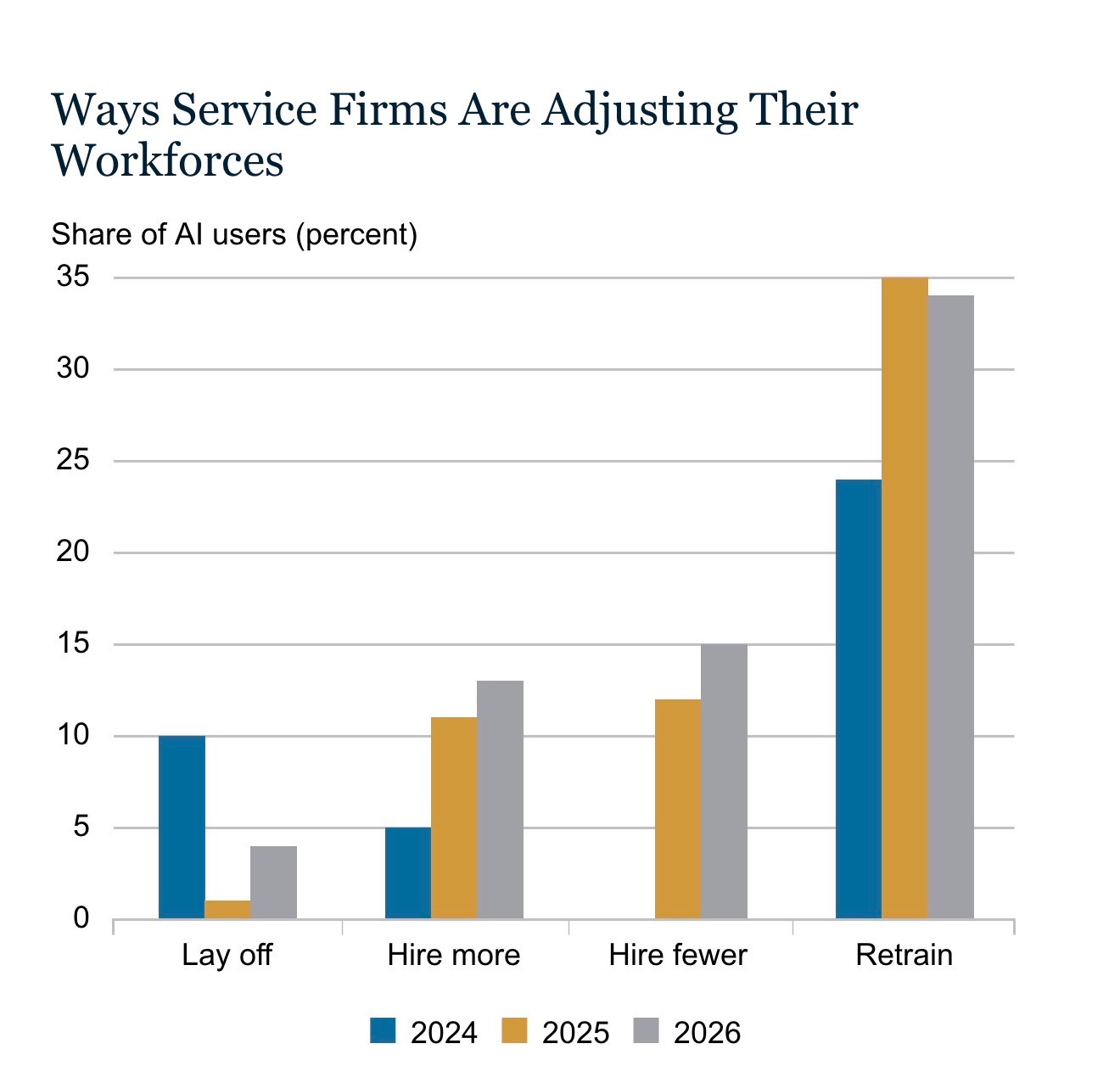
More than a third of service firms and over 20 percent of manufacturers that use AI are retraining existing workers because of it. That’s across the education spectrum, though a bit more concentrated among college educated employees. The training itself is practical, learning the tools, automating repetitive tasks, writing better prompts, applying AI to specific job functions like marketing or accounts payable, always with a human still checking the output.
Companies are also spending real time teaching people how to use this responsibly, verifying outputs, watching for bias, protecting data, not leaning on the tool so hard they stop thinking for themselves. That’s not what a company preparing for mass elimination of headcount looks like. That’s a company investing in the people it already has.
Why Some Firms Are Staying Out
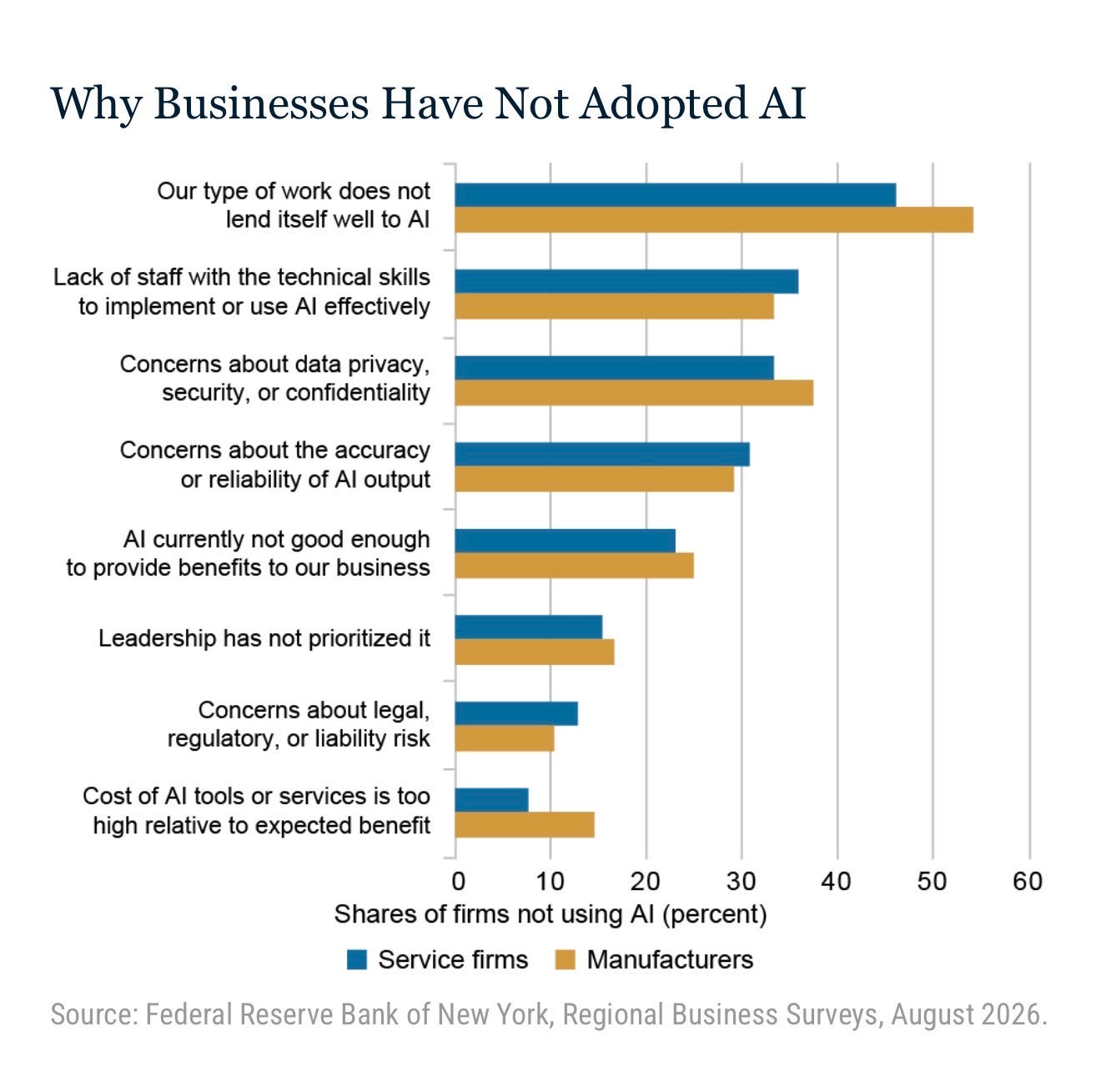
Interesting wrinkle here too. Cost is barely a factor in why firms haven’t adopted AI yet. About half say their work just doesn’t lend itself to it. A quarter say the technology isn’t good enough yet to move the needle for them. Another third cite data privacy and security concerns, a similar share worries about accuracy, and roughly a third say they don’t have the technical talent in house to use it well.
None of that reads like fear of the technology. It reads like operators being disciplined about where a tool actually fits their business, which is exactly how I’d want the businesses I’m invested in to think about it.
One Real Caveat
I’m not going to pretend the data is all upside. There’s a legitimate concern buried in the research, entry level workers may be absorbing more of the impact than anyone else. AI is good at routine tasks, and routine tasks are often the on ramp for someone’s first job. That’s worth watching closely, because it’s not the same story as senior employees getting replaced. It’s a question about whether the bottom rung of the ladder is getting harder to reach.
That’s a real issue. It’s just a different issue than “AI is destroying jobs,” and it deserves its own conversation instead of getting flattened into the same panic narrative.
The Bottom Line
The mainstream story is AI is here to eliminate your job. The actual data says AI is here, adoption is real and accelerating, and companies are responding by retraining the people they already have, not clearing them out.
This is the same mistake I see in real estate all the time, people react to the headline instead of the underlying numbers, and they end up positioned for a story that isn’t actually happening. AI is changing how work gets done. It is not, at least not yet and not at the scale the narrative suggests, eliminating the workforce.
Three years of data on the same question from the same firms is a real trend line, not a hot take. Pay attention to that instead of the panic in your feed.
The Kaufman Report covers markets, capital, and the data behind the headlines from an operator’s perspective. No fluff. No consensus takes.

— Daniel Kaufman