
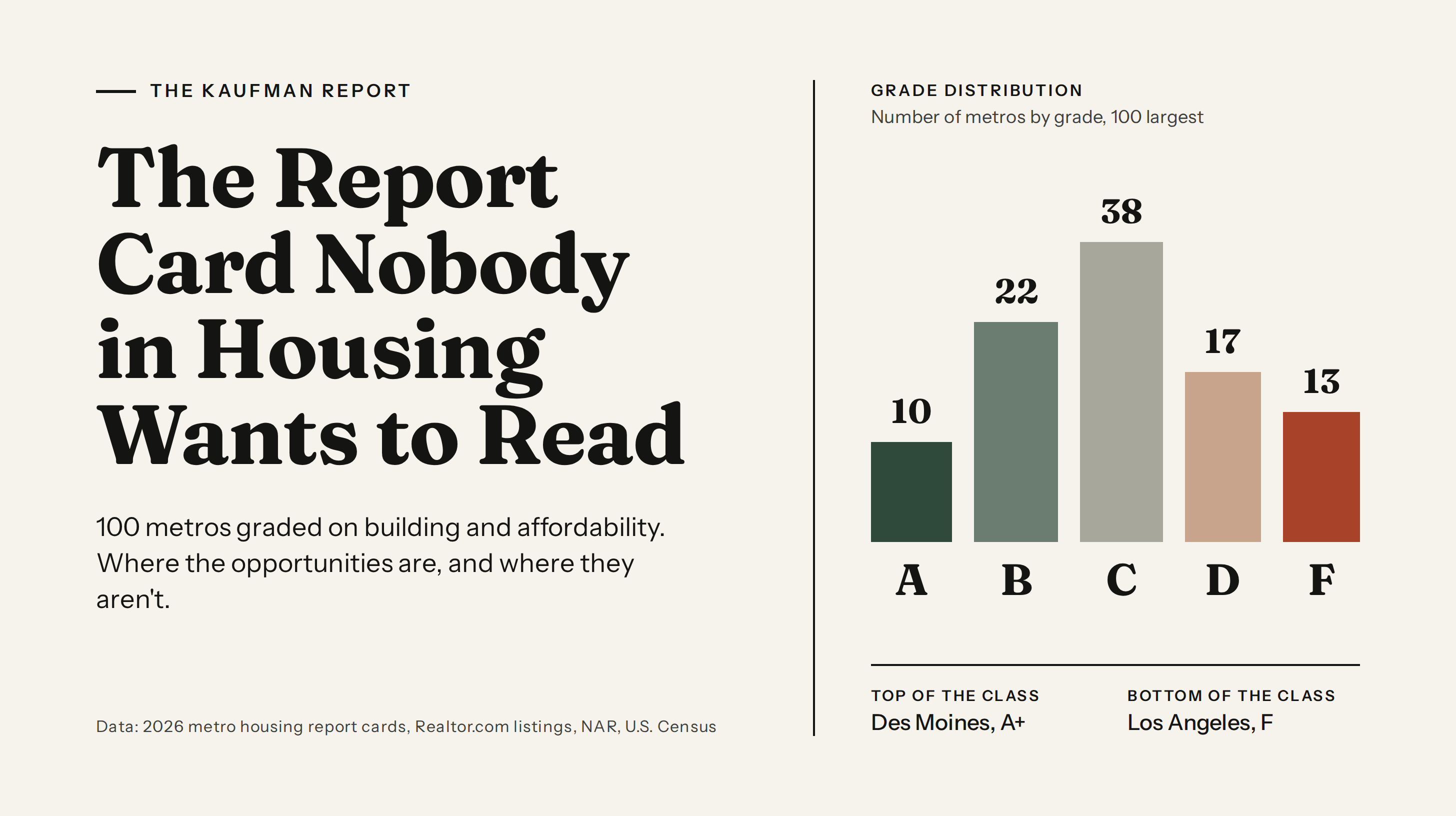
Most market reports tell you what already happened. This one is more useful, because it grades the 100 largest metros on two things that matter together: are they building enough homes, and can a normal family afford one?
The report scores metros on permits relative to population, how new construction is priced against existing homes, and two affordability measures. It uses Realtor.com listing data and the NAR affordability score. The results matter more now because the 21st Century ROAD to Housing Act ties Community Development Block Grant money to homebuilding growth. For the first time, a city that refuses to build can lose federal dollars for it.
Here is how I read it as an operator, not an economist.
The headline: we’re still short over 4 million homes
The country is short more than four million homes. The report says the only long term fix is to build, and I agree. The picture is clear. The South and Midwest are building and staying affordable. The coasts are doing neither.
Des Moines finished first. It permits 85% more homes than its population would suggest, and the median earner spends about 27.5% of income on a mortgage for the median home. Raleigh is close behind with a permit ratio of 2.51, among the highest in the country. The rest of the A list is Columbia, Houston, Indianapolis, Austin, Jacksonville, Oklahoma City, Palm Bay, and Columbus.
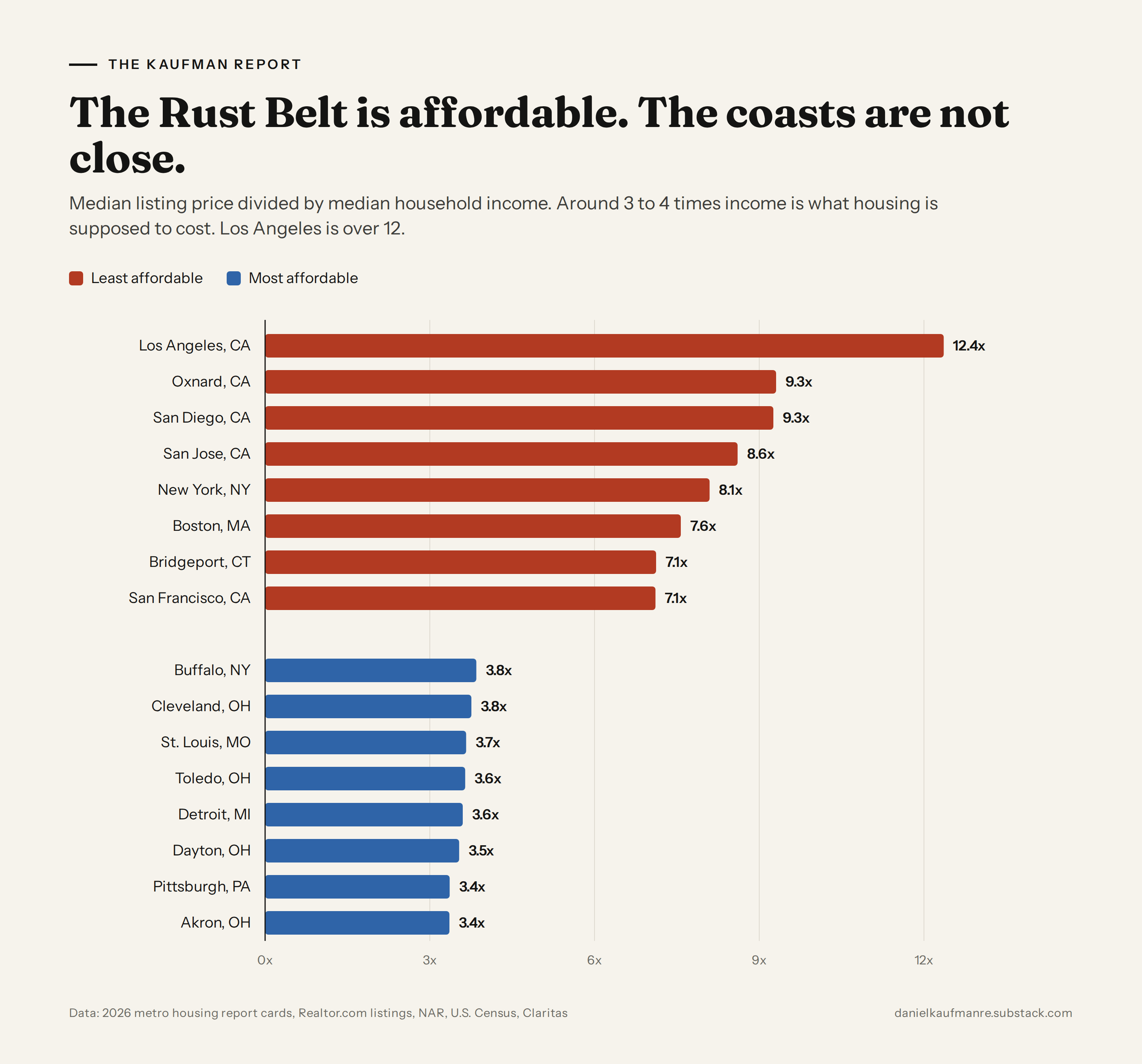
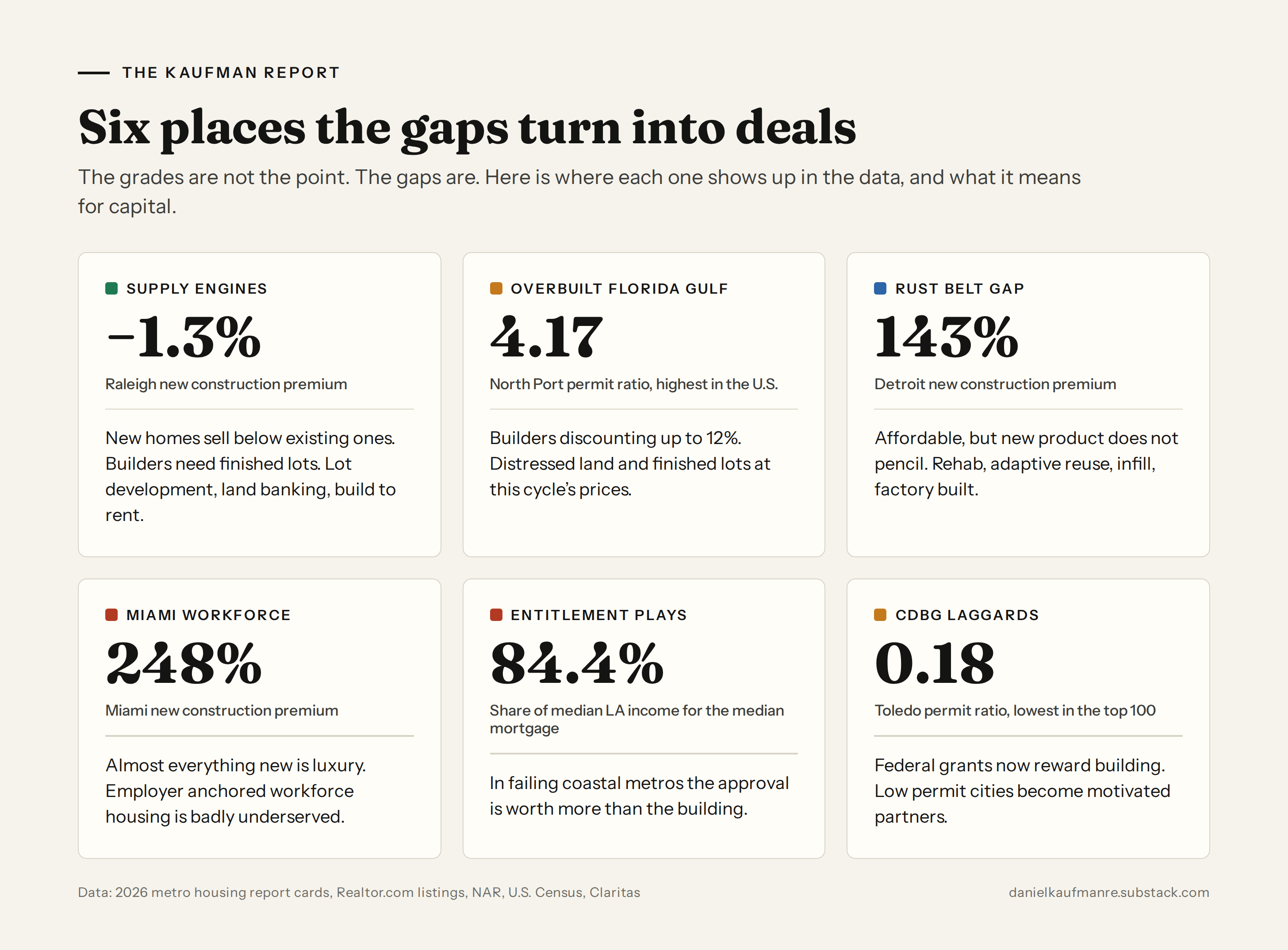
At the bottom is Los Angeles. The median earner there would spend 84.4% of income on the mortgage for a median priced home. The median listing is about $1.13 million against a median household income of about $91,000. That’s a price to income ratio over 12. LA is building less than half the national average per resident. New York, Boston, Providence, Honolulu, San Francisco, San Diego, and Miami are all on the failing list too.
None of that is surprising. The opportunities are in the details.
Opportunity 1: Metros where new homes cost less than old ones
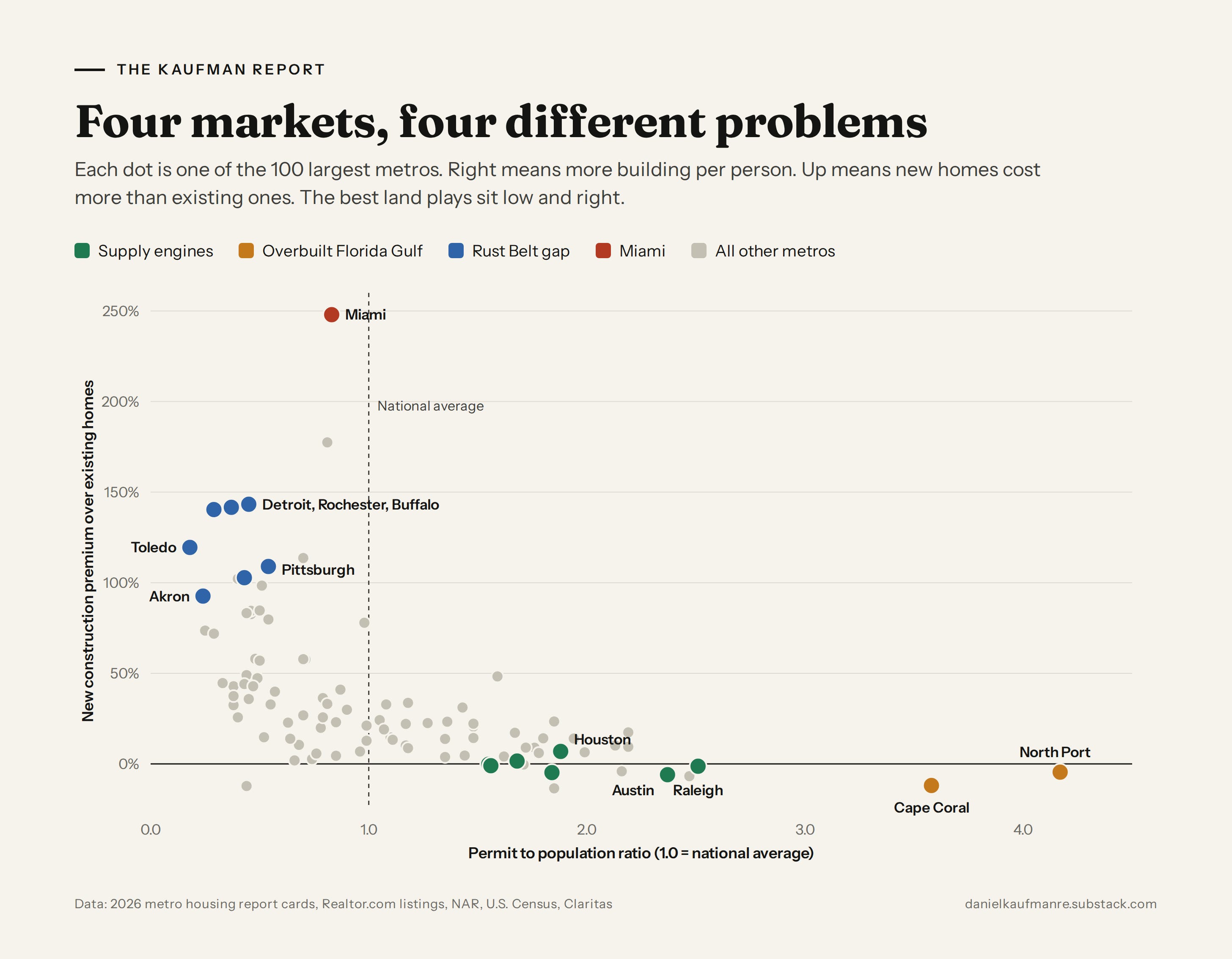
Look at the new construction premium, which compares new build prices to existing homes. In Raleigh it’s negative 1.3%. In Austin it’s negative 6.0%. In Columbia, Palm Bay, and Greenville it’s around zero or below.
When new homes sell for less than existing ones, it means land, entitlement, and production are working. Builders are competing on price. These markets reward speed and volume.
That makes these metros the best places in the country for lot development, land banking ahead of the growth path, and build to rent communities. The builders there need a steady supply of finished lots and will pay for certainty. If you can deliver entitled, serviced dirt in Raleigh, Columbia, Houston, or Jacksonville, you have a buyer.
Opportunity 2: The Florida Gulf is overbuilt, and that’s the point
North Port and Bradenton have a permit ratio of 4.17, the highest in the country. Cape Coral and Fort Myers are at 3.58. Both have negative new construction premiums, negative 4.6% and negative 11.9%. Cape Coral builders are selling new homes at nearly a 12% discount to existing stock.
That’s an oversupplied market. Builders are cutting prices to move inventory. Some will slow down, some will shed land, and some will walk away from lot contracts.
That’s where I want to be. Distressed land and finished lots in oversupplied Florida markets are among the best risk adjusted buys available right now, if you have your own capital and patience. You’re not betting on today’s absorption. You’re buying the land the next cycle needs at a price set by this cycle’s stress. Florida got a B at the state level. Orlando is a B minus with a permit ratio of 2.13. The fundamentals are intact. The pricing just hasn’t caught up.
Opportunity 3: The Rust Belt is affordable but not building
This is the part of the report that stood out most to me.
Detroit, Pittsburgh, Cleveland, Toledo, Akron, Rochester, and Buffalo have some of the best affordability scores in the country. Pittsburgh’s median listing is about $245,000 against income near $73,000, roughly 3.4 times income. That’s what housing is supposed to cost.
But none of them are building. Toledo’s permit ratio is 0.18. Akron’s is 0.24. And their new construction premiums are enormous: Detroit 143%, Rochester 142%, Buffalo 140%, Toledo 120%, Pittsburgh 109%.
That tells you exactly what’s wrong. In these markets a new home costs twice what an existing one sells for. Ground up construction doesn’t pencil at local incomes, so nobody builds, and the housing stock gets older every year.
The opportunity is closing that gap. That means rehab and adaptive reuse of existing buildings, missing middle infill on lots that already have infrastructure, and modular or factory built housing that lowers the cost basis enough to compete. The first operator who can deliver new product in Detroit or Buffalo at close to existing home pricing has a market to themselves. The demand is there. The problem is the cost of delivery.
Opportunity 4: Miami’s 248% problem
Miami got an F, the only failing metro in a state that otherwise did fine. The key number is its new construction premium: 248%. New homes in Miami cost roughly three and a half times existing ones.
That means almost everything being built is luxury. Land is scarce, with the Everglades on one side and the Atlantic on the other, so developers build for the top of the market. The workforce that runs the city gets priced out.
That’s where I see opportunity. Workforce and attainable housing tied to employers in South Florida is badly underserved. Hospitals, school systems, hospitality groups, and logistics operators all have a staffing problem that is really a housing problem. Development anchored to an employer who needs the units fixes the demand side before you break ground.
Opportunity 5: Entitlement is the product in failing metros
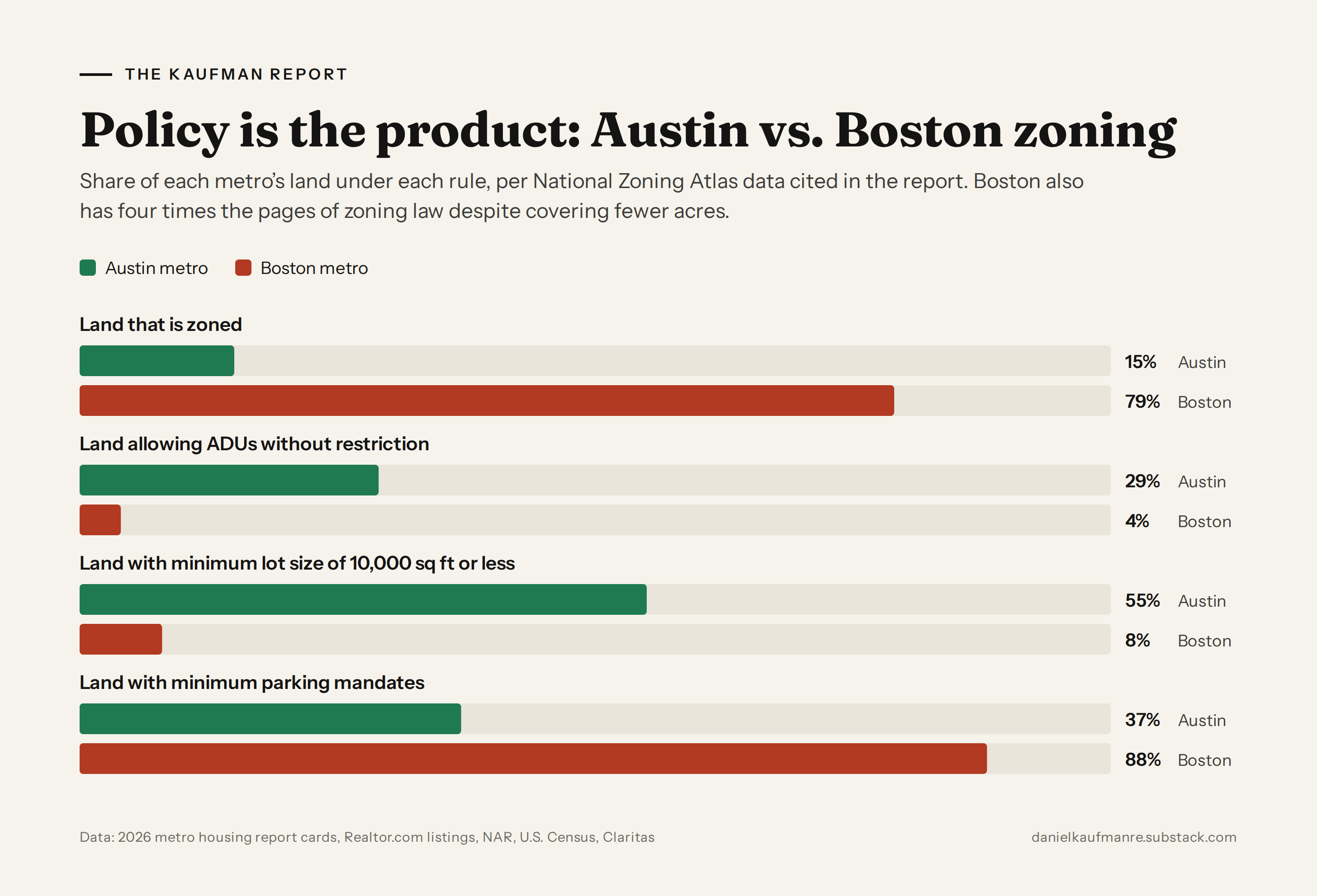
In LA, Boston, New York, and the Bay Area, you won’t win by building faster. You win by getting approvals. The report compares Boston and Austin using National Zoning Atlas data. Only 4% of Boston’s land allows ADUs without restriction, compared to 29% in Austin. And 88% of Boston’s land carries minimum parking mandates, compared to 37% in Austin.
In these markets the approval is worth more than the building. Buying land, carrying it through entitlement, and selling or partnering with approvals in hand is the value creation. It takes patience and local knowledge, but the returns match the scarcity.
Watch Riverside, San Diego, Stockton, and San Jose. They’re still failing on affordability, but their homebuilding scores are much better than the rest of California. If any coastal failing metro climbs out, it will likely be one of these.
Opportunity 6: The ROAD to Housing Act turns laggards into partners
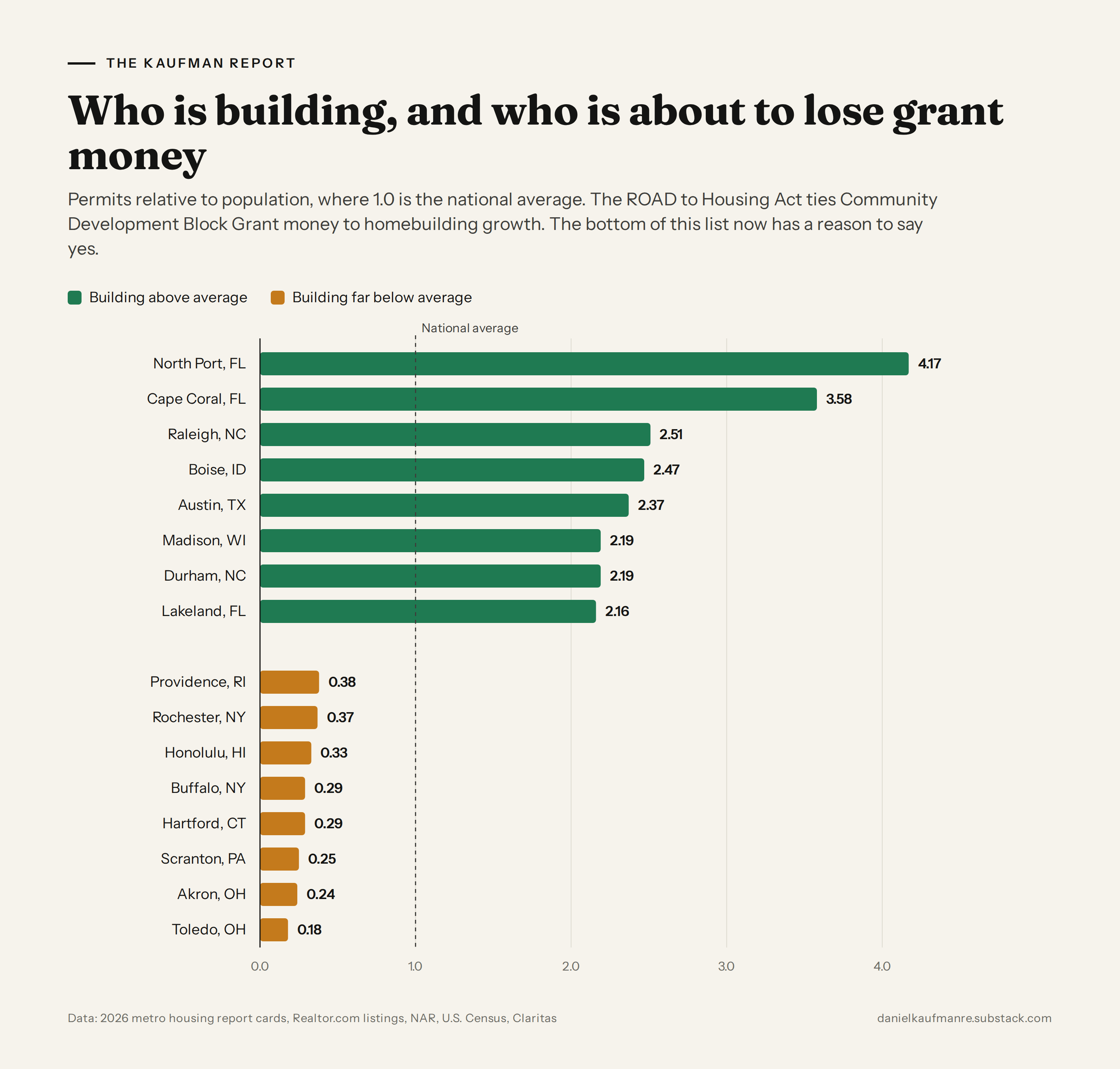
Now that CDBG money depends on homebuilding growth, the cities at the bottom of the permit rankings have a financial reason to say yes. Scranton, Hartford, New Orleans, Milwaukee, Albany, Virginia Beach, and much of the Northeast have permit ratios around 0.5 or lower.
Those municipalities will need projects that move their numbers. A developer who shows up with a credible plan and the capital to execute becomes a partner, not an opponent. I expect faster approvals, fee concessions, and public land deals in places that have been hostile to housing for decades. Early movers will get the best terms.
What I’m watching in the Mountain West and Northeast
The Mountain West and Northeast show the same tension. Boise is building fast, with a permit ratio of 2.47, but affordability is falling and it only earned a C. Denver and Salt Lake City are both C grades, with median listings near $580,000 to $590,000. Portland, Maine, earned a C minus, with a median listing around $639,000 and one of the weakest affordability scores in the country.
Resort and gateway towns aren’t in the top 100, but they are the same story, only more extreme. Constrained land, high demand, and a workforce that can’t afford to live where it works. The answer there is the same as Miami: employer anchored workforce housing, done at a scale the local market can support.
The bottom line
This report confirms what I see on the ground. Supply follows policy, and affordability follows supply. The best metros are mostly blue cities in red states, with local flexibility and no heavy state review layered on top. Austin’s Affordability Unlocked program, which waives height, unit count, and parking limits for projects that are majority income restricted, is a playbook other cities should copy.
For investors, the grades aren’t the point. The gaps are. Overbuilt markets are selling land at a discount. Affordable markets can’t build at a price people can pay. Failing markets are about to face a federal incentive to change. Every one of those gaps is a deal for someone who understands it.
That’s where I’m spending my time.

Daniel Kaufman
The Kaufman Report