That’s not a labor collapse. Layoffs are still low and jobless claims are falling. What we have is a low hire, low fire economy, and it looks like it will carry us into 2027.
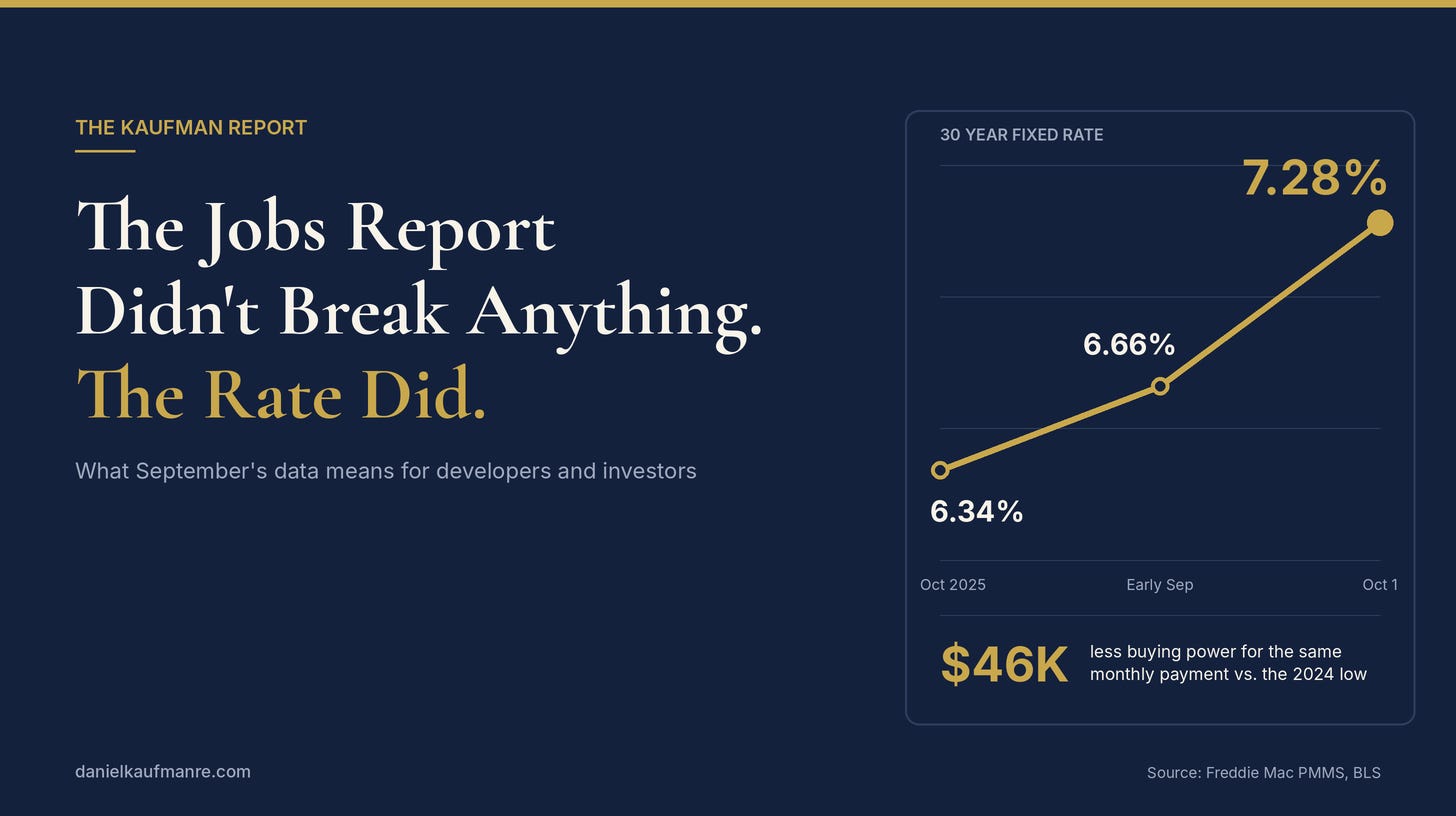
The number that matters for anyone building or buying housing is the mortgage rate. It went from 6.66% at the start of September to 7.28% this week.
The warning bells
Rate pressure isn’t going away. The soft jobs report makes a hold at the October 27 and 28 Fed meeting more likely. Odds of a hold went to 85%, with the federal funds rate at 3.75% to 4%. Most people still expect one more hike before year end. The Fed under Kevin Warsh is focused on inflation from energy prices and geopolitical instability, and a 29,000 job print won’t change that. The 10 year Treasury just hit a 24 year high. Mortgage rates follow the 10 year.
Your buyer just lost purchasing power in one month. That’s what the chart shows. On a $400,000 loan, principal and interest went from $2,571 to $2,737 since early September, an extra $166 a month. Put it the other way. A buyer who could afford $2,419 a month at last year’s low could borrow $400,000 then. Today the same payment supports about $354,000. That’s $46,000 of buying power gone, without a single listing price changing.
Financial jobs keep shrinking. The sector lost 7,000 jobs in September and 129,000 since May 2025. Those are the people who underwrite, originate, and service real estate loans. Fewer of them means tighter, slower credit.
Revisions are trending one way. When back months keep getting revised down, the trend is weaker than the headlines.
The opportunities
Construction added 11,000 jobs. Builders are still hiring and labor is no worse. If you have entitled land and a reason to build, the trade base is there.
Health care added 17,000 jobs and manufacturing added 9,000. Those are employers that need workforce housing near the hospital, plant, or distribution hub. Markets anchored by those jobs hold up better than markets built on rate driven demand.
Rate driven sellers are your counterparties. Owners who bought or refinanced around 6% and need to sell or recap will meet a thinner buyer pool at 7.28%. Patient capital gets better pricing and terms when the other side has a clock running.
Low fire means demand isn’t evaporating. People aren’t losing jobs in large numbers. They’re stuck. Rental demand, build to rent, and smaller product designed to fit a real payment still have a buyer.
What this means for developers and investors
-
Underwrite at today’s rate or higher. Don’t build a pro forma around a cut that isn’t coming. Stress test exits at 7.5% plus.
-
Design to the payment, not the price. If your buyer lost $46,000 of borrowing power, smaller units, rate buydowns, and attainable product win.
-
Follow the employers. Health care and manufacturing job growth tells you where demand is durable.
-
Watch the land basis. Land priced on 2022 math will need to reset. Wait for it.
Free tools to help
At www.landbriefing.com we put together the data we use ourselves, free:
-
The Watchlist, land and housing fundamentals across markets
-
Market Pulse, what’s moving and why
-
Our scoring methodology, so you can see how we rank markets and apply it yourself
-
Mountain Watch, coverage of mountain resort and gateway towns
-
The newsletter, so the next data drop lands in your inbox
The jobs report didn’t break anything. The rate math did. Underwrite for what’s in front of you.
About the Author
Daniel Kaufman is the founder of Kaufman & Company, a private investment and holding firm focused on real estate development, venture investment, and infrastructure, with a focus on workforce housing.
Daniel@kaufmanredev.com | danielkaufmanre.com