
Deloitte just asked 950 commercial real estate executives where they are putting their money for 2027, and the housing group gave the strangest answer in the survey. Twenty two percent of housing respondents said they plan to divest or exit assets in the next twelve to eighteen months, the highest share of any property type Deloitte tracked. Office, industrial, retail, and data centers all showed less appetite to sell than multifamily.
That would make sense if multifamily were the sector still searching for a bottom. It is not. Look at the capital markets data instead of the sentiment survey and you get a different story.
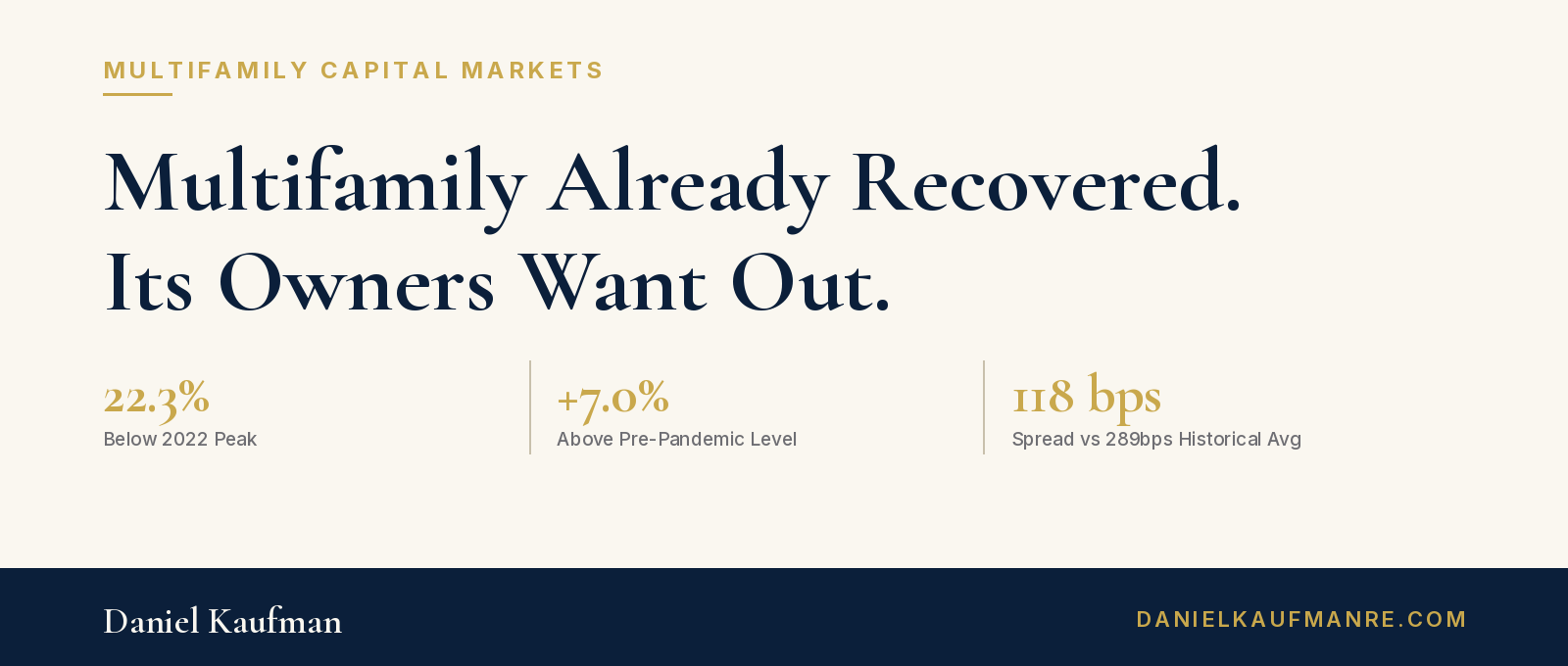
Apartment values are still 22.3 percent below their July 2022 peak, according to the Arbor and Chandan State of the Rental Housing Market report released this month. That is the number owners carry around in their heads, and it is the number that makes a sale feel like a loss. But the peak was the top of a zero rate market that was never going to hold. The more useful comparison is to February 2020, before any of that distortion started, and against that baseline apartment values are up 7.0 percent. Multifamily did not crash. It gave back a bubble and is still standing above where it started.
The spread data backs this up. Cap rate spreads over the ten year Treasury narrowed to 118 basis points in the second quarter of 2026, versus a historical average of 289 basis points going back to 2010. A narrower spread means buyers are paying up relative to the risk free rate, which only happens when capital believes the risk in the asset has already come down. Lending standards and borrower demand are both moving back toward neutral. Supply deliveries are moderating, absorption is broadening across more markets, and occupancy is firming. None of that is a forecast. It is what already happened in the data this year.
So why are housing owners the most eager sellers in the Deloitte survey? Because sentiment lags data, and it lags it by roughly the length of a bad vintage. Deloitte’s own sentiment index fell to 57.8 this year, down from 64.9 last year and 68.3 the year before, the third straight annual decline. Executives are not pricing current fundamentals. They are pricing the memory of the two years they just lived through, cost of capital, rate volatility, and a supply wave that scared everyone before it got absorbed. Those are the top three concerns in the same survey, and all three describe conditions the capital markets data says are already easing.
I keep coming back to the same mechanism across property types, and it is at work here again. The investors who get hurt are not the ones reading the spread data. They are the ones who sell on the anniversary of the worst year, right as the professional capital that actually prices risk has already moved on. If you are holding multifamily that cash flows and you are tempted to sell because the value is still below a 2022 number that should never have been your anchor, ask what the 2020 number says instead. If you are underwriting an acquisition from a motivated seller this quarter, that twenty two percent divestment share is your opportunity, not your warning sign.
Practitioners sitting on stabilized multifamily should run the pre pandemic comparison before they run the 2022 comparison, and buyers should treat every housing seller’s urgency as a data point about that seller’s mindset, not about the asset.
About the Author
I’m the founder and CEO of Kaufman & Company, a private investment and holding firm working across real estate development, venture investment, and infrastructure. My focus is workforce housing and employer-anchored development, including mountain resort communities through Oldivai.
Reach me at Daniel@kaufmanredev.com or find more at danielkaufmanre.com.