
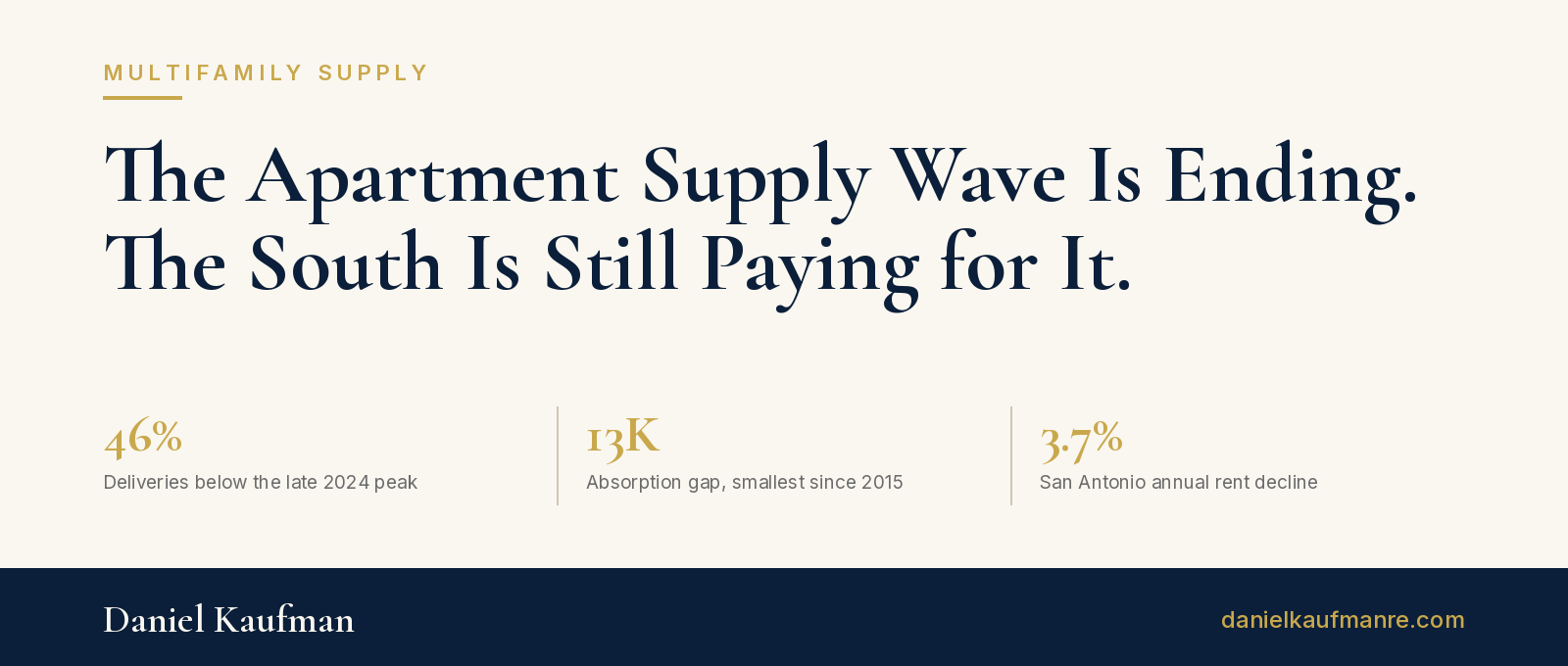
Nationally, the apartment market just crossed a line I have been waiting on for two years. CRE Daily, reporting RealPage data, said renters absorbed nearly 304,800 units in the year ending in the third quarter, while about 318,000 new units were delivered. That gap of roughly 13,000 units is the smallest since late 2015. Deliveries are down 46% from the late 2024 peak of 588,000 units.
On the surface, that reads like a recovery. National occupancy sits at 95.4%, and effective asking rents rose 0.9% year over year, the first positive annual print since the second quarter of 2025, according to the same RealPage figures. But a national average blends very different markets, and this one hides the most important regional story in American housing right now.
The recovery is regional, and the South is last
The markets leading are the ones that could not build. CRE Daily reported San Francisco posted 14.3% annual rent growth. San Jose and Oakland rose 6% to 9%. Virginia Beach rose 6.5% with occupancy of 97.7%. The Midwest led every region at 2% growth, carried by Milwaukee, Chicago, Cleveland, and Detroit.
The South was the only region with falling rents and occupancy below 95%. San Antonio dropped 3.7%. Charlotte, Tampa, and Houston, along with Denver, fell 2% to 3%. Phoenix and Austin are improving at the margin, with annual losses narrowing below 2% and quarterly rents turning positive, but they are still in the red over twelve months.
This is the Southern Squeeze from the other side
I have written about the Southern Squeeze as an affordability problem: home prices, insurance, and taxes rising faster than local wages across the Sun Belt. The apartment data shows the other half of it. The same markets that attracted the most capital also permitted the most units, and owners there are carrying the longest hangover. CRE Daily reported that 22.7% of apartments nationally still offer incentives, averaging 7.5%. In oversupplied Sun Belt submarkets, concessions are where effective rent goes to disappear.
Values tell the same story. Green Street’s price index, as reported by CRE Daily on October 9, has apartments down 4% year over year and 22% below the 2022 peak. Expenses are not helping. Yardi Matrix data in the same issue put property taxes at 20.9% of apartment operating expenses in the second quarter, second only to payroll. Rising taxes on top of flat rents squeeze NOI no matter what cap rates do.
Where I see opportunity
Supply is the variable that matters most, and it is falling fast. The delivery pipeline for 2027 and 2028 is being set right now by starts that higher rates have already choked off. Sun Belt markets with real job growth, not just population growth, are likely to tighten faster than consensus expects once the last wave leases up. The buyers positioned to win are the ones who underwrite today’s concession heavy rents, not pro forma rents, and can still make the deal work.
The Midwest result is not a fluke either. Markets that never overbuilt, and that many investors dismissed as slow, are now printing the best regional rent growth in the country. Data over emotion keeps winning in the places that were written off.
Where it breaks down
I see three risks. First, rates. Realtor.com reported Freddie Mac’s 30-year fixed average at 7.40% for the week ending October 8, a three year high. That keeps would-be buyers renting, which supports absorption, but it also keeps pressure on cap rates and values. Second, demand quality. Quarterly absorption of 69,800 units ran below seasonal norms, per CRE Daily, so the narrowing gap is mostly about supply falling, not demand surging. Third, the K shaped economy. Luxury lease ups with heavy concessions are absorbing higher income renters, while workforce renters face a wage ceiling that no supply cycle fixes on its own.
What I’m watching
Fourth quarter absorption in San Antonio, Charlotte, and Tampa. Concession share by submarket rather than by metro. And starts, because the next shortage is being written into the pipeline now, and the markets that can actually entitle land in the next cycle will be the ones that capture it.
If you want to track which metros have the land and the growth to absorb the next cycle, the free National Land Opportunity Watchlist and market pulse at https://www.landbriefing.com is where we publish that work.
About the Author
I’m the founder and CEO of Kaufman & Company, a private investment and holding firm working across real estate development, venture investment, and infrastructure. My focus is workforce housing and employer-anchored development, including mountain resort communities through Oldivai.
Reach me at Daniel@kaufmanredev.com or find more at danielkaufmanre.com.
Sources
Apartment Demand Catches Up to a Fading Supply Wave, CRE Daily, October 8, 2026, https://www.credaily.com/newsletters/national/issue/apartment-demand-catches-up-to-a-fading-supply-wave/
CRE Price Recovery Stalls as Higher Yields Threaten Further Declines, CRE Daily, October 9, 2026, https://www.credaily.com/newsletters/national/issue/cre-price-recovery-stalls-as-higher-yields-threaten-further-declines/
Mortgage Rates Hit New 3-Year High as Fed Official Says More Hikes Are Needed, Realtor.com, October 8, 2026, https://www.realtor.com/news/trends/mortgage-rates-fed-hikes-today-october-8-2026/