
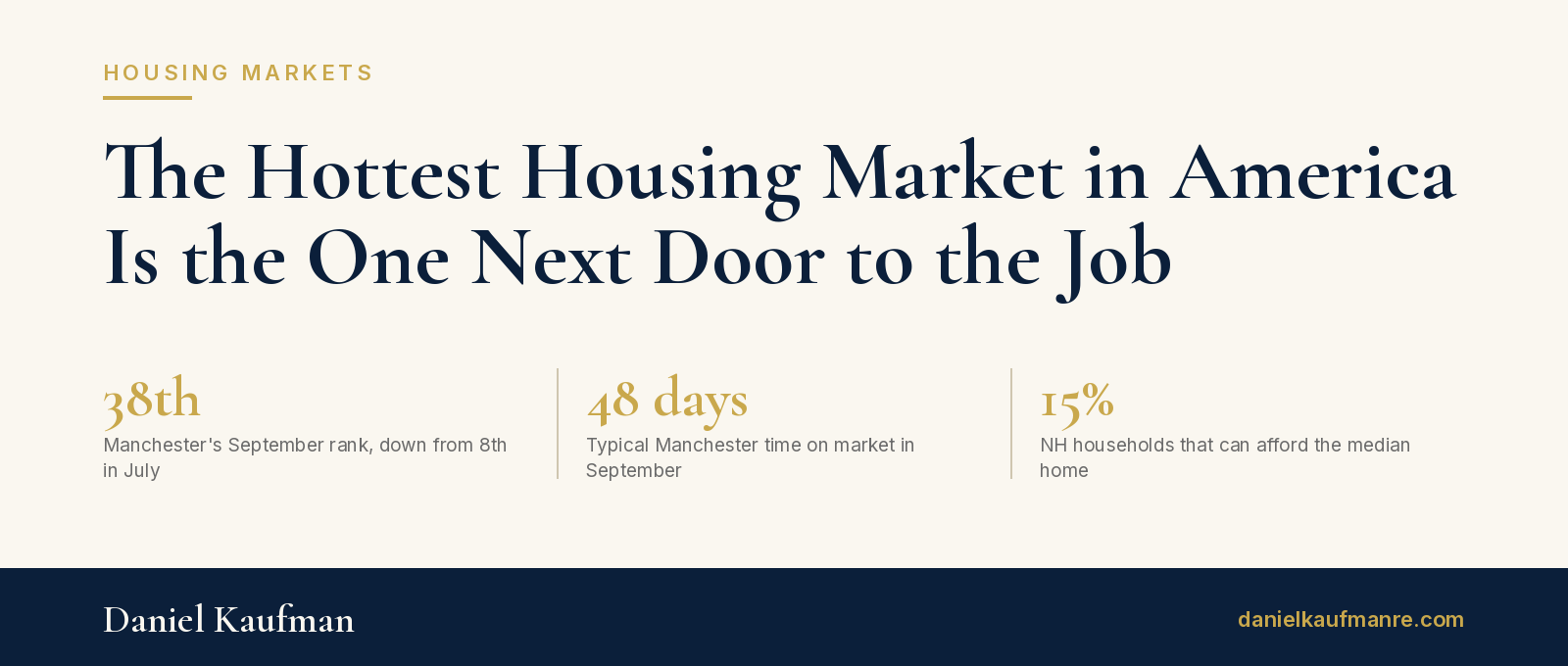
Realtor.com’s latest Hottest Housing Markets ranking came out this week, and the headline most people will read is that Kenosha, Wisconsin took the No. 1 spot. The more useful headline sits underneath it. Manchester-Nashua, New Hampshire, the metro that has topped this list 35 times since the data began in 2017, fell to 38th in September after ranking eighth in July.
I read those two facts together, because they tell one story. Buyers are not chasing hot markets. They are chasing a payment that works within driving distance of a paycheck. When that payment stops working, even the most reliable market in the country cools off fast.
What the ranking actually measures
Realtor.com scores hotness on two things: how many people view each listing and how quickly listings leave the market. According to Realtor.com, the Midwest and Northeast split the top 20 evenly in September, ten spots each. The South, which owned the growth narrative for most of the last decade, is not the story here.
Kenosha drew roughly three times the national average in views per property, and homes there sold in about 32 days, roughly a month faster than the national norm, according to Realtor.com’s reporting. Racine sits about 25 miles from Milwaukee with a median list price near $352,000. Janesville offers about an $85,000 discount to Madison. Providence and Hartford offer $200,000 or more in savings to buyers coming from Boston or New York.
Realtor.com senior economist Hannah Jones calls this the rise of the affordable alternative metro. I call it what it is on the ground: the commuter shed around a real employment base, priced before the market noticed.
Why Manchester broke
Manchester did not lose buyer interest. Realtor.com reports its listings still pull 2.7 times the views of a typical U.S. home. What it lost was speed. Typical time on market stretched to 48 days in September. The median listing price was $579,900, and Freddie Mac’s 30 year fixed average has since climbed to 7.40% for the week ending October 8, its highest level since November 2023, according to Realtor.com.
New Hampshire Housing’s figures, cited by Realtor.com, put the income needed to buy a median priced single family home in the state at about $189,000, and only 15% of households clear that bar. That is the K shaped housing economy in one number. The top of the K can still buy. Everyone else is window shopping, which is exactly what high views and slow sales look like.
Manchester is what happens to an affordable alternative after it stops being affordable. That is the lesson I would carry to every market on this month’s list.
Where I see opportunity
The winners in this cycle will not be the metros with the best story. They will be the ones where land is still priced for yesterday’s demand and the job base is already in place. Kenosha works because it sits between Chicago and Milwaukee with a lower tax burden. The same logic applies to dozens of secondary metros in the Midwest and Northeast that nobody puts on a conference panel.
For builders, that means smaller product near highway, rail, and employer corridors, delivered at a payment the local wage can carry. For lenders, it means the demand in these markets is grounded in value rather than speculation. CRE Daily, citing RealPage, reported this week that the Midwest posted the strongest regional apartment rent growth in the country at about 2% annually, while the South was the only region with falling rents. Demand is following the cost of living, and it is not subtle.
Where I see the risk
The same pattern can eat itself. Every affordable alternative becomes the next expensive market if supply does not follow demand. Manchester had just 0.8 months of supply in August, per NH Realtors data cited by Realtor.com. That is not a market correcting because buyers left. That is a market stalling because there was never enough to buy, and the rate move finally caught up with prices.
The other risk is rates themselves. A ranking built on views and days on market can turn quickly when the 30 year mortgage moves a full point in a year. Kenosha at $350,000 is resilient. Kenosha at $450,000 with an eight percent mortgage would not be.
What I’m watching
Three things. Whether Kenosha and Racine hold their days on market through the winter at these rates. Whether the Northeast entries start showing the same slowdown Manchester did. And whether local governments in these alternative metros approve enough housing, fast enough, to keep them affordable. Land and entitlement are the real bottleneck. They always are.
If you want to see how we score metros like these on growth, land pricing, and entitlement risk, our free National Land Opportunity Watchlist and market pulse are at https://www.landbriefing.com.
About the Author
I’m the founder and CEO of Kaufman & Company, a private investment and holding firm working across real estate development, venture investment, and infrastructure. My focus is workforce housing and employer-anchored development, including mountain resort communities through Oldivai.
Reach me at Daniel@kaufmanredev.com or find more at danielkaufmanre.com.
Sources
America’s Hottest Market No More: This New England City Just Dropped Out of the Top 20, Realtor.com, October 9, 2026, https://www.realtor.com/news/trends/manchester-nh-hottest-markets-report-september-2026/
Mortgage Rates Hit New 3-Year High as Fed Official Says More Hikes Are Needed, Realtor.com, October 8, 2026, https://www.realtor.com/news/trends/mortgage-rates-fed-hikes-today-october-8-2026/
Apartment Demand Catches Up to a Fading Supply Wave, CRE Daily, October 8, 2026, https://www.credaily.com/newsletters/national/issue/apartment-demand-catches-up-to-a-fading-supply-wave/