
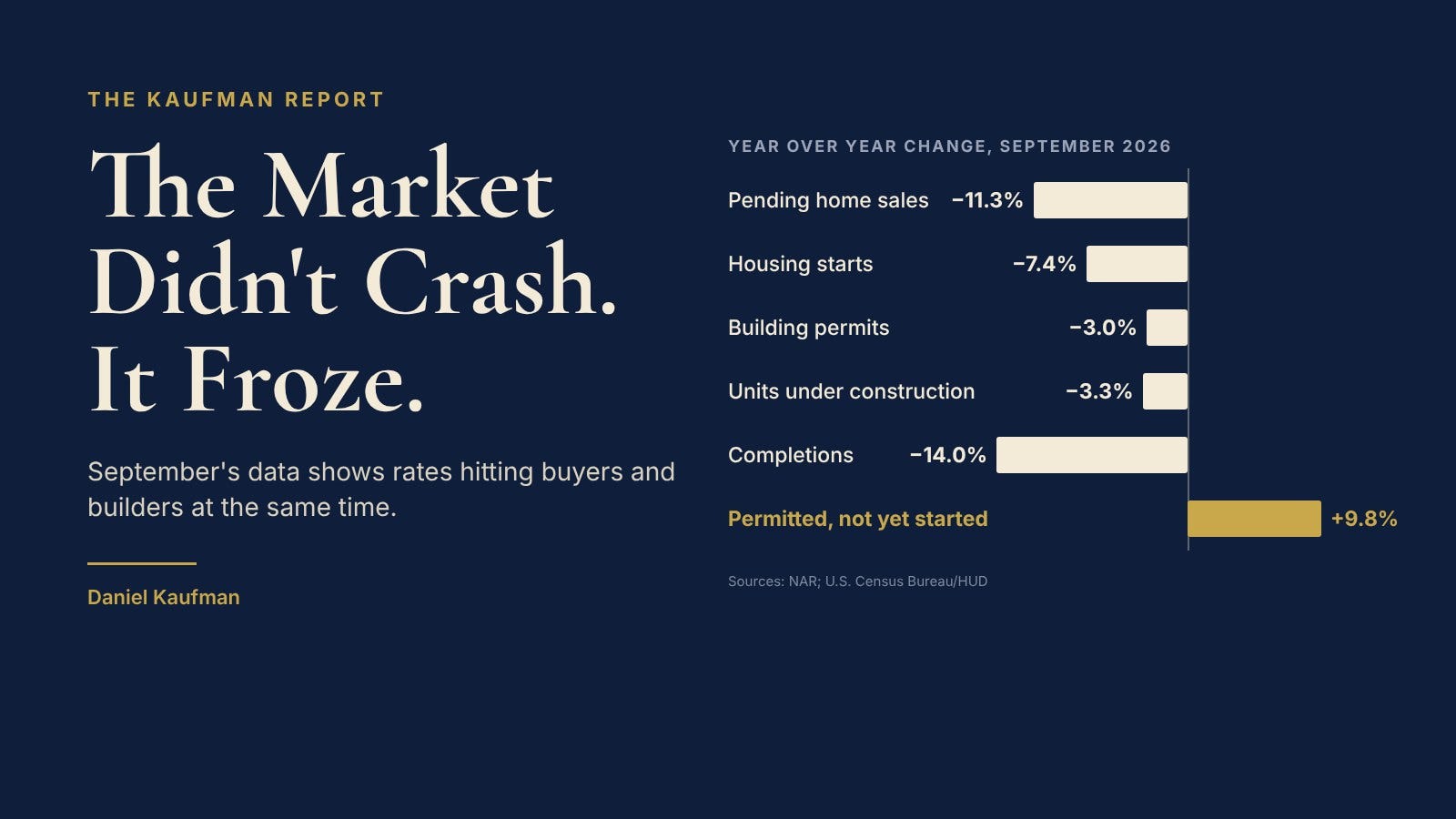
Housing hit a wall in September. Not just sales. Starts, completions, and the permits builders are sitting on all tell the same story: mortgage rates are crimping affordability, and both sides of the market stepped back in the same month.
That’s the part I want to focus on, because a market where only buyers pull back looks very different from one where builders pull back with them.
The demand side
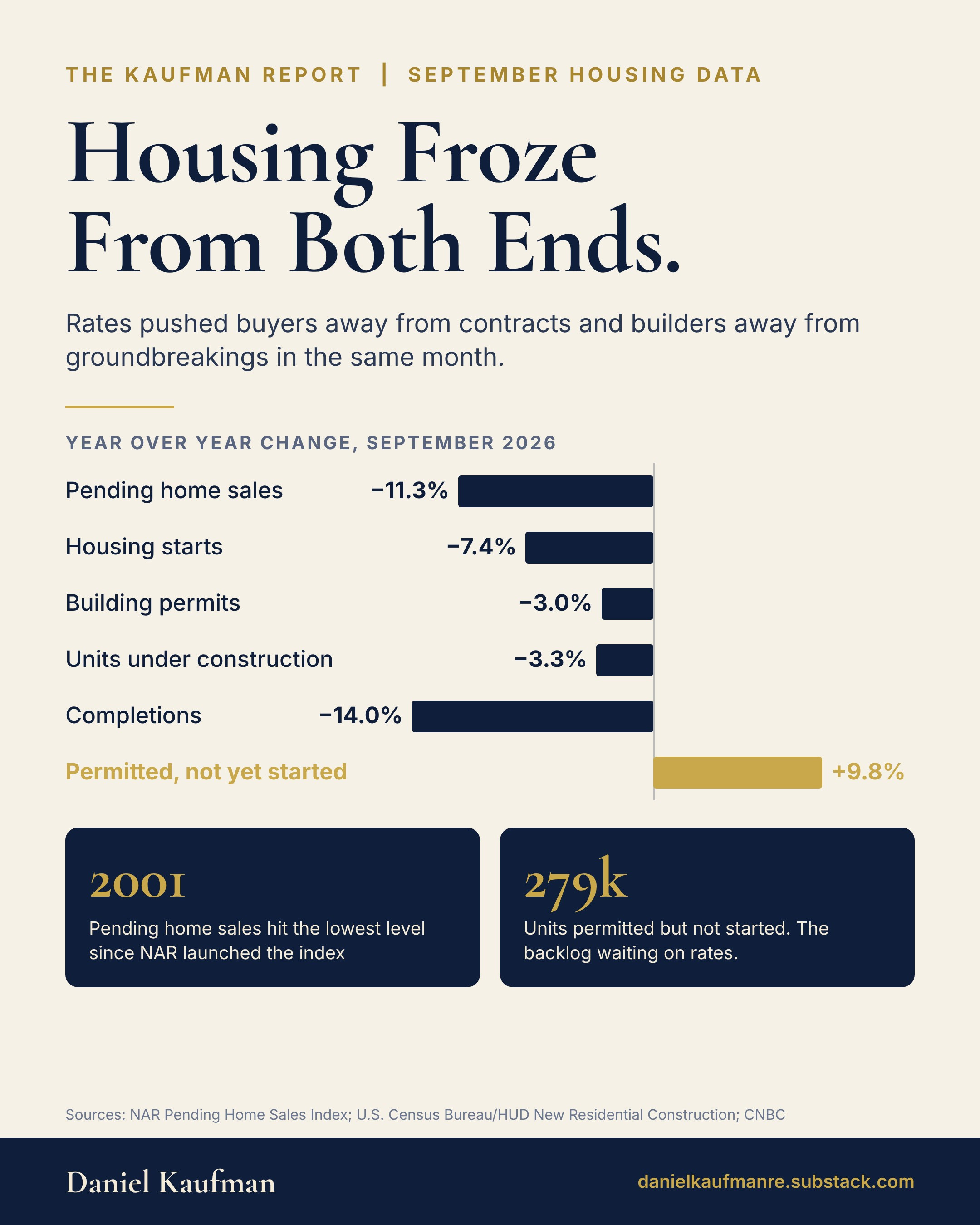
NAR’s pending home sales index fell 7.3% from August. Consensus was looking for a dip of 0.4%. Year over year, signed contracts were down 11.3%, the lowest reading since NAR launched the index in 2001.
All four regions fell on both a monthly and annual basis. The West was weakest, down 9.2% on the month and 15.0% on the year. The South followed, down 8.2% on the month and 12.0% on the year.
The trigger isn’t hard to find. According to Mortgage News Daily figures cited by CNBC, the 30 year fixed started September around 6.8% and finished near 7.6%. That’s close to a full point in four weeks. Pending sales measure contracts signed, so this is buyers reacting in real time to a payment that moved on them mid search.
NAR’s Lawrence Yun put it simply: job and income growth help, but affordability moves with mortgage rates.
The supply side
The Census Bureau and HUD numbers for September:
-
Housing starts fell 5.2% month over month and 7.4% year over year to an annualized 1.2 million. Single family starts were 859,000, down 4.6%, the lowest since September 2025.
-
Building permits were roughly flat on the month and down 3.0% on the year at 1.4 million. Single family permits fell 4.0% to 845,000, while permits for buildings with five or more units rose 5.9% to 503,000.
-
Units under construction were flat from August but down 3.3% year over year at 1.3 million.
-
Completions rose 2.0% on the month but were down 14.0% on the year at 1.19 million, the second lowest reading since December 2019. Year to date, completions are down 12.5%.
-
Units permitted but not yet started rose 9.8% year over year to 279,000.
Builder sentiment backs it up. NAHB’s October read came in at the lowest level in 14 years, with buyer traffic the weakest component.
So what’s going on?
Higher rates are hitting demand and supply at the same time. Buyers are stepping back from contracts. Builders are holding off, and the pile of permitted but unstarted units keeps growing while they wait for demand to come back.
That 279,000 number is the one I keep coming back to. Those aren’t speculative projects. Somebody already bought the land, got it entitled, paid the fees, and pulled the permit. The hard part is done. What’s missing is a buyer at a payment that pencils, so the work sits. That’s capital waiting, not capital leaving.
Here’s the other side of it. Fewer completions today mean less new inventory in 2027. That helps explain why prices, not counting incentives, are holding steady even as sales slow. The “not counting incentives” part matters. Builders are protecting the sticker price and giving it back through rate buydowns and closing cost credits. Nationwide’s Ben Ayers expects construction to stay sluggish into 2027 as builders keep working through current projects with price cuts and incentives eating into margins.
And notice where permits are going up: buildings with five or more units. When the monthly cost of owning jumps, the capital that’s still moving shifts toward rentals.
The rate question
Yun believes mortgage rates may be close to peaking, since they’ve already climbed well beyond the Fed’s increases. I think that’s a reasonable read. Still, energy driven inflation is the wild card, and it’s the variable nobody in housing controls.
If rates ease, there is pent up demand on both the buyer side and the builder side ready to come back at once. Buyers who walked from contracts in September haven’t stopped needing a house. Builders holding 279,000 permitted units can move quickly. That’s how a frozen market can turn into a tight one faster than most people expect.
How I’m reading it
A frozen market isn’t a broken one. NAHB’s Robert Dietz said demand persists; it’s sitting on the sidelines. Here’s what I’m watching:
-
The downside is carry. Builders and land holders sitting on permitted sites are paying interest, taxes, and fees every month the shovel doesn’t go in. The longer this lasts, the more of those sites change hands.
-
The opportunity is entitled land. When completions drop 14% and the backlog grows, the land that’s already through the approval process gets more valuable on the other side of the cycle, not less.
-
Workforce housing gets harder and more necessary. The households most sensitive to a point on the mortgage rate are the ones employers need housed. Projects that don’t depend on a 7.6% mortgage buyer are the ones that keep moving.
-
Watch the rentals. Five plus unit permits rising while single family falls tells you where the money still sees demand.
This is the kind of market where the work is on land and fundamentals, not on headlines. If you’re tracking where the next cycle sets up, that’s what we built LandBriefing for: land and housing fundamentals across markets, in one place.
About the Author
Daniel Kaufman is the founder and CEO of Kaufman & Company, a private investment and holding firm working across real estate development, venture investment, and infrastructure. He writes The Kaufman Report on housing, land, and the markets underneath them, from an operator’s point of view.
Contact: Daniel@kaufmanredev.com | danielkaufmanre.com
Sources: CNBC, “September data shows housing market in a deep freeze” (Oct. 20, 2026); National Association of Realtors, Pending Home Sales Index, September 2026; U.S. Census Bureau and HUD, New Residential Construction, September 2026; National Association of Home Builders, October 2026 Housing Market Index.