
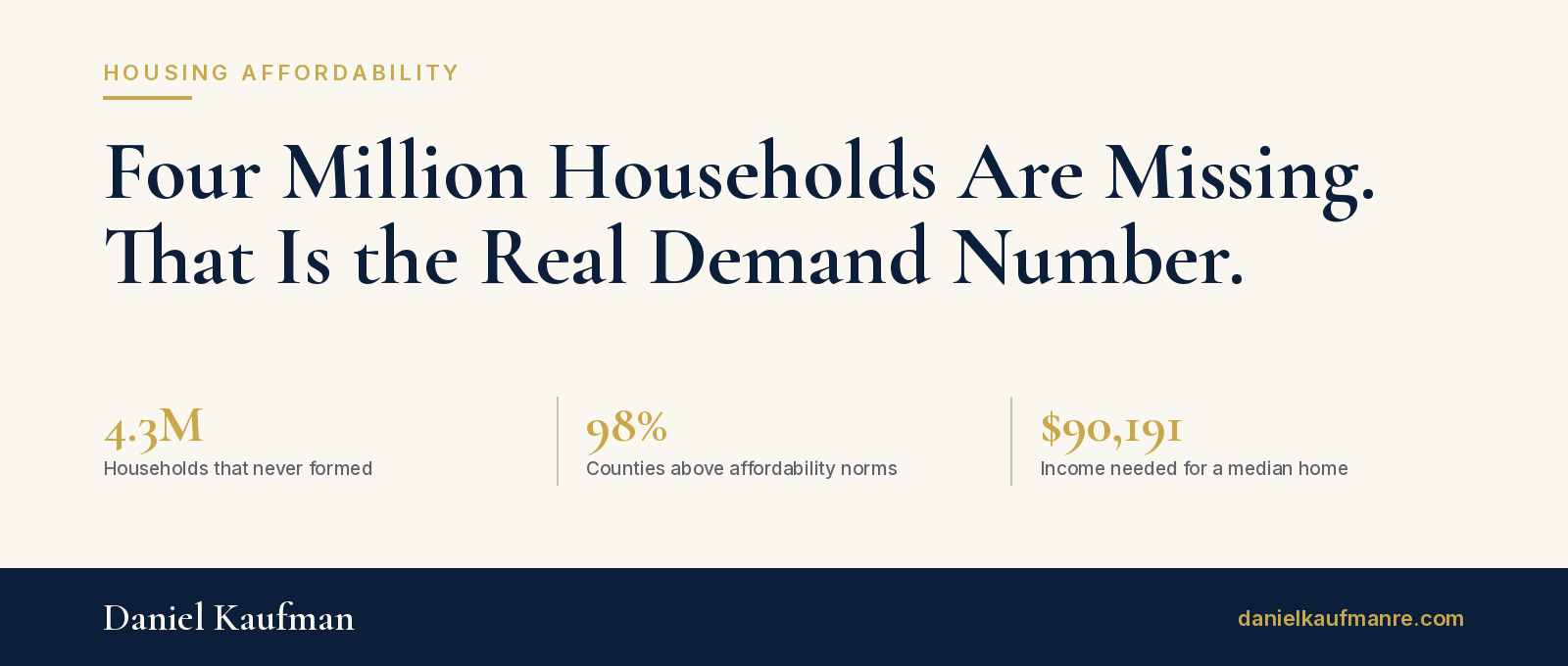
Two reports landed this morning that belong together. Realtor.com covered ATTOM’s third quarter affordability report, which found that major ownership costs exceed historical affordability norms in 98% of the 583 counties ATTOM analyzed. The same morning, Realtor.com reported on new John Burns Research and Consulting work showing the country has 135 million households when 2010 living patterns would have produced 139.3 million. That is 4.3 million households that never formed.
Read them separately and you get two gloomy headlines. Read them together and you get the most important demand number in housing right now.
The price fell. The house did not get cheaper.
ATTOM put the median single family and condo price at $368,000 in the third quarter, down 2% from a year earlier. Prices moved the right way. Affordability did not. With mortgage rates reaching 7.3% by the end of the quarter, as Realtor.com reported, ATTOM calculates that a buyer needs $90,191 a year to carry a median priced home at a 28% front end ratio, against a national average wage of $79,534. In one of every three counties, ownership costs eat more than 43% of the typical local wage, which ATTOM labels seriously unaffordable.
This is the K shaped housing economy in one table. Owners with equity and old debt are fine. Anyone who has to finance today, at today’s rate, is shut out even when the sticker price softens. A 2% price cut does not offset financing at more than 7%.
Where the missing households went
The Burns report, as Realtor.com described it, finds every age group short 600,000 to 900,000 households. Relative to size, the youngest adults carry the heaviest load: 15 to 24 year olds are missing 9% of their households, versus 2% to 4% for older groups. Realtor.com’s own research counted a record 25.2 million adults under 35 living with parents in 2025, and NAR’s latest buyer profile put the median first time buyer at 40.
Those people did not disappear. They are in childhood bedrooms and shared apartments, waiting for a product they can afford. That is suppressed demand, not absent demand, and it is why I do not buy the argument that the country is overbuilt outside a handful of oversupplied submarkets.
Where I see the opportunity
The builders who win from here are the ones building small and pricing for the middle. Burns and Realtor.com senior economist Hannah Jones land on the same prescription: smaller homes, zoned and permitted at lower cost. I agree, with Jones’ own caveat attached. Small only helps if it is actually priced lower. Realtor.com found the starter home share of inventory slipped from 38.1% to 36.2% over seven years while the median starter price climbed from $260,000 to $340,000.
The other winner is Texas. ATTOM found Harris, Dallas, and Bexar counties still well under the 28% threshold. That is not luck. It is permitting. Markets that let builders deliver lots at scale keep ownership within reach of local wages, and those are the markets where the missing households will form first. Inside the Southern Squeeze, the metros that kept building are the ones keeping their discount.
Employer anchored workforce housing gets more valuable in this setup too. When a third of counties are seriously unaffordable, a company that can house its people has a recruiting edge, and a developer partnered with that employer has a demand floor most spec builders do not.
Where it breaks down
Pent up demand is not the same as effective demand. A 26 year old living at home only becomes a household when the payment works. If rates stay above 7%, that demand stays bottled up, and builders who underwrite to it too early carry inventory nobody can finance.
The coastal counties at the top of ATTOM’s list will not be fixed by small homes alone. In Kings County, ATTOM found ownership costs on a median priced home running at 114.1% of local wages. Land is the whole problem there, and entitlement is the bottleneck behind the land.
I also expect the 4.3 million figure to get misused. It is a count measured against 2010 behavior, not a construction target, and Realtor.com’s coverage notes that lower divorce rates and longer lives are part of the shift. The useful read is directional: the demand exists, and it is concentrated at the entry level.
What I am watching
Three things. Whether the starter home share of listings turns back up. Whether the next ATTOM report shows counties moving back under the 28% line as wages keep climbing. And which cities move first on lot size and small home zoning, because that is where land gets repriced.
If you want to follow which metros are lining up the land and entitlements to meet that pent up demand, the free National Land Opportunity Watchlist and market pulse at www.landbriefing.com track it every week.
About the Author
I’m the founder and CEO of Kaufman & Company, a private investment and holding firm working across real estate development, venture investment, and infrastructure. My focus is workforce housing and employer-anchored development, including mountain resort communities through Oldivai.
Reach me at Daniel@kaufmanredev.com or find more at danielkaufmanre.com.
Sources
Homes Are ‘Seriously Unaffordable’ in Nearly a Third of U.S. Counties, New Report Finds, Realtor.com, October 22, 2026, https://www.realtor.com/news/trends/housing-affordability-report-by-county-q3-2026/
U.S. Is Missing 4.3 Million Households as Priced-Out Young Adults Stay Home, Realtor.com, October 22, 2026, https://www.realtor.com/news/trends/millions-missing-households-young-adults-stay-home/