
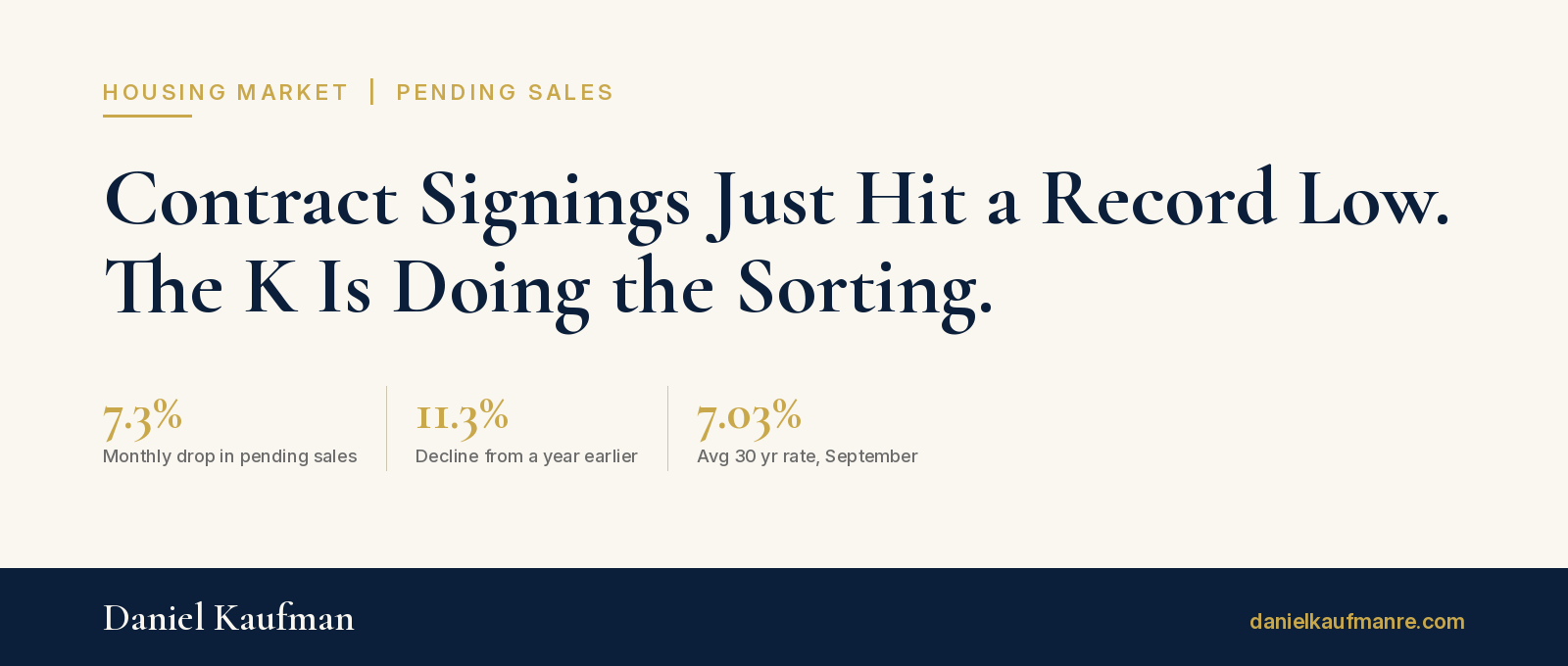
Pending home sales fell to the lowest level on record in September. Not the lowest since the last downturn. The lowest ever measured. Realtor.com reported on Tuesday that contract signings dropped 7.3% from August and 11.3% from a year earlier, according to the National Association of Realtors Pending Home Sales report.
I want to be careful about what that number says and what it does not. It does not say prices are about to collapse. It says the transaction itself is breaking. And when the transaction breaks, the market sorts people by balance sheet, not by need. That is the K shaped housing economy in a single data point.
Every region fell, both month over month and year over year. The West led the decline at 9.2% for the month and 15% for the year, followed by the South at 8.2% and 12%. Even the strongest metros went negative. Nashville, the best performer in the country, was still down 2% from a year ago, with Hartford and San Francisco close behind at 2.1% and 3.5%.
The cause is not mysterious. CRE Daily’s Texas newsletter, citing the Texas Real Estate Research Center, put the average 30 year mortgage rate at 7.03% in September, up from 6.66% a month earlier, as the 10 year Treasury climbed to 5.29%. A 37 basis point jump in one month reprices every buyer who was stretching to the edge of a budget.
Here is the part that matters most. Conditions for buyers are actually improving. Realtor.com noted that asking prices fell for an 11th straight month in September, price reductions edged up, inventory climbed, and months of supply held near a 10 year high. Its Market Clock now puts the national market at 4 o’clock, a late balanced market leaning toward buyers. The leverage has moved to the buyer. The buyer just cannot finance the leverage.
Why this is a K story. When rates do the rationing, the top of the K keeps transacting. Cash buyers, move up buyers sitting on equity, and households whose pay has kept pace get the soft market, the price cuts, and the negotiating room. The bottom of the K, first time buyers and renters trying to cross over, gets the payment. Realtor.com senior economist Hannah Jones pointed out that wage growth is running below inflation, which keeps eroding real buying power. A market can be friendly and inaccessible at the same time. That is exactly where we are.
Where I see opportunity. Sellers and builders who solve the payment rather than the price will take share. At these rate levels, a buydown moves a first time buyer further than a list price cut of similar cost, and builders with their own mortgage arms are best positioned to offer one. Patient, well capitalized land buyers are also in a better spot than they have been in years, because a frozen resale market is when owners of entitled lots start returning calls. And several of the metros that held up best, like Buffalo, Richmond, and Pittsburgh, are relatively affordable places with steady employment bases. Data over emotion says that is where demand is stickiest.
Where I see the downfalls. Thin volume is its own risk. NAR chief economist Lawrence Yun argues that a limited number of distressed properties is keeping prices steady, and for now he is right. But steady prices on record low volume are fragile prices. Agents, title companies, loan originators, and small builders live on transactions, not on values, and another year like this one thins out that whole ecosystem. Jones also said markets are pricing in the possibility of another Fed hike before year end after hot inflation data. If that happens, winter could be worse than fall. For the Sun Belt, which drove much of the South’s 12% annual decline, this is another turn of the Southern Squeeze: more inventory, falling asking prices, and still too few buyers who qualify.
What I am watching next. Closings trail contracts by one to two months, so the November and December existing home sales reports will carry this September drop. I am watching whether the 10 year holds above 5%, whether builders widen incentives or cut starts further, and whether the best performing metros keep their edge or converge with everyone else. If signings stay this low into the spring market, the question stops being about price and becomes about who is still standing to sell, lend, and build when demand comes back.
If you are a builder or developer trying to keep a project moving while the cost of money does the rationing, I wrote a free e-book on exactly that problem, The Capital You Don’t Have to Rent, about funding development without hard money. You can get it at https://danielkaufmanre.com/capital.
About the Author
I’m the founder and CEO of Kaufman & Company, a private investment and holding firm working across real estate development, venture investment, and infrastructure. My focus is workforce housing and employer-anchored development, including mountain resort communities through Oldivai.
Reach me at Daniel@kaufmanredev.com or find more at danielkaufmanre.com.
Sources
Pending Home Sales Plunge to All-Time Low in Troubling Sign for Fall Housing Market, Realtor.com, October 20, 2026, https://www.realtor.com/news/trends/pending-home-sales-fall-september-2026-housing-update/
Texas Job Growth Triples the Nation’s as Mortgage Rates Top 7%, CRE Daily, October 14, 2026, https://www.credaily.com/newsletters/texas/issue/texas-job-growth-triples-the-nations-as-mortgage-rates-top-7/