
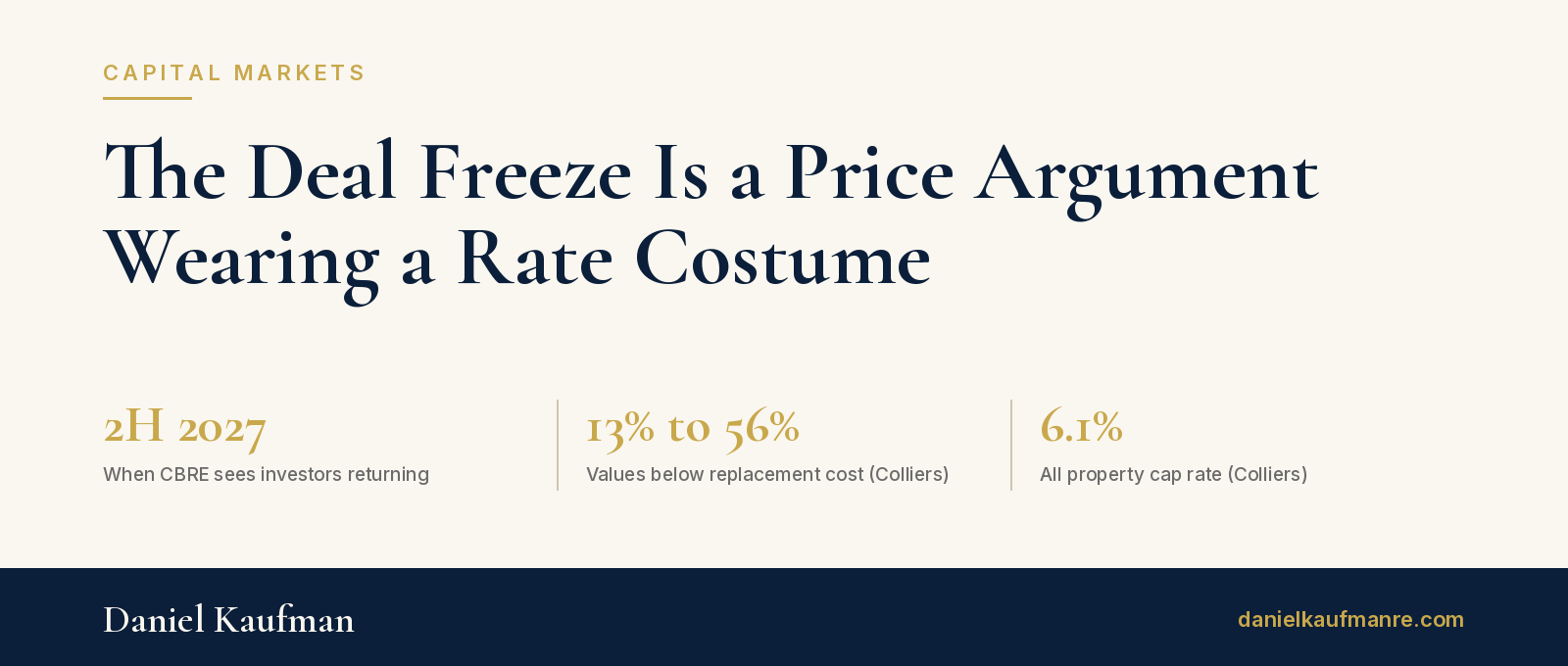
CBRE just said out loud what most of us feel in our inboxes. CRE Daily reported on October 23 that CBRE chief executive Bob Sulentic expects rate volatility to keep a lot of investors on the sidelines, potentially until the second half of 2027. Deals are being repriced, canceled, or quietly converted into refinancings.
Now read that next to the rest of CBRE’s quarter. According to the same CRE Daily report, CBRE’s third quarter revenue rose 13% to $11.5 billion, global property sales rose 28%, and U.S. property sales rose 37%. Data center revenue jumped 80%. That is not a market where nothing trades. It is a market where some things clear easily and a lot of things do not clear at all.
That is the K shaped economy showing up in commercial real estate. The top leg is capital that does not need the rate to fall: well capitalized buyers, infrastructure and data center money, trophy assets with real demand behind them. The bottom leg is everything financed for a world that ended in 2022. Both legs live inside the same headline number, which is why the headline number misleads.
Here is my read. The rate is the excuse. The price is the argument. Sellers are still anchored to values set when money was nearly free. Buyers are underwriting off a 10 year Treasury sitting right around 5%, which both CRE Daily’s market snapshot and Realtor.com’s coverage this week put in that range. CRE Daily also cited Colliers putting all property cap rates at 6.1%. Run those two numbers against each other and the spread for taking real estate risk over a government bond is roughly one point. That is my math, not theirs, but it explains the standoff better than any forecast does.
The most important number in the whole week is one most people will skip. CRE Daily’s chart of the day, citing Colliers, shows commercial property values sitting 13% to 56% below replacement cost. When existing buildings trade below what it costs to build new ones, new supply stops. You can already see it: CRE Daily reported third quarter retail construction starts fell to about 7.7 million square feet, the weakest since 2016.
That is where I see the opportunity. Scarcity is being manufactured right now by math, not by policy. Owners who can hold good, well located assets through the freeze, without a forced sale or a maturity they cannot meet, are going to own the only product available when demand returns. Buyers with patient capital and modest leverage can buy below replacement cost in sectors where demand has not gone anywhere. And anyone positioned around power, data centers, and critical infrastructure is on the leg of the K that CBRE says is still growing.
Now the downfalls. Waiting until late 2027 is itself a bet that rates come down, and I would not bet the company on it. Realtor.com chief economist Danielle Hale noted this week that the Fed is widely expected to hold on Wednesday while inflation pressure lingers and an oil supply shock works through the economy. If higher for longer simply stays higher, then a deal converted into a refinancing is not a solution. It is a delay with interest. The exposure is already visible: CRE Daily reported that 25% of Texas floating rate apartment loans sit below a 1.0x debt service coverage ratio. Those owners are not waiting for clarity. They are waiting for a buyer, a lender, or a special servicer, whichever comes first.
On the housing side the same tension holds. Realtor.com reported Freddie Mac’s 30 year rate at 7.32% for the week ending October 22, the first dip after seven straight weekly gains. One good week does not make a trend, and anyone who repriced a deal on one good week in 2024 or 2025 learned that the hard way.
What I am watching next: the Fed decision on Wednesday and, more importantly, what the 10 year does afterward; Freddie Mac’s Thursday rate print; whether CBRE’s 37% U.S. sales growth holds into the fourth quarter or proves to be a few large trades; and whether the deals being converted into refinancings start showing up as special servicing transfers in the first half of next year. Data over emotion. The data says the freeze is selective, and selective freezes are where disciplined buyers do their best work.
If your project’s capital stack was built for a rate that never came back, start with how the deal is funded instead of hoping for the cut. My free e-book, The Capital You Don’t Have to Rent, walks through ways to fund development without leaning on hard money: https://danielkaufmanre.com/capital
About the Author
I’m the founder and CEO of Kaufman & Company, a private investment and holding firm working across real estate development, venture investment, and infrastructure. My focus is workforce housing and employer-anchored development, including mountain resort communities through Oldivai.
Reach me at Daniel@kaufmanredev.com or find more at danielkaufmanre.com.
Sources
Rate Uncertainty Is Repricing and Delaying Commercial Property Deals, CRE Daily, October 23, 2026, https://www.credaily.com/newsletters/national/issue/rate-uncertainty-is-repricing-and-delaying-commercial-property-deals/
Housing Week Ahead: Metro Rankings, Home Prices, and Fed Rate Decision, Realtor.com, October 26, 2026, https://www.realtor.com/news/trends/housing-week-ahead-video-home-prices-fed-decision-october-26-2026/
Why Today’s 5% Treasury Yield Reset Means Big Moves for Down Payment Cash, Realtor.com, October 26, 2026, https://www.realtor.com/news/trends/treasury-yields-above-5-homeowners-savings-money-monday/