
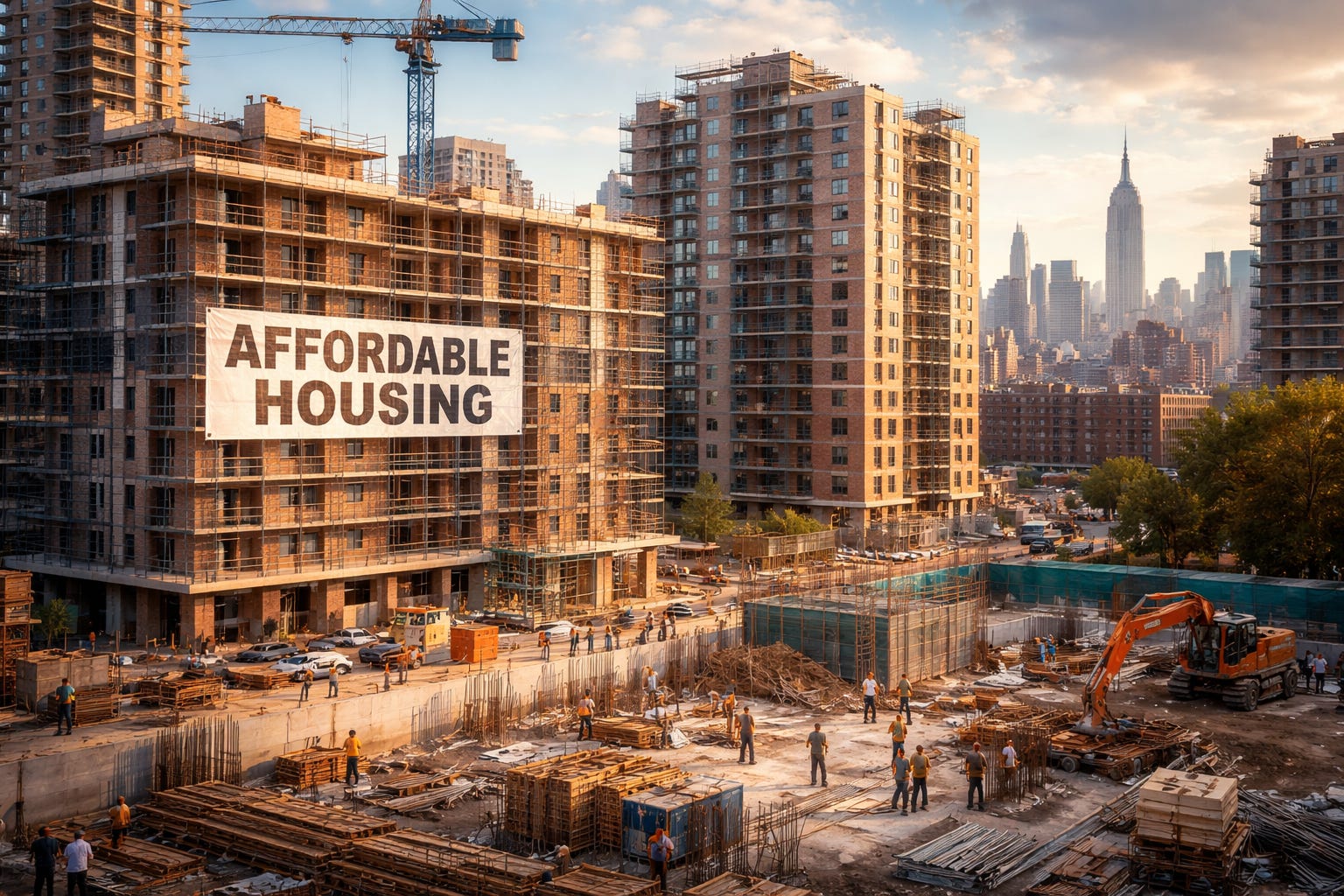
New York City is once again at the center of America’s housing affordability debate, and the timing is almost cinematic.
This month, Zohran Mamdani was sworn in as New York’s new mayor on a platform built around one clear promise, deliver more affordable housing in the nation’s most expensive rental market. He wasted no time. On day one, he signed executive orders creating task forces to “speed up housing production,” appointed housing activist Cea Weaver to run the Mayor’s Office to Protect Tenants, and publicly declared, “We will not wait to deliver action. We will stand up on behalf of the tenants of this city.”
At the same time, the Wall Street Journal published a quietly devastating article titled “To Make Homes Affordable Again, Someone Has to Lose Out.” It gets to the heart of a truth that almost no politician wants to say out loud.
Affordable housing is not a free lunch. Every affordability intervention transfers value from someone to someone else.
And right now, New York is trying to run that transfer at full speed.
The Pipeline Is Already Full
What’s striking about Mamdani’s moment is that New York already has thousands of affordable units either under construction or hitting the market soon.
Developers were busy in 2025 filing permits, pouring foundations, and securing certificates of occupancy across Brooklyn, the Bronx, Manhattan, and Queens. A few notable examples:
North Cove, Inwood (611 units)
A 30-story mixed-use development with units targeted to households earning between 27 percent and 110 percent of AMI, with 15 percent reserved for formerly homeless residents. Retail, parking, and amenities included.
Stewart Hotel Conversion, Midtown (579 units)
A permanently affordable conversion of a former hotel, capped at 60 percent of AMI. Construction slated for 2026. Includes on-site social services for formerly homeless residents.
Concern Inwood, Bronx (210 units)
A nonprofit-led project capped at 60 percent of AMI, with community gardening space and green amenities.
River Avenue II, Bronx (292 units)
A mixed-use affordable development capped at 80 percent of AMI, opening in 2029, with commercial space, parking, and on-site amenities.
Sparrow Square, Brooklyn (1,090 units)
Built on the former Kingsboro Psychiatric Center site, capped at 30 percent of AMI, delivered in phases through 2028, including a Brooklyn Ballet studio.
These projects matter. They are real supply. They will house real people. Many directly target homelessness.
And yet, despite this pipeline, New York’s asking rent is still hovering near a record high, roughly $3,529 per month, about double the U.S. average.
Which brings us back to the uncomfortable math.
The WSJ’s Core Insight: Someone Has to Lose
The Wall Street Journal framed the problem bluntly.
If rents are too high, and incomes are not rising fast enough, then prices only come down if:
1. Developers accept lower returns.
2. Landowners accept lower land values.
3. Lenders accept lower interest or higher risk.
4. Taxpayers subsidize the gap.
5. Existing owners absorb regulatory losses.
6. Or some combination of all of the above.
There is no other option.
When governments mandate below-market rents, impose stricter rent stabilization, delay foreclosures or bankruptcy sales, or block transactions in the name of “tenant protection,” they are not creating value. They are reallocating it.
Mayor Mamdani’s attempted intervention in the $450 million sale of 5,200 rent-stabilized apartments is a perfect example. The city wanted time to evaluate the buyer’s bid and explore alternatives “that protect tenant interests.”
That sounds noble.
It also injects political risk into capital markets that are already tightening.
When investors, lenders, and developers start pricing in political interference, they do not respond by building more housing. They respond by demanding higher returns, pulling capital, or shifting it to jurisdictions that do not change the rules mid-stream.
The result is fewer starts, fewer conversions, and less supply over time.
Which means higher rents later.
The Political Illusion
Here is the political illusion that keeps repeating itself.
Politicians run on affordability.
They regulate rents.
They impose new requirements.
They slow down sales and conversions.
They tighten tenant protections.
They pressure developers to “do more.”
And then they are shocked when:
• Construction slows.
• Capital leaves.
• Supply contracts.
• Rents keep rising.
You cannot regulate your way out of a supply shortage.
You can only build your way out of it.
And building requires private capital, institutional lenders, predictable rules, and returns that justify the risk.
The Wall Street Journal is right. Someone always loses.
The only real question is whether we are honest about who that someone is.
The Real Constraint Is Not Ideology, It’s Math
What New York is running into now is not a philosophical problem. It is a capital stack problem.
Affordable housing in high-cost markets only pencils when:
• Land costs are discounted or donated.
• Construction costs are subsidized.
• Interest rates are below market.
• Tax credits fill the equity gap.
• Rents are regulated but expenses are not.
That model works at scale only if public subsidy fills the delta between real costs and politically acceptable rents.
When subsidy does not keep up, developers either stop building or shift to markets that still allow risk-adjusted returns.
This is why hotel-to-residential conversions matter. They are one of the few ways to create new housing at a basis that can still support affordability. It is also why nonprofit developers dominate many of these deals, they are structurally designed to operate at thinner margins.
But even those models break when political risk keeps rising.
My Take as a Developer and Investor
From where I sit, New York is approaching a familiar inflection point.
The city is producing meaningful affordable supply.
It is also signaling to capital that rules are fluid, transactions are politicized, and ownership rights are conditional.
Those two forces move in opposite directions.
If the Mamdani administration genuinely wants to accelerate housing production, the fastest lever is not ideology or executive orders.
It is certainty.
Certainty that:
• Deals that are struck will close.
• Sales will not be retroactively delayed.
• Returns will not be regulated away.
• Conversions will be approved quickly.
• Subsidies will be predictable and durable.
• Capital will not be vilified for showing up.
Affordable housing is not a moral issue. It is a financial engineering problem.
If you want more units, you must make the capital stack work.
Everything else is political theater.
The Hard Truth
The Wall Street Journal nailed it.
To make homes affordable again, someone has to lose.
The question is not whether that loss happens.
It is whether we distribute it in a way that still attracts the capital required to build the housing in the first place.
If New York gets that balance right, the projects already in the pipeline will be the beginning of a real affordability reset.
If it gets it wrong, the city will win a few political headlines now and lose a decade of housing production later.
And that loss will fall on the very tenants the policies were meant to protect.
Daniel Kaufman is a real estate developer and investor focused on housing, infrastructure, and capital markets. He writes about development, affordability, and the financial realities behind urban policy.