
For the last decade, I’ve been building across multiple asset classes—multifamily, workforce housing, data-center adjacency, modular platforms, hospitality, mixed-use, and now AI-driven infrastructure. I’ve seen cycles, corrections, moments of irrational exuberance, and moments of panic. But I’ve never seen anything reshape demand fundamentals the way AI is reshaping them right now.
Two recent Wall Street Journal articles captured something that every serious developer and investor needs to internalize. One focused on the massive construction boom behind the data-center explosion, and the other examined how America’s tariff-driven inflationary pressures collided with a surge in AI-driven capital investment, ultimately rescuing sectors that would otherwise be under water.
What the WSJ didn’t explicitly say—but what you can feel if you’re actually in the trenches—is this:
AI infrastructure has become the most powerful macroeconomic force in real estate today.
It is quietly rewriting labor markets, supply chains, trade flows, and regional development patterns. And the developers who understand this will define the next decade.
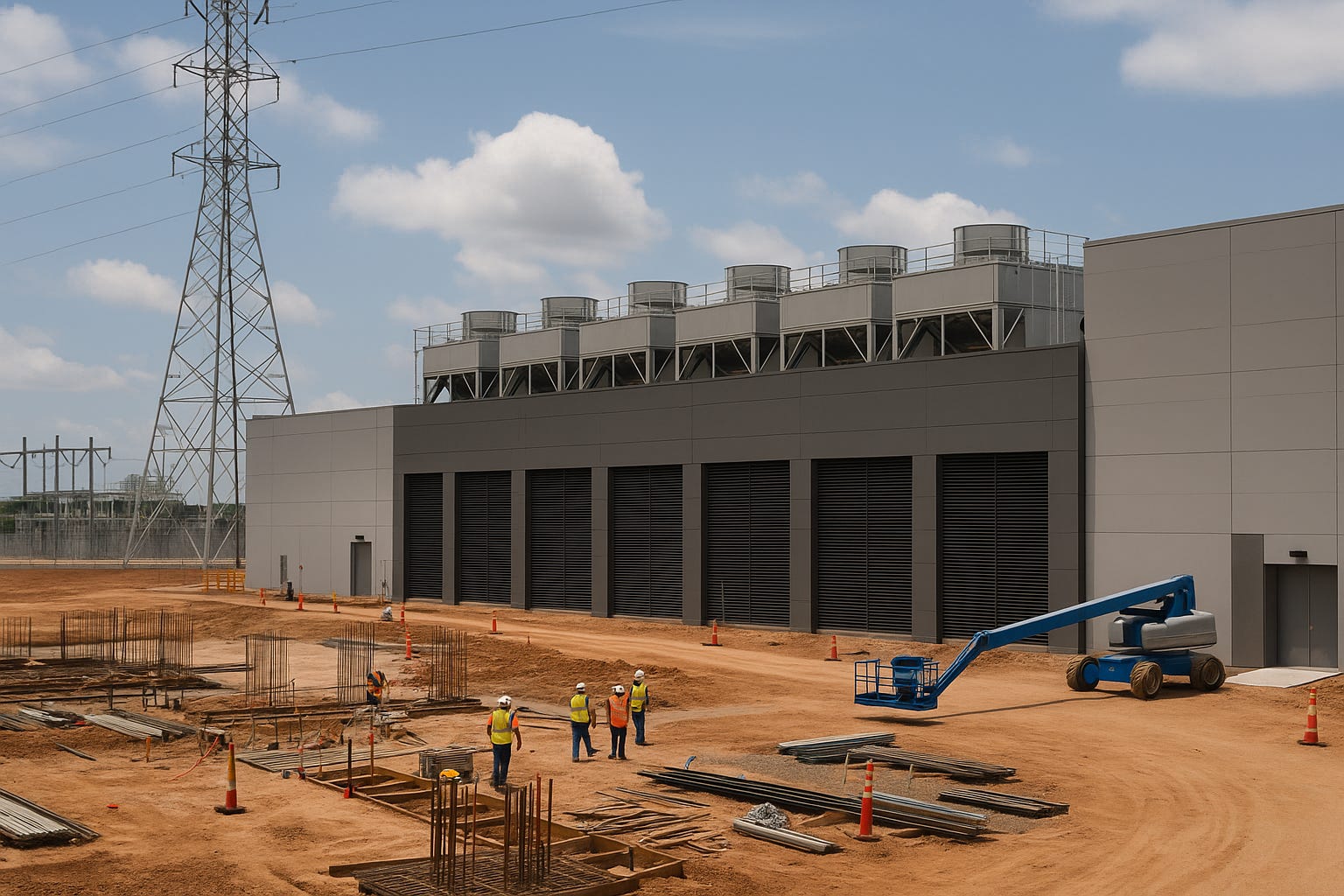
The Data Center Gold Rush Is Not a Metaphor. It’s a Labor Story, a Land Story, and a Power Story.
The Journal described data centers as a “gold rush for construction workers.” That’s accurate. Developers like me have watched trades that were struggling for steady work during the post-COVID slowdown suddenly get absorbed into the AI build-out at wages that would have seemed absurd just five years ago.
Electricians, linemen, concrete crews, steel installers—every specialty tied to heavy infrastructure has been pulled into a massive national build cycle.
What’s remarkable is that this isn’t speculative construction. The demand is real, quantifiable, and backed by ironclad corporate commitments.
NVIDIA Blackwell clusters, NVL72s, NVL144s, and next-gen training racks require staggering amounts of power and cooling. Meanwhile, cloud providers and private AI companies are signing multi-billion-dollar build-to-suit agreements that run longer, firmer, and more aggressively than any multifamily pipeline I’ve seen in years.
In practical terms, that means:
• Land with power is the new Manhattan waterfront.
• Sites adjacent to substations or transmission lines are worth multiples of their 2021 values.
• Municipalities that were begging developers for economic activity now find themselves inundated with hyperscaler demand.
The era of marginal land suddenly becoming mission-critical is here. It’s why my team at Kaufman Development is leaning heavily into data-center adjacency, next-generation industrial, and AI-compatible mixed-use formats—because the power grid is now the ultimate zoning code.
Tariffs Raised Construction Costs, but AI Spending Smothered the Fire
The second WSJ article examined how U.S. tariffs over the last several years jolted global supply chains, raised material costs, and fueled inflation across manufacturing and construction. Anyone developing in 2021–2023 felt this personally. Lumber, steel, PVC, electrical components—everything inflated.
But something interesting happened.
Just as these pressures should have tipped major parts of the economy into contraction, AI-driven capital spending surged. Corporate America, hyperscalers, and private AI companies started pouring historic sums into servers, networking, chips, power infrastructure, and real estate.
In a normal cycle, tariffs + cost inflation = stalled projects.
But in this cycle, tariffs + AI investment = re-industrialization.
AI has essentially become a macroeconomic shock absorber. It is offsetting inflationary pressure by creating an unprecedented demand engine beneath it.
The takeaway for developers is simple:
We are operating in a bifurcated economy. Parts of the real estate world are slow, but AI-adjacent categories are moving at the pace of a boom.
This divides markets into two categories:
-
Regions with power, fiber, and available land
-
Everyone else
The gap is widening. Fast.
Why Real Estate Developers Must Think Like Infrastructure Developers Now
The AI economy has a very different development profile than traditional real estate:
1. Power is the gating factor – not capital, not tenant demand, not construction labor.
2. Time-to-power is the new time-to-market.
3. AI demand is non-cyclical for the foreseeable future.
4. Workforce availability is tight, so prefabrication/modular will only accelerate.
5. Secondary and tertiary markets with strong grid access are becoming primary destinations.
This is why we are seeing places like Ohio, Iowa, Northern Nevada, Central Texas, and parts of the Mid-Atlantic become new centers of gravity. These aren’t “emerging markets.” They’re becoming the backbone of American AI infrastructure, and that drives everything from industrial outdoor storage demand to workforce housing pipelines.
Developers who only think in terms of “multifamily vs. single-family vs. retail” will miss the macro shift happening under their feet.
Developers who think in terms of grid, water, cooling, fiber, and modular throughput will lead the next cycle.
Where I See Opportunity Right Now
Across my platform—from Kaufman Development to DanReDev LLC to Oldivai—my thesis is consistent:
Go where the AI infrastructure build-out is creating durable long-term demand, not where yesterday’s housing hype cycle peaked.
This includes:
• AI-adjacent industrial and logistics
• Workforce housing near hyperscale development clusters
• Modularized construction to overcome labor shortages
• Secondary metros with power abundance, not speculative demand
• Mixed-use formats that integrate tech infrastructure without sacrificing community design
Everyone is still looking at Florida and Texas because that’s where the last wave hit.
But the Gretzky rule applies here: skate to where the puck is going, not where it has been.
And right now, the puck is skating toward grid capacity, AI infrastructure, utility-linked land value, and the regions prepared to support it.
The Bottom Line
AI isn’t just transforming technology. It is transforming the economics of real estate development, the labor market, and the long-term demand curve for physical infrastructure.
This is the most consequential shift of my career, and the investors, developers, and policymakers who understand it early are going to define the next decade of growth.
If you’re building anything in America right now, the question is no longer:
“Where is the population growing?”
The real question is:
“Where is the power going?”
Because wherever the grid goes, AI goes.
And wherever AI goes, real estate value and opportunity follow.