
I’ve spent more than 25 years building, lending, and investing across housing markets, and one lesson keeps repeating itself: supply decisions made today show up in fundamentals two to three years from now. Right now, the for-sale housing machine is quietly downshifting, and if you own or operate apartments, that matters more than almost anything else in the data.
Let me walk through what I’m seeing.
The Builders Are Stepping Back
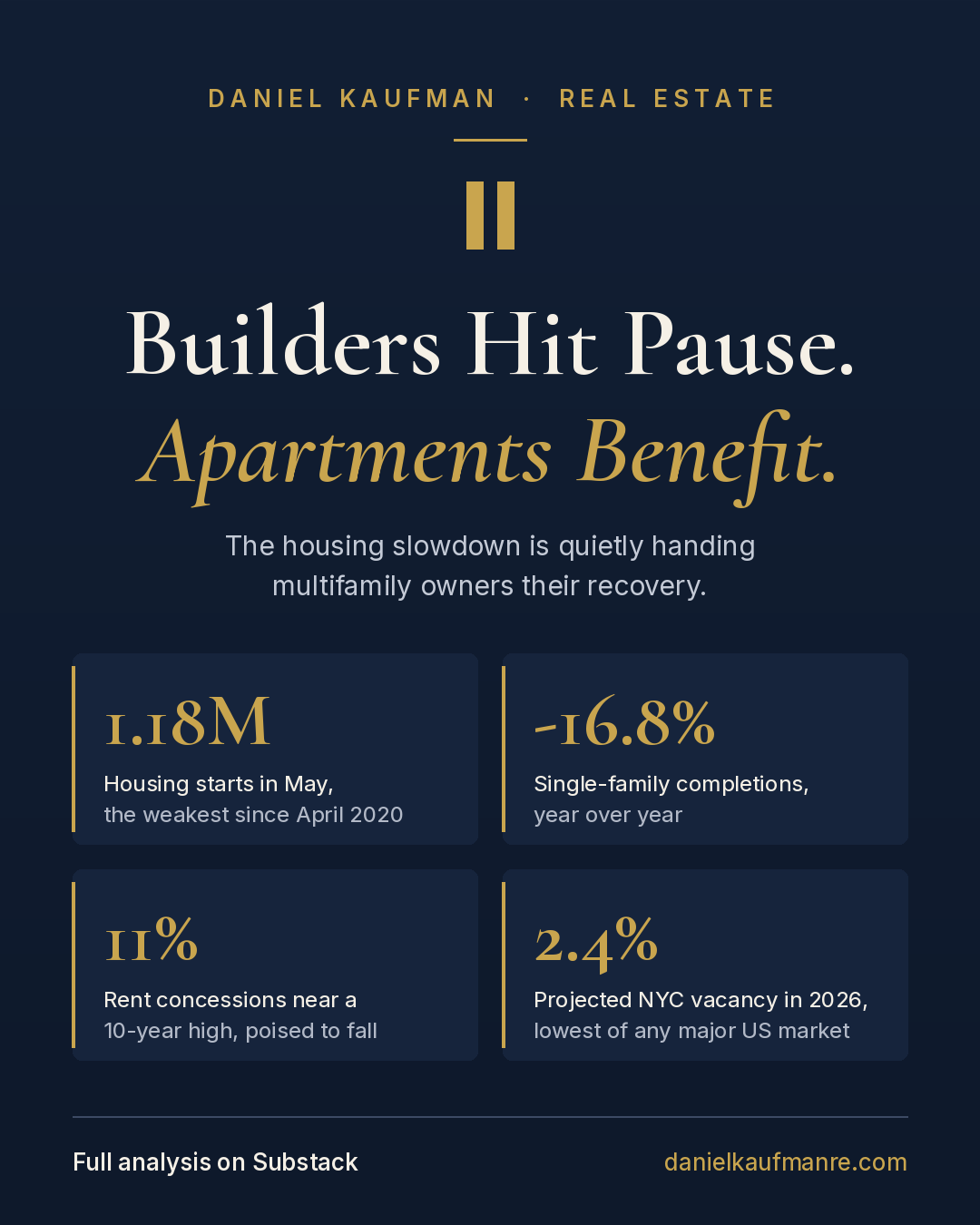
Residential construction is losing momentum in a way we haven’t seen since the early days of the pandemic. Housing starts fell to a seasonally adjusted annual rate of 1.18 million units in May, the weakest pace since April 2020, according to Marcus & Millichap. At the same time, the share of new homes listed for sale but not yet under construction hit a record high.
Read that second data point carefully, because it’s the one that tells you how builders are actually thinking. They’re increasingly moving to build-to-order strategies rather than breaking ground on spec. Delay the start, hold the lot, stay ready to ramp when demand returns. It’s a rational risk posture, and frankly it’s the same discipline I’d want to see from any developer I’m lending to. But the aggregate effect is a thinning supply pipeline.
The demand side explains why. New-home sales fell to a seasonally adjusted annual rate of 580,000 in May, the second-lowest level in three years, while new-home supply climbed to 10.3 months, the highest since mid-2022. Buyers are on the sidelines, builders know it, and nobody is in a hurry to add inventory into that environment.
Single-family completions tell the same story from the other end, down 16.8% year over year in May to their lowest level since mid-2020. Marcus & Millichap expects today’s slowdown to constrain new housing deliveries through at least 2027.
Why Apartment Owners Should Be Paying Attention
Here’s the setup as I see it. Apartment rent concessions are still sitting near a 10-year high of roughly 11%. That’s the hangover from the delivery wave of the past few years, and it’s been painful for operators trying to hold face rents.
But the math changes when the competing supply dries up. Fewer new for-sale homes means fewer renters getting pulled out of the pool, and fewer new deliveries means existing product gets time to lease up. Slower construction today gives operators room to reduce incentives, improve lease-ups, and support healthier rent growth tomorrow. Add more stable interest rates to that picture and investment activity should follow.
This is the part of the cycle where patient capital gets rewarded. The for-sale pipeline is shrinking, multifamily owners finally have room to absorb excess supply, and pricing power starts drifting back toward the landlord. It doesn’t happen overnight, but the direction of travel is clear.
New York: The Case Study in Supply Scarcity
If you want to see what constrained supply does to a market over time, look at New York City.
Marcus & Millichap projects NYC apartment vacancy at just 2.4% in 2026, which would be the lowest rate among major U.S. markets and would extend the city’s streak of sub-3% vacancy to 11 consecutive years. And this is happening despite genuine demand headwinds. Roughly 50,000 residents are expected to leave the city this year, matching 2019 levels, and household formation is projected to decline for only the second time in two decades. The first was during the pandemic.
So why isn’t the market softening? Two reasons.
First, supply. Only about 15,000 units are under construction citywide, the lowest development pipeline in a decade. Deliveries are expected to slightly exceed net absorption, but not by enough to materially loosen conditions. Average effective rents are forecast to climb 2.1% in 2026 to roughly $3,198 per month.
Second, retention. Renewal rates have hovered near 70% in recent quarters, well above the national average of roughly 55%. When tenants don’t move, turnover costs stay low and occupancy stays sticky. That’s an operator’s dream, and it’s structural in New York.
The wrinkle is policy. The Rent Guidelines Board approved a rent freeze covering roughly one million rent-stabilized tenants whose renewals fall between October 1, 2026 and September 30, 2027. For stabilized owners, that means flat revenue against operating expenses that keep rising. I’ve underwritten enough deals to know exactly where that leads: capital rotates toward newer market-rate assets where owners keep pricing flexibility, and the performance gap between stabilized and market-rate product widens further.
The capital markets are already telling you this. Multifamily transaction volume increased 20% during the year ending in March, with activity expanding across all five boroughs, though Manhattan gains were more modest because pricing there continues to challenge acquisitions. For investors, the long-term supply imbalance still outweighs the near-term demographic concerns. I agree with that read.
Los Angeles: Holding Its Footing, Barely
LA is a more nuanced picture, and worth watching precisely because it’s not a clean story in either direction.
Advertised asking rents rose 0.1% on a trailing three-month basis through April, to $2,639, just 10 basis points below the national figure. Modest, yes, but it was the first improvement after five months of contractions, and inflection points matter more than magnitudes. Occupancy for stabilized assets slid 30 basis points year over year to 95.7% in March.
The economic backdrop is the concern. Unemployment stood at 5.1% in March against a 4.3% national figure. Employment growth clocked in at just 0.3% year over year through December, half the national average, and the metro lost 6,700 net jobs in 2025 with only three sectors posting growth. Education and health services carried the load with 45,600 positions added, while professional and business services shed 19,200.
Yet construction momentum hasn’t collapsed. Some 24,121 units were underway in April, with 1,995 delivered in the first four months of the year. And the city keeps investing in itself, with the first section of the D Line extension now open and One Beverly Hills securing $4.3 billion in financing. LA is a market where the fundamentals are sluggish but the long-term bones remain strong. I wouldn’t call it a buy signal, but I wouldn’t write it off either.
The Macro Overlay: A Cooling Labor Market, Not a Breaking One
All of this sits underneath a labor market that just delivered its first downside surprise in months. June nonfarm payrolls rose by only 57,000, well below expectations, and prior months were revised lower. The unemployment rate declined to 4.2%, but the details were less encouraging, because much of the improvement came from a drop in labor force participation rather than stronger hiring.
Here’s the distinction that matters: this is a labor market that’s cooling, not one that’s breaking down. Layoffs remain contained, and overall employment growth is hovering around levels consistent with stability. Markets keep debating whether the economy is simply moderating or sliding toward something worse, and June’s report supports the former.
Treasury yields moved lower immediately after the release as investors trimmed expectations for near-term tightening. But even after the rally, markets are still pricing the possibility of further rate hikes later this year. That tells you everything about where the Fed’s attention remains: the labor market may be losing momentum, but inflation is still the bigger problem.
Chair Kevin Warsh has made that dynamic even sharper. Where previous Fed leadership spent enormous effort telegraphing policy intentions, Warsh has been clear that the committee will weight incoming data over forward guidance. Every major release now carries more market significance because there’s no roadmap to lean on. For those of us pricing debt and underwriting deals, that means more volatility around data days and more premium on staying nimble.
My read: June’s report probably takes a July hike off the table, but one soft payroll print is not a trend, and it won’t outweigh inflation that remains above target, especially with energy markets and geopolitics still capable of creating price pressure.
Pulling It Together
Step back and the picture is coherent. Builders are pausing, which thins the future housing pipeline. The labor market is cooling but stable, which keeps household formation alive without forcing the Fed’s hand. Supply-constrained markets like New York are proving that scarcity beats demographics, while markets like LA show that even soft fundamentals can find a floor when long-term investment keeps flowing.
For multifamily owners and investors, the opportunity is in the lag. The competitive supply that would have hit the market in 2027 and 2028 is being deferred right now, in the spring and summer of 2026. Concessions near 11% won’t last in that environment. Operators who use this window to stabilize lease-ups, tighten operations, and position for rent growth will look smart in two years.
I’ve built through enough cycles to know that the best entries rarely feel comfortable in the moment. This is one of those moments. The builders hitting pause today are, whether they intend to or not, handing apartment owners the recovery they’ve been waiting for.
Data referenced throughout from Marcus & Millichap research and the Bureau of Labor Statistics.