
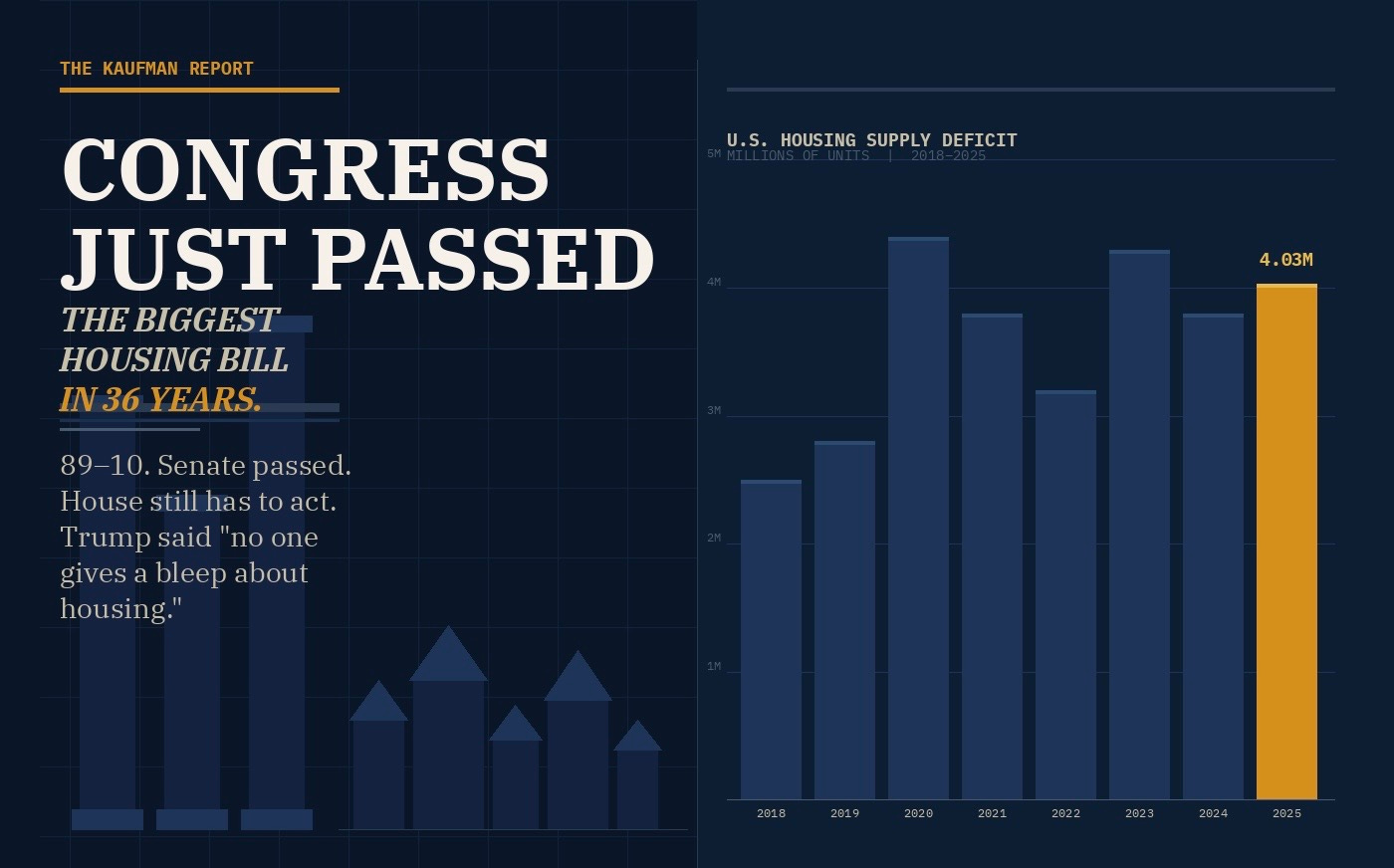
The 21st Century ROAD to Housing Act sailed through the Senate 89-10. Here’s what it actually means — and why the real test is just beginning.
Let me be direct with you: when Tim Scott and Elizabeth Warren agree on anything, you notice. When they co-sponsor the most sweeping housing legislation since 1990 and it passes 89 to 10, you pay attention. And when the President who ran on affordability privately tells House Speaker Mike Johnson that “no one gives a [bleep] about housing” — well, that tells you everything you need to know about the road ahead.
I’ve been building, buying, and financing housing for over 25 years. I’ve watched Congress talk about the housing crisis my entire career. So forgive me if I’m reading this one carefully before I get excited.
Let’s break it down.
The Good: This Bill Actually Gets the Problem Right
The supply crisis isn’t a narrative — it’s a number. The U.S. housing supply gap widened to an estimated 4.03 million homes in 2025, up from 3.8 million the year before, with roughly 1.82 million Millennial and Gen Z households effectively “missing” — unable to form independent households due to cost and scarcity.  That’s not a policy talking point. That’s a generation of people stuck in their parents’ basements and doubled-up apartments while politicians argue about what to do.
Even under an optimistic scenario where construction increases 50% from the 2025 pace and pent-up demand fully dissipates, it would still take approximately seven years to eliminate the current deficit. 
Seven years. Think about that. Even if everything goes right — all the political will, all the capital, all the permits — we’re still a decade away from a balanced market. That’s the scale of what we’re dealing with.
The ROAD to Housing Act at least understands this. The bill focuses on the root cause of rising costs: not enough supply.  It streamlines environmental reviews, modernizes manufactured housing definitions, expands multifamily loan limits, and ties some CDBG funding to actual housing production — meaning localities that aren’t building don’t get rewarded for it. That last piece is something I’ve been advocating for years. Stop paying places to stand still.
The manufactured housing provisions are particularly interesting to me as someone who has been deep in the modular and factory-built space. Expanding the definition so factories can build homes without a steel chassis removes a structural constraint that has kept costs artificially high and innovation artificially slow. Factory-built is the future of attainable housing. The bill nudges that door open a bit wider.
The Complicated: The Institutional Investor Crackdown
Here’s where I want to slow down, because this is the provision that has the industry most divided — and frankly, where the politics are getting way ahead of the economics.
The bill includes a provision requiring large investors who own 350 or more single-family homes to sell after seven years. The intent is clear: stop Wall Street from crowding families out of the homeownership market. I understand the political appeal. I’d be lying if I said I haven’t heard the horror stories.
But the execution is problematic.
While the bill would allow investors to build single-family homes exclusively as rentals, the requirement that builders sell those homes after seven years has drawn criticism — including from some House Republicans — who argue it would make it harder for developers to build new rental housing at a time when the country desperately needs new supply. 
They’re not wrong. About 7% of all single-family construction is built-to-rent. That’s not a rounding error — it’s a meaningful segment of the market, and it’s a segment that serves people who want or need to rent a single-family home: young families, relocating workers, people recovering from credit events. Forcing a mandatory divestiture schedule doesn’t make those homes affordable — it just makes the economics of building them unworkable.
I’m not defending every institutional landlord. Some of these operators have been predatory, and the consolidation in certain markets has been real. But the 350-unit threshold and the seven-year forced sale provision are blunt instruments aimed at a nuanced problem. You end up punishing the guys building new product in Phoenix while doing nothing to address the Invitation Homes portfolio that was assembled a decade ago — because the rule doesn’t apply retroactively.
Senator Schatz was right to call the seven-year provision “a very bizarre thing.” It is.
The Ugly: Washington Being Washington
Let’s be honest about the political reality here.
Trump privately told Speaker Johnson the importance of a separate voting bill — the SAVE America Act — and reportedly said “no one gives a [bleep] about housing” in the same conversation.  That’s your signal. The Senate can pass whatever it wants at 89 votes, but if the White House isn’t genuinely engaged, the House won’t move — and several right-wing members have already said they won’t consider any Senate-passed legislation until the voting bill clears.
Meanwhile, House Democrats are frustrated too, with Representative Maxine Waters signaling the bill would need changes before getting her support , and House Republicans have their own grievances about provisions stripped from the original House version. Rep. Mike Flood of Nebraska, the chairman of the Housing Subcommittee, openly said this “has not been a bicameral effort” — which is not a great sign for conference negotiations.
So here’s where we are: a genuinely meaningful housing bill with some real flaws, passed by a Senate that got a moment of bipartisan religion, now heading into a House where the President is ambivalent, both parties have objections, and an unrelated voting bill is being held as a hostage.
What It Means on the Ground
I want to be careful not to dismiss this entirely, because the supply-side provisions matter — even if they’re imperfect. The environmental review streamlining, the manufactured housing modernization, the FHA multifamily loan limit expansion, the CDBG production incentives — these are real tools that real developers will use if this becomes law.
The housing market is “digging out from more than a decade of underbuilding,” as Realtor.com’s chief economist put it. Without sustained policy action, affordability challenges will continue to sideline buyers indefinitely. 
The average first-time buyer is now 40 years old. I’ve built housing my whole career for people who should have been buyers at 28 or 32. That demographic shift represents a permanent loss of wealth accumulation for an entire generation, and no bill fixes that overnight. But bills like this can shift incentives at the margins — and in a 4-million-unit deficit, margins matter.
If this clears the House in some form, the manufactured housing, NEPA reform, and FHA provisions are worth more to the housing market than the institutional investor provisions are harmful. That’s my net read. The question is whether political dysfunction buries something genuinely useful.
My bet? This gets stuck in the House for months, gets renegotiated, and emerges as something smaller and less coherent — which is the Washington tradition on housing going back to before 1990. But the fact that 89 senators voted for it matters. The politics of housing have shifted. Affordability is no longer a secondary issue — it’s a voting issue, a midterm issue, a kitchen table issue that politicians ignore at their peril.
That pressure doesn’t go away. Even if this bill stalls, the next one will be closer. And the one after that closer still.
Build anyway. The demand isn’t going anywhere.

Daniel Kaufman is a real estate developer and investor with 25+ years of experience across multifamily, mixed-use, workforce, and resort development. He publishes The Kaufman Report on Substack.