
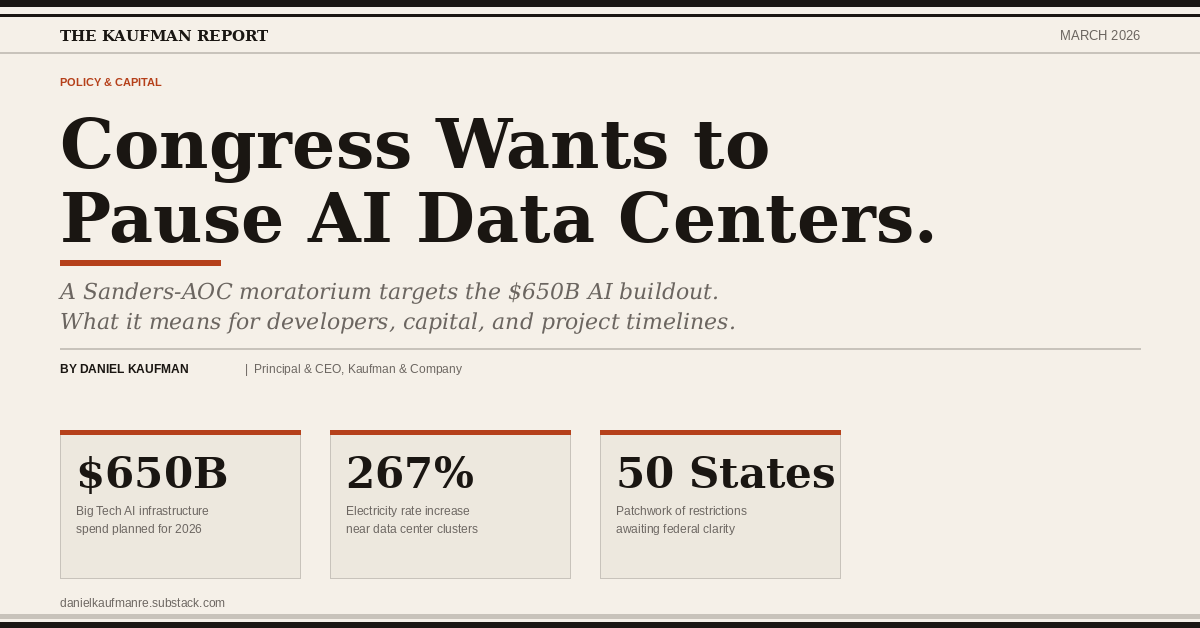
A new Sanders-AOC bill would freeze new data center construction nationwide. Big Tech has $650B riding on 2026. As a developer, I’m watching this closely, and you should be too.
Let me be direct: I’m in the data center business. And I am in the business of reading regulatory risk before it hits project timelines, and what’s unfolding in Congress right now is worth every developer’s attention, regardless of asset class.
Senator Bernie Sanders and Representative Alexandria Ocasio-Cortez have introduced the Artificial Intelligence Data Center Moratorium Act, which would halt all new AI data center construction across the United States until the federal government puts in place safeguards protecting workers, communities, and the environment. That’s not a fringe proposal. That’s a formal bill with two of the most media-visible members of Congress attached to it.
Why This Bill Exists
You can’t understand this legislation without understanding the backlash that’s been building at the local level. Communities sitting next to large data center clusters have seen electricity rates spike, in some cases by 267% according to numbers lawmakers are citing. Water consumption. Noise. Utility grid strain. These aren’t hypothetical concerns manufactured by activists. They’re documented complaints from real constituents in real districts, and elected officials are responding accordingly.
Several states have already moved toward their own restrictions. The federal bill is the natural next step, an attempt to get out ahead of a patchwork of conflicting state rules by establishing a national framework. Whether you agree with the policy or not, the political logic is sound. Regulatory fragmentation creates its own problems for developers and operators. A moratorium at least has the virtue of clarity.
What the Industry Is Actually Doing
Here’s where it gets interesting from a real estate and capital standpoint. Amazon, Microsoft, Meta, and Alphabet are collectively planning to spend more than $650 billion on new digital infrastructure in 2026 alone. That is an extraordinary capital commitment. It doesn’t evaporate because of a Senate bill that may or may not advance through committee. But it does get complicated, and complicated capital timelines are where developers get hurt.
Industry analysts are already tracking the shift toward rural siting and alternative energy sourcing. That’s not altruism. It’s a pragmatic response to opposition and grid constraints in established markets. If you’re a landowner or developer with rural land exposure near power transmission infrastructure, that trend is worth tracking closely. Data center operators don’t want to build in places that hate them. They want willing host communities with stable power and room to scale.
What This Signals for Developers Broadly
We’re living through a moment where two enormous policy forces are colliding in the real estate world simultaneously. On one side, you have the housing shortage debate, Congress and state legislatures debating new legislation that could reshape development pipelines for residential and mixed-use projects. On the other, you have this emerging AI infrastructure buildout absorbing enormous capital, land, and political attention.
The regulatory environment for real estate development is not getting simpler. It’s getting layered. If you’re building anything that touches energy demand, community resources, or federal environmental review, you need to be thinking about this. Not because the Sanders-AOC bill is necessarily going to pass in its current form, it probably won’t, given opposition from industry groups and members worried about stifling American AI competitiveness, but because it signals the direction of political pressure.
The scrutiny on AI data centers’ resource demands is not going away. It will shape site selection, community engagement strategy, and project financing for years. Developers and investors who treat this as a niche tech-sector story are missing the broader read: this is a land use fight, an infrastructure fight, and an energy fight. Those happen to be exactly the fights that define where real estate capital wins and loses.
The Bottom Line
Watch this bill, but don’t overweight it. The more important signal is the political environment it reflects. Local opposition to large-scale infrastructure is intensifying across multiple sectors. Data centers today, distribution warehouses and logistics parks yesterday, dense residential tomorrow. The playbook for getting controversial projects built is evolving — and the developers who adapt their community engagement and energy strategy earliest will have the cleaner path to entitlement and delivery.
This is 2026’s version of a problem I’ve seen in every major development cycle: the rules change mid-game. Your job is to know which way they’re moving before everyone else does.

Daniel Kaufman is a real estate developer and investor with 25 years of experience across multifamily, mixed-use, workforce housing, and resort development. He writes The Kaufman Report to cut through media noise with ground-level analysis from an operator’s perspective.