
THE KAUFMAN REPORT
Distressed Office Is Finally Trading. Here’s Where I’m Looking this Morning.
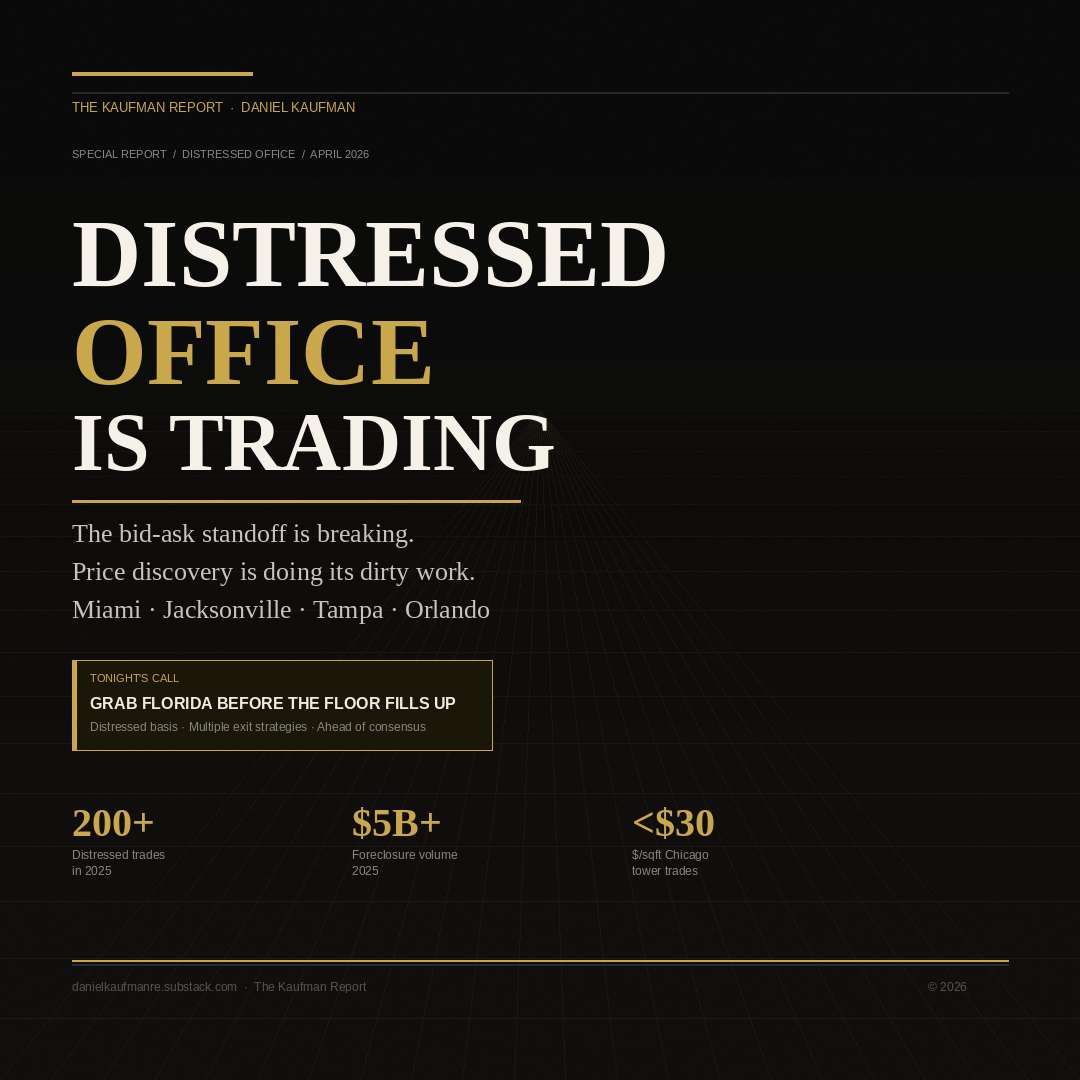
The bid-ask standoff is breaking. And for investors paying attention, the window is open.
After years of sellers holding at fantasy valuations and buyers refusing to blink, distressed office trades are actually moving. More than 200 distressed office properties changed hands in 2025 — foreclosure and bankruptcy-driven transactions alone cleared $5 billion. Early 2026 is already running hotter. Buildings that had nine-figure price tags are trading at fractions of those levels. Downtown Chicago towers under $30 a foot. Denver and D.C. assets at prices nobody would have said out loud a decade ago.
This is price discovery doing its ugly, necessary work. And I’m watching it closely.
New York: Converting Its Way Through the Mess
Manhattan has a playbook now. Buy cheap, convert to residential, collect.
David Werner has turned it into a repeatable strategy — picking up older office product at steep discounts, his latest Hell’s Kitchen deal closing at roughly a third of its 2018 price. Nathan Berman’s Metro Loft and Idan Ofer’s Quantum Pacific are in contract on 1 Whitehall Street for just over $100 million, heading toward a rental conversion after Chetrit got foreclosed out. RXR’s $500 million recapitalization of 55 Broad alongside Silverstein and Metro Loft tells you something important: institutional capital is now comfortable stepping into stabilized post-conversion assets.
The conversion thesis has legs in New York. Zoning, density, and residential demand give it structural support. Not every market can say that.
Not Every Buyer Needs a Conversion Plan
Igal Namdar just paid $280 million for ESRT’s 250 West 57th Street. No conversion thesis. No repositioning narrative. Just an opportunistic buyer who looked at midtier office product with real income, a dramatically lower basis, and enough room for upside to justify the hold.
That’s a different kind of play — and it’s valid. Not every distressed office deal needs to become apartments. Sometimes the math works if you’re patient and you bought cheap enough.
Chicago and LA: Deepest in the Hole
Chicago is where the discounts get uncomfortable. Sales are distress-driven, vacancy is still climbing, and conversions haven’t moved the needle on shrinking demand. If you’re buying there, you need conviction on a very long runway or a very specific asset.
LA is grinding through a wave of legacy debt defaults, pushing large assets into deeply discounted trades with no clear timeline for resolution. That’s not necessarily a reason to stay out — but it’s a reason to be very precise about what you’re buying and why.
South Florida Is Still Sitting on Its Hands
The region has slowed down. Buyers waiting on rate clarity and broader macro visibility. South Florida office remains attractive in theory — but selective in practice. That hesitation creates opportunity for buyers willing to move while others are still watching.
Which brings me to today’s call.
Florida Is My Next Pick for Investors
I’ve been watching this setup develop, and I’m telling you directly: tonight, I’m looking at distressed office in Florida.
Miami. Jacksonville. Tampa. Orlando.
Here’s why now: South Florida and the broader Florida market are in that early-innings phase where the deals are starting to appear but the crowd hasn’t arrived yet. You’re buying ahead of the consensus, at basis levels that leave room — real room — for multiple exit strategies. Conversion, long-term hold, repositioning. The flexibility is in the pricing.
Miami’s office market has supply constraints that don’t exist in Chicago or LA. Jacksonville and Tampa have workforce and population dynamics that support eventual re-tenanting or residential conversion. Orlando has hospitality-adjacent demand that gives repositioning optionality most Midwest markets can’t match.
The window won’t be open forever. Distressed trades are doing the market’s dirty work — establishing floors, unlocking frozen deals, and giving buyers with different playbooks a reason to engage.
Get in before the floor gets crowded.

Daniel Kaufman is the Principal & CEO of Kaufman & Company, a vertically integrated real estate development and investment firm based in Los Angeles. The Kaufman Report is published on Substack.