
I have been doing this since 1992. I have watched three separate media cycles declare the American mall finished. Time magazine did it in 1998. The trade press did it again in the mid 2000s. Then Amazon showed up and an entire content industry got built on the corpse, drone footage of empty food courts, dead mall channels with millions of views, the whole thing. Somewhere in there, “the mall is dead” stopped being an argument and became a background assumption, the kind of thing a reporter can put in a subordinate clause and nobody asks for a citation.
Here is what nobody was doing while the obituaries piled up. Nobody was building new ones.
This is the same pattern I wrote about with the Rust Belt markets and with the K shaped rent roll. The narrative and the data separate, the narrative gets louder because it is emotionally satisfying, and the gap between what a thing is worth and what people believe it is worth becomes the entire opportunity. I do not get paid to hold the popular opinion. I get paid to price the asset correctly.
Start with the actual numbers
Green Street’s September index is the one to read, not the headline about it.
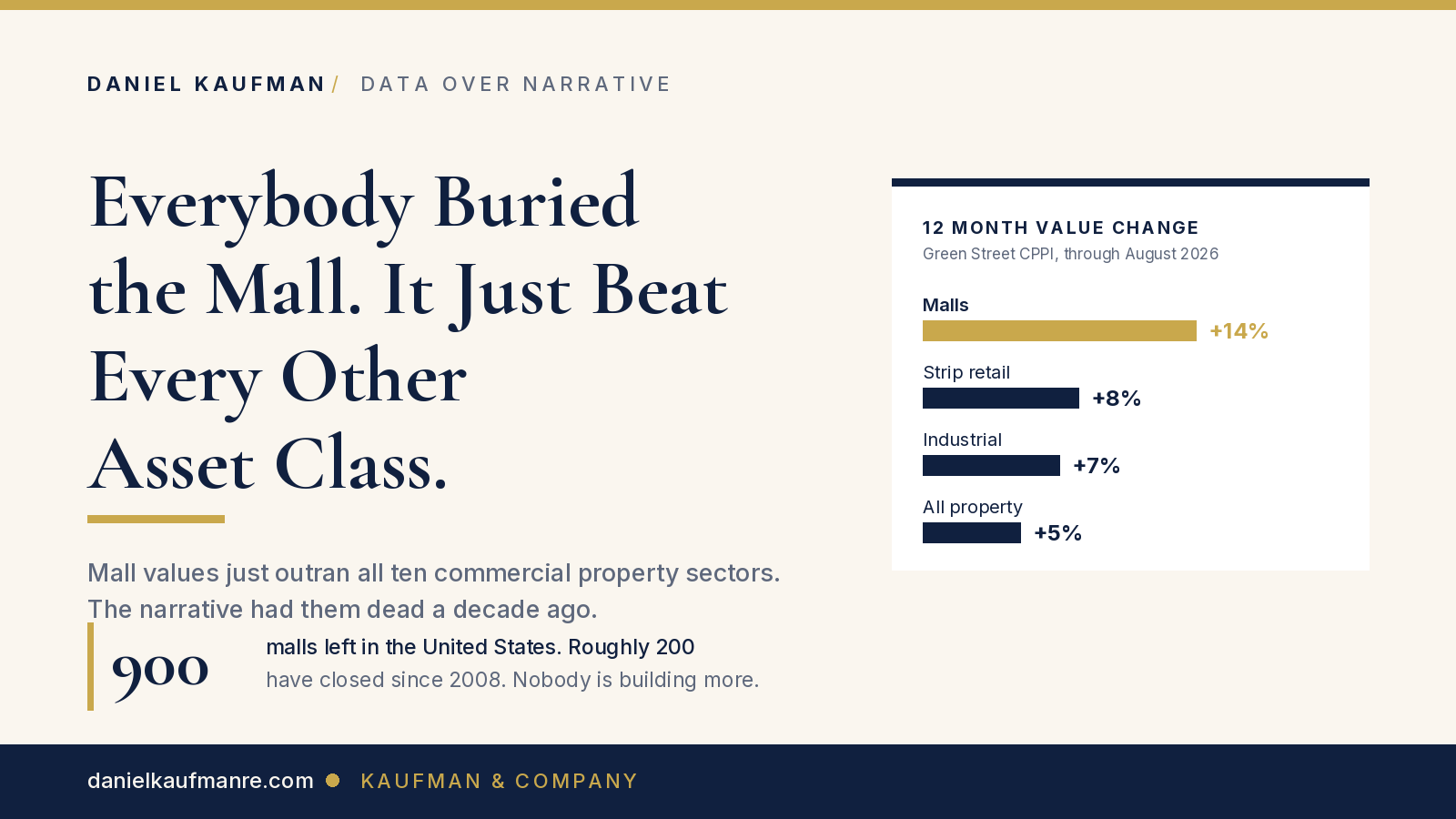
Mall values rose 2.5 percent in August alone and roughly 14 percent over the trailing twelve months. Set that against the rest of the table:
– All property index, up 0.8 percent in August, up 5 percent for the year, still roughly 13 percent below its 2022 peak.
– Industrial, the sector every institution crowded into, up 0.6 percent in August, up 7 percent for the year, still 8 percent below peak.
– Strip retail, up 2.1 percent in August, up 8 percent for the year, essentially back to peak.
– Health care, up 3.1 percent in August.
– Office, still the anchor dragging the aggregate down.
The two sectors at the top of that table are the two that spent a decade being described as structurally impaired. The sector at the bottom was considered the safest institutional allocation in America in 2019.
The equity market got there first, as usual. Simon Property Group’s stock passed its prior record high in July for the first time since 2016 and has beaten the S&P over the past twelve months. Morgan Stanley’s Ronald Kamdem told the Journal this is the best the mall fundamentals have felt since Covid.
One honest caveat that the Journal includes and most of the coverage of the coverage will drop. Mall values are still far below where they peaked a decade ago. Being 6 percent above the 2022 mark is not the same as a full recovery, and anyone quoting the 13 percent without that context is selling something.
Why the narrative was wrong
The Journal actually names the mechanism in one line, and it is worth stopping on, because it is the entire thesis. Occupancy and rent growth held up in retail in large part because there was no new supply.
That is it. That is the whole thing.
No new indoor megamall has been built in this country since 2019. Roughly 200 malls have closed since 2008, leaving about 900 operating nationwide, per Green Street. Subtract inventory for fifteen straight years, hold demand anywhere above zero, and price goes up. That is not a retail insight. That is the same arithmetic I run on every workforce housing deal I underwrite, and it is why I keep saying that the supply curve tells you more about the next ten years than any sentiment survey ever will.
Two other things the story gets right.
The mall” was never one asset class.
It is at least three. Class A centers in affluent trade areas are running vacancy near 5.6 percent. Class B is closer to 9 percent. The bottom tier is land with a roof on it. Averaging those together and calling the result an asset class is how you get a decade of bad analysis. And the part that matters most for anyone deploying capital right now is that the recovery has moved past the trophy assets. Middle market centers are posting occupancy and sales growth too.
The capital that quit is coming back and paying up.
Unibail Rodamco Westfield announced four years ago that it was leaving the United States. It is now committing close to a billion dollars this year to buy out its partners at Westfield UTC in San Diego and Westfield Southcenter, taking full control of both. Its chief executive describes rent growth he has not seen since the start of the 2010s. That is not a contrarian value buyer. That is an institution paying retail to rebuy the exposure it dumped at the bottom. When that shows up in print, you are no longer early.
The deal that tells the real story
Forget the index. The instructive item in the piece is CBL’s West County Center in St. Louis, because it is a financing story, and financing is where I live.
In 2022, that 1.2 million square foot mall had debt coming due into a market where lenders had blacklisted midtier malls as a category. CBL could not refinance it. Value down 30 percent over the prior decade. Vacancy climbing. Three of the four prime restaurant spaces sitting empty. A competing mall pulling sales away from its Nordstrom.
Today tenant sales are up 13 percent since 2023, the competitor’s Nordstrom closed instead, Macy’s put money into its store, Cheesecake Factory and Urban Outfitters are opening, and CBL expects to close the refinancing inside 60 days.
Nothing structural changed about that building. What changed is that the lenders who had priced it as a category finally priced it as an asset. CBL itself is the broader version of the same story. It went through bankruptcy after the pandemic, walked away from or sold more than two dozen malls since 2013, and has bought five properties since July of last year. Its stock is up 48 percent this year.
That is the trade in one sentence. The people who were forced sellers in 2021 are buyers in 2026, and the spread between those two dates was created entirely by narrative.
Where the opportunity actually is
The trade is not “buy malls.” The window on A quality product is largely closed, and the arrival of URW writing billion dollar checks is the tell. Here is where I still see room.
The dirt.
Bob Neighoff at Mariner is the skeptic in the article, and his skepticism is the most useful line in it. In his words, unlocking the dirt is the true value of the mall, and he is cautious about hanging a thesis on the retail experience itself. I agree with him completely, and that is a bullish position, not a bearish one. A dead or dying mall is 40 to 80 acres at the best signalized intersection in a first ring suburb, with water, sewer, road capacity and parking already built and paid for by somebody else in 1974. I do not underwrite that as retail. I underwrite it as entitled land with existing infrastructure and a cash flowing carry while I entitle the rest.
Anchor box recapture.
A vacant department store is 120,000 square feet of structure you can cut into smaller boxes at a multiple of the prior rent. The public REITs have spent three years proving out that math with sporting goods, fast fashion and grocery backfill. Private owners who cannot fund the capital to execute it are your sellers.
Mixed use conversion, which is really a housing play.
Close to half of mall redevelopments now carry a mixed use component and a growing share is straight residential. Vallco in Cupertino is the cleanest example, a mall that fell to 24 percent occupancy, demolished, now entitled under state housing law for more than 2,600 units including 890 affordable. That is not a retail story. That is a workforce housing story sitting on a retail basis. This is where I am spending real time, because it solves the problem I actually care about, which is getting units in the ground near jobs at a cost basis that supports attainable rent.
The debt.
Plenty of these assets still carry loans underwritten to a narrative the data has now falsified. West County Center is the template. Lenders who marked retail down as a category rather than asset by asset are holding paper worth more than their own risk committee believes, and borrowers with good real estate are still paying a category penalty to refinance it. I would rather write that credit than bid against ten buyers for a trophy center.
And the discipline to pass.
The Journal’s caution is the right one. Owners who filled dead anchors with entertainment and restaurants have taken on tenants that are genuinely hard to replace if they go dark. The bottom tier is still the bottom tier. A center in a shrinking trade area with no anchor, no daytime population and a four million dollar deferred maintenance number is a demolition project you are paying retail for. Anyone selling you the sector rather than the asset is selling you something.
The part that actually transfers
I do not really care about malls as a category. I care that this happened again.
An asset class acquires a narrative. The narrative is emotionally clean, it explains something real that did happen, and it gets repeated until it is treated as a closed question. Capital exits. Supply stops. The underlying cash flow quietly stabilizes. Then eight or ten years later a value index prints a number that makes the front page and everybody acts surprised, including the institution that sold at the bottom and is now buying back in at a billion dollars a pop.
It happened with Detroit, where I started in 1992. It happened with the Midwest markets I have been buying in while the consensus said the growth was all in the Sun Belt. It is happening right now in the mountain towns I work in, where the story is that workforce housing does not pencil, told mostly by people who have never run the sheet.
Read the index, not the headline about the index. Underwrite the asset, not the category. The crowd is usually right about what already happened and almost always wrong about what happens next.
About the Author

Daniel Kaufman is the founder and CEO of Kaufman & Company, a private investment and holding firm active in real estate development, venture investment and infrastructure. He has more than 25 years of experience building, lending and investing across housing markets in the Mountain West, Texas, Florida, Vermont and the Northeast, with a focus on workforce housing and employer anchored development. He has led investment across seven equity funds representing more than 2 billion dollars in property investments and the financing or development of more than 10,000 housing units.
Reach him at Daniel@kaufmanredev.com or at https://www.danielkaufmanre.com
*Sources: Kate King, “Malls Were Left for Dead. Now They Are the Top Performer in Commercial Real Estate,” The Wall Street Journal, September 14, 2026; Green Street Commercial Property Price Index, September 2026; Coresight Research; Simon Property Group, Macerich and CBL Properties disclosures.