
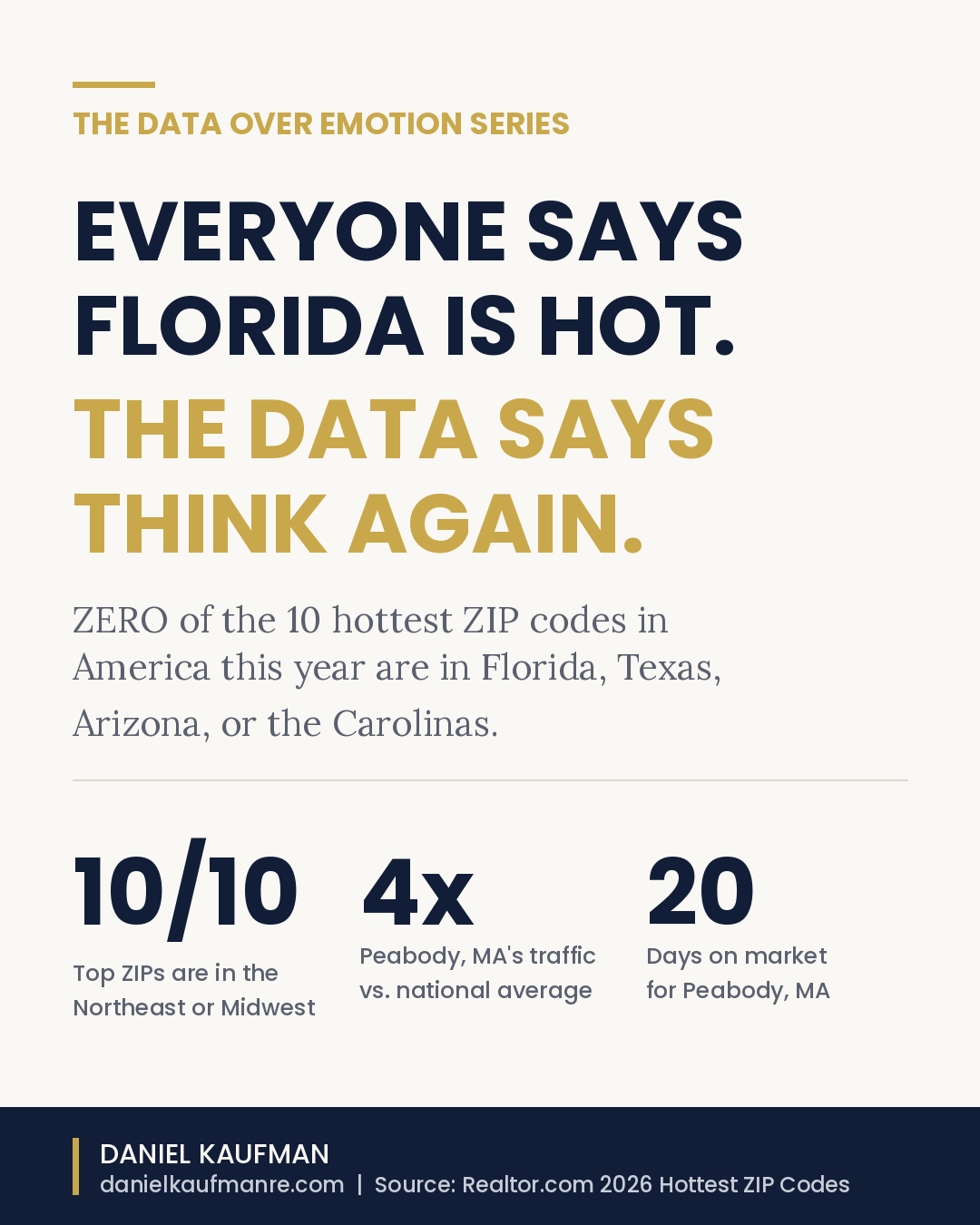
It’s a good story. It’s also increasingly not true, and the newest national data makes the gap between the narrative and reality impossible to ignore.
I’ve spent this whole year pushing back on that story with data, not vibes, and the 2026 numbers just handed me the clearest proof yet.
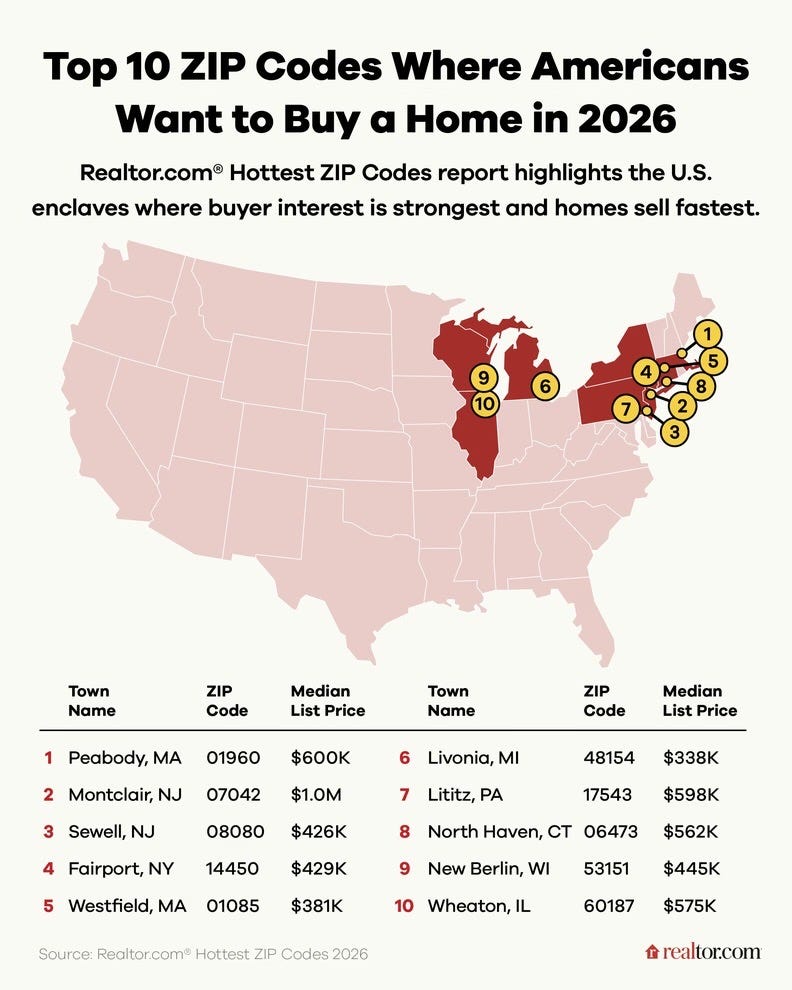
Realtor.com just released its annual Hottest ZIP Codes ranking, and the list should embarrass anyone still repeating the Sunbelt migration story uncritically. Every single one of the top 10 ZIP codes sits in the Northeast or Midwest. Not one is in Florida, Texas, Arizona, or the Carolinas. That’s not a coincidence, it’s structural. These are markets where buildable land is scarce and zoning is restrictive, so supply can’t stretch to meet demand the way it can in Sunbelt sprawl. Constrained supply plus real job hubs equals sustained pricing power. I’ve been saying this for months.
Peabody, Massachusetts
The number one ZIP in the country this year is Peabody, MA, 01960, a city of about 55,000 people twenty minutes outside downtown Boston. Peabody built its name in the 1800s as a leather tanning capital, the “Tanner City,” and today its commercial anchor is the Northshore Mall. Not a glamorous pitch on paper. But the data doesn’t care about glamour.
Listings in Peabody pulled more than four times the national average of unique viewers per property in the first half of 2026, and homes sold in about 20 days versus the national norm. Median asking price is $667,000, which sounds steep until you compare it to the Boston metro average north of $800,000, a 20 percent discount. And Boston is the single biggest source of demand for Peabody, accounting for 70 percent of buyer traffic. This isn’t outside money discovering a hidden gem. It’s people who already live and work in Boston deciding they’d rather buy a bigger, more characterful home twenty minutes away than keep competing in the city itself. That’s about as strong a vote of confidence in a metro’s staying power as you can get.
New York buyers show up too, accounting for nearly 9 percent of Peabody’s out of market traffic, which tells you something about how far Northeast job market gravity extends.
The rest of the list looks the same
Montclair, NJ. Sewell, NJ. Fairport, NY. Westfield, MA. Livonia, MI. Lititz, PA. North Haven, CT. New Berlin, WI. Wheaton, IL. Every one of them is a suburban enclave sitting in commuting range of a major job center, New York, Philadelphia, Chicago, Boston, and every one of them is priced above its surrounding metro, with Peabody as the lone exception.
That last point matters more than people realize. Nine of the ten hottest ZIP codes in the country are priced at a premium to their own metro. Buyers aren’t chasing the cheapest option on the map. They’re paying up for space, character, and a real commute to a real job hub. That’s a fundamentally different buyer than the one the Sunbelt growth story assumes. It’s someone with capital already in the market, often drawing on existing home equity rather than starting from scratch, who has decided proximity and quality of life are worth the premium.
Why this matters for how I’m allocating capital
This is the same argument I’ve made around the Southern Squeeze, just from the other side of the ledger. Sunbelt affordability has been eroding as population growth outpaces the infrastructure and housing stock built to absorb it. Meanwhile the Northeast and Midwest get written off in the same breath as “declining,” “high tax,” “no growth,” when the actual demand data says buyers, especially buyers who already live in these metros, are voting with their wallets for exactly these markets.
I’m not saying the Sunbelt story is fake. Plenty of those markets have real fundamentals. What I am saying is that the mainstream narrative has gotten lazy, and lazy narratives create mispriced opportunity. Constrained supply markets with strong local job bases and buyers who understand the metro from the inside are exactly where I want to keep putting capital to work, and it’s exactly why our workforce housing and infill strategy has leaned this direction all year.
Follow the data, not the feed.

Daniel Kaufman is the founder and CEO of Kaufman & Company, a private investment and holding firm spanning real estate development, private credit, venture investment, and infrastructure. He writes about housing markets, workforce housing, and where the data actually points at danielkaufmanre.com.
Questions or deal ideas, reach him at Daniel@kaufmanredev.com