
In three weeks, Florida voters decide on Amendment 3, the proposal to raise the homestead exemption from $50,000 today to $150,000 in 2027 and $250,000 in 2028. Governor DeSantis says it would wipe out property taxes for roughly 60% of Florida homeowners. On a campaign flyer, that looks like a clear win. On a development pro forma, it looks like a problem.
I build and invest in Florida. I underwrite land, entitlements, infrastructure, and rental housing here, and every one of those deals depends on local governments that work. So when I look at Amendment 3, I’m not asking how much my neighbor saves. I’m asking who pays for the roads, the sewer lines, the schools, and the fire stations that make a piece of land worth building on. Right now, nobody has a good answer.
The hole is real, and it’s big
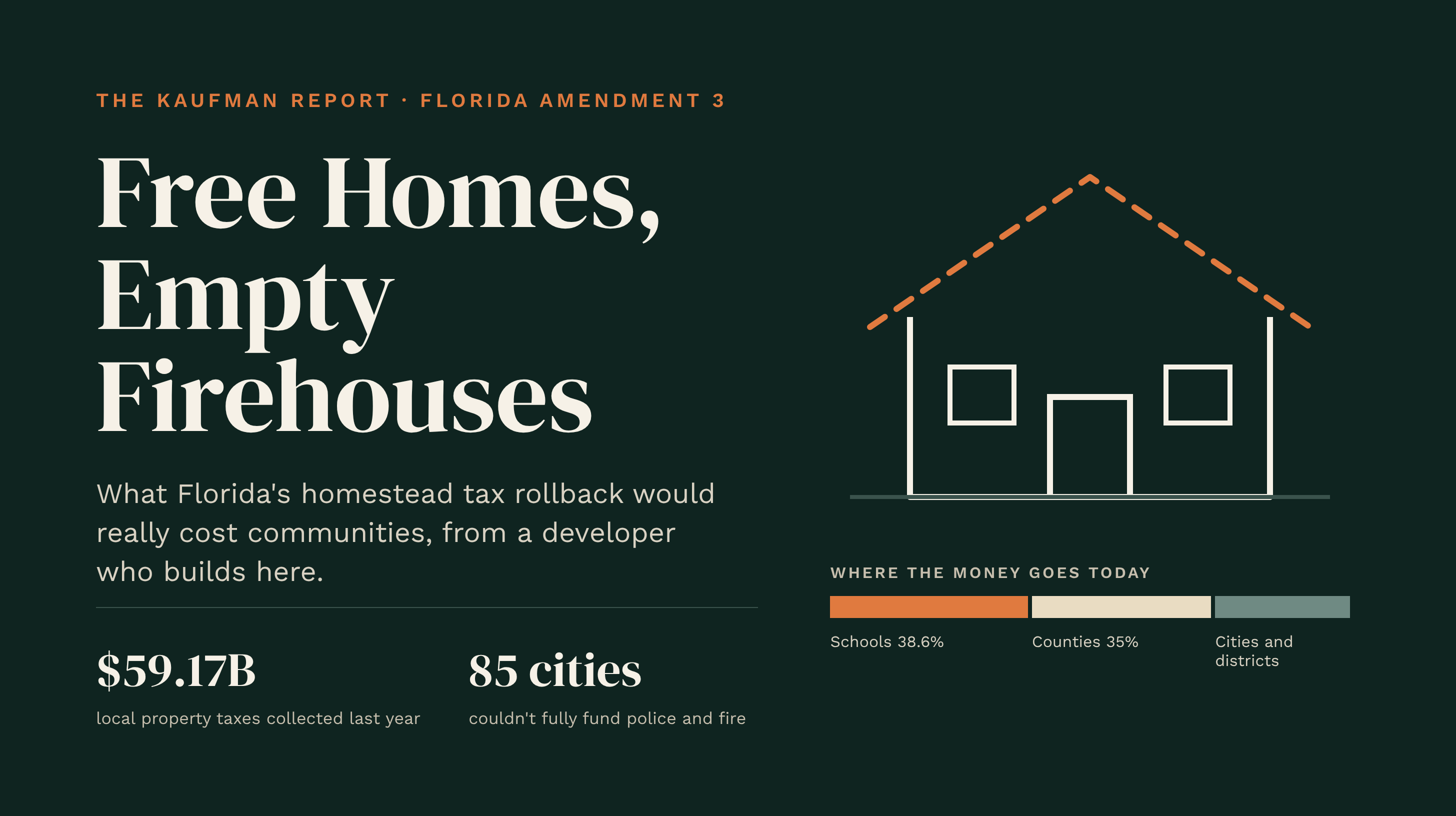
Homestead property makes up about a third of the property tax revenue that funds local government in Florida. Last year, cities, counties, schools, and special districts collected $59.17 billion in property taxes, up from about $32 billion in 2019, and the state projects $83 billion by 2032. According to the Florida Chamber of Commerce, school boards took the largest share, $22.83 billion or 38.6%. Counties took $20.68 billion, about 35%. Cities and special districts split the rest.
Shrink a revenue source that size and the cuts don’t land on abstract line items. They land on people.
The Florida League of Cities found 85 cities, including Pensacola, Fort Myers, and Key West, could not fund public safety at current levels even if they eliminated every other service paid for by property taxes. That isn’t a budget trim. That’s a city choosing between a fire engine and a police patrol.
Both candidates for governor see the gap. Republican nominee Byron Donalds supports reform but has called for a way to replace what police and fire departments would lose, and he hasn’t said what that is. Democratic nominee David Jolly has turned against the measure, saying the math probably doesn’t work, and he’d rather see a first time homebuyer exemption. When firefighters and police come out against a tax cut, I pay attention.
The bill doesn’t disappear, it moves
This is what concerns me most as someone who builds rental housing. When homestead owners stop paying, pressure shifts to everyone who isn’t homesteaded: apartment owners, single family rental owners, retail centers, offices, hotels, and second homes.
In practice, that means renters. Property tax is an operating expense, and it shows up in the rent.
Florida already has a workforce housing shortage. Teachers, nurses, deputies, hotel staff, and young families mostly rent. Amendment 3 gives a tax break to people who already own and quietly raises costs on people who can’t afford to buy yet. Every workforce rental deal I look at gets harder to make work when the tax line goes up, and when deals don’t pencil, they don’t get built.
Growth still has to be paid for
Florida adds people every year, and new neighborhoods need water plants, sewer capacity, roads, and schools. A big share of that is carried by the local property tax base. Shrink the base and local governments do the predictable things: raise impact fees, slow approvals, push more infrastructure cost onto developers, and pass on projects they can’t service.
All of that ends up in the price of a new home. The irony is that a measure sold on affordability could make new housing more expensive to deliver.
Higher prices, fewer listings
Realtor.com estimates that eliminating property taxes would lift Florida home values 7% to 9% almost immediately, adding $200 billion to $250 billion in total value. Its senior economist, Joel Berner, points out that makes homes less affordable for first time buyers. Great news for anyone who already owns. Bad news for the young nurse trying to buy her first condo in Orlando.
I also expect it to deepen the lock in effect. If your tax bill drops to zero, you have one more reason never to sell. That means fewer listings, less turnover, and tighter inventory.
Then add the five year residency requirement for new arrivals. You end up with a two tier system where the people moving here, the same people who have powered Florida’s growth, pay full freight while longtime owners pay little or nothing.
Somebody still pays
If the money has to come from somewhere, the realistic options are higher sales taxes, new fees, or deep service cuts. Neil Schiller of Government Law Group has warned that a sharply higher sales tax would hurt tourism and widen the gap between the wealthy and everyone else. Tourism is the backbone of this economy, and sales taxes hit working families hardest. Taxing visitors and renters so homeowners with paid off houses can pay nothing isn’t reform.
Schiller makes another point I agree with. People don’t come to Florida only for the weather. They come because local governments built places worth living in. Cut those services and you change the product.
It doesn’t touch the real cost problem
Ask Florida homeowners what’s squeezing them and property tax usually isn’t first on the list. It’s insurance and HOA fees. Florida sits at the center of the national property insurance crisis and has some of the highest HOA fees in the country. Amendment 3 does nothing about either.
MidFlorida Credit Union estimated in 2024 that the average Florida homeowner pays about $2,338 a year in property tax. That’s real money, but for a lot of owners the insurance bill is bigger, and it keeps climbing.
Uncertainty is its own cost
Amendment 3 needs 60% to pass, and Florida Chamber CEO Mark Wilson has said that will be hard to reach. But this doesn’t end on Election Day. Donalds has said he’ll push to eliminate homestead property taxes whether the amendment passes or fails, and the state’s Tax and Budget Reform Commission could come back with a new proposal in 2028.
For anyone underwriting long term projects here, that means years of not knowing what local governments can spend, or what tax load rental and commercial property will carry. Capital prices in that uncertainty. Communities pay for it in projects that never start.
What I’d rather see
I’m not against property tax relief. I’m against relief with no replacement plan. I’d rather see targeted help for first time buyers, real insurance reform, and any homestead expansion tied to a funded plan, so a city like Fort Myers never has to choose between its police and its firefighters.
If you’re buying
An agent in Austin who has watched homestead exemptions play out in Texas put it well: the question buyers rarely ask is where the missing revenue comes from. When small counties trim services or shift the load onto commercial and nonhomestead owners, the neighborhood changes, even if your own bill went down. Her advice is to weigh the exemption against your specific property and street over ten years, not the headline number.
I’d go one step further. A neighborhood is only as good as the services behind it. A lower tax bill on a street with weaker schools, slower emergency response, and roads nobody can afford to fix isn’t a deal. It’s a discount on a declining asset.