
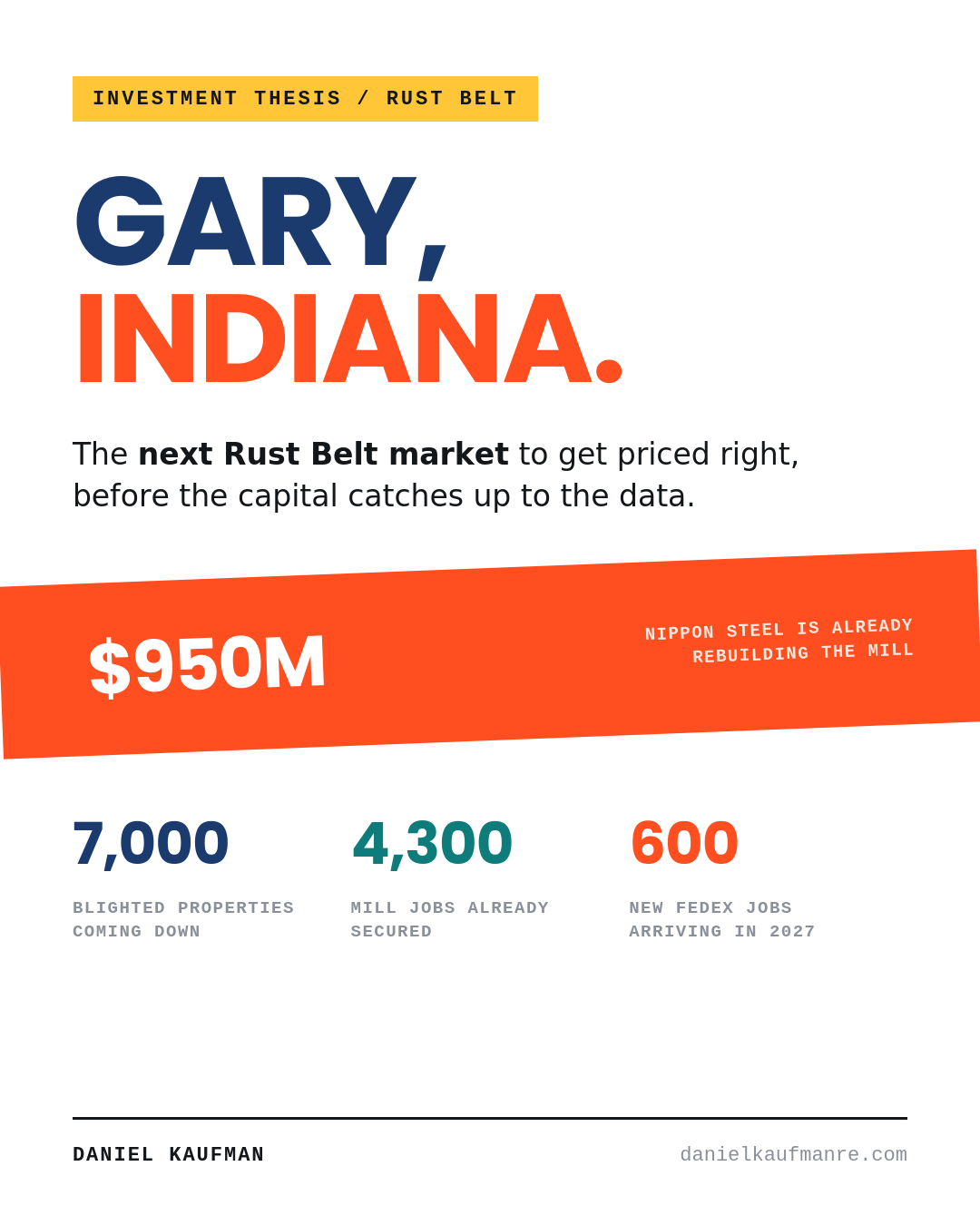
That is not a metaphor. It is the literal first move in an $80 million blight elimination campaign targeting 7,000 abandoned homes and businesses across a city that has lost more than half its population since its 1960 peak of 180,000. A downtown convention center is coming down. A crumbling church is coming down. City Hall calls it clearing the way for the future. I call it the most underpriced setup I have seen in a Rust Belt market in years, and I have been watching this playbook since Detroit ran it a decade ago.
The Detroit Parallel Is Not a Coincidence
When Eddie Melton became mayor of Gary in 2024, he called Detroit’s Mike Duggan for advice. Duggan’s answer was not glamorous. Fix the streetlights first. Repave the roads. Give residents something they can see and feel before you ask them to believe in anything bigger. Melton fixed nearly 1,000 broken streetlights and doubled the city’s paving budget. Then he ramped up demolition, funded by state and city dollars plus a $3 million grant from the Hard Rock Casino that opened on Gary’s outskirts in 2021.
This is the exact sequence Detroit ran under Duggan: infrastructure first, demolition second, private capital third. Detroit is not a cautionary tale anymore. It is a completed case study in what happens when a city clears the runway and lets the market land.
The Data Has Already Turned
Here is what the headlines about a shrinking steel town will not tell you. Gary’s population decline has slowed to 2.6% from 2020 to 2025, a fraction of the collapse the city saw in prior decades. Violent crime and homicides have plummeted. Median household income sits at $38,731, about half the Indiana median of $71,957, and roughly a third of the city lives below the poverty line versus 12% statewide. That gap is not a warning sign to me. It is the arbitrage. Underpriced labor and underpriced real estate sitting next to a market, Chicago, that is an hour’s commute away.
Jamillah Taylor just bought a refurbished three bedroom in Gary for $146,000. She works nights as a patient care technician making about $63,000 a year. Her sister told her the neighborhood looked rough on paper. It was not. “There are people here, they are thriving, they are working in the mills,” Taylor said. A few blocks over, home builder David Sutor moved from Chicago because he saw the opportunity screaming at him. He has rehabbed seven homes and bought twenty empty lots. A new four bedroom he just finished sold for $273,000.
The Anchor Capital Is Already Committed
This is not a speculative story riding on hope. Nippon Steel, which now owns U.S. Steel, has begun investing $950 million to upgrade the Gary mill that still employs 4,300 people, and it has pledged to restart a tin mill on site that will add 225 more jobs. FedEx is opening a 300,000 square foot distribution center next year projected to create 600 jobs. That is real, committed, non-speculative capital from two of the largest logistics and industrial names in the country, landing in a market still priced like it is 1985.
Grassroots Proof of Concept, Already Working
Seven years ago, a local contractor named Jim Wiseman rallied his construction company and others in the community to donate excavators and crews. Since then they have torn down 115 blighted homes with volunteer labor alone, and it triggered a wave of organic renovation on the surrounding blocks. Wiseman called it a chain reaction. That is the small scale, unfunded version of what the $80 million campaign is about to do at city scale. If volunteer demolition can spark private renovation, funded demolition backed by a real master plan should do it faster and bigger.
The Master Plan Is Real, and It Has an Address
Gary brought in architects from Notre Dame to design the comeback, and the plans are specific, not aspirational. A new train station on the Chicago rail line, partly financed through $90 million in state matching funds, connected to a 60-mile lakefront biking and hiking trail. Housing blueprints for vacant lots that any builder can pull and use to speed construction. And a redevelopment plan for the corner of Fifth Avenue and Broadway downtown, renovating two existing buildings and constructing three new ones for apartments, retail, and office space.
Mayor Melton put it plainly: that intersection is going to determine a lot about whether the rest of this works. “We have to show the market that the city is able to sustain itself and prop itself up economically.” Developers have already started circling those buildings. That tells me the window on getting in ahead of the market is not open indefinitely.
Data Over Emotion
I do not invest on feeling and I do not wait for a market to become obvious. I invest where the data has already turned and the capital has not caught up yet. Gary has stabilizing population, falling crime, funded and executing blight removal, a real master plan with an anchor institution behind it, and two of the largest logistics and industrial employers in the country putting nine figures of capital on the ground. That combination, in a Rust Belt city this early in its cycle, is exactly the setup I have built a career on finding first.
Follow the data, not the feed. Gary is next.
Daniel Kaufman