
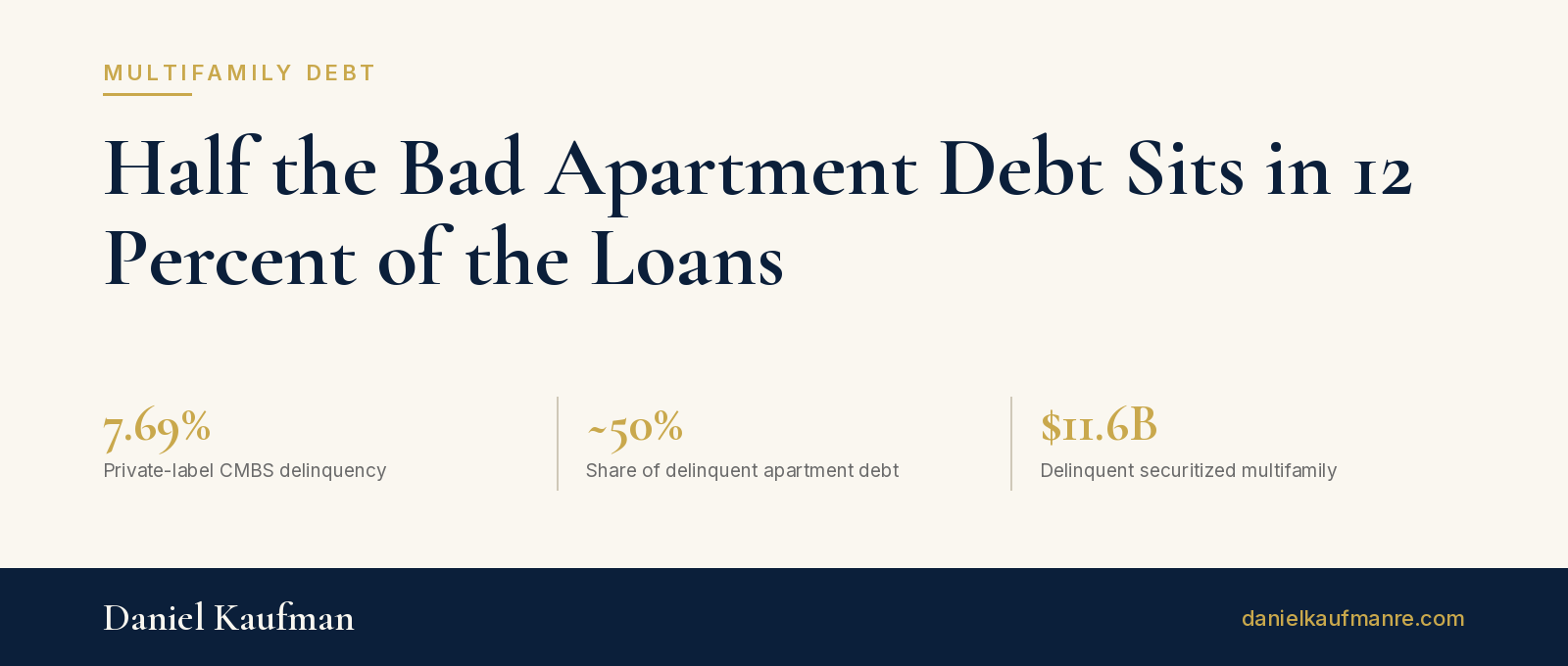
Multifamily distress has a location problem, and it is not the one most people assume. CRE Daily reported this week on Trepp’s August data for securitized apartment debt, and the headline is striking: private-label CMBS now carries about half of all delinquent multifamily debt while holding only about 12 percent of the outstanding balance.
Here is the scale. Trepp tracks roughly $635.8 billion of securitized multifamily debt. About $11.6 billion of it is delinquent, up from $7.04 billion two years ago. Private-label CMBS accounts for about $75.5 billion of that balance, and its delinquency rate has more than doubled in two years, from 3.30 percent to 7.69 percent. Freddie Mac, which holds about 82 percent of the tracked total, sits at 0.80 percent. CRE CLOs, the home of floating rate transitional loans, actually improved, falling from 6.05 percent to 3.88 percent.
Read that quickly and you would conclude the bridge lending problem fixed itself while conduit loans fell apart. I don’t read it that way, and neither does Trepp.
The CLO number is partly a structure story. As CRE Daily laid out, CRE CLO managers can pull defaulted or impaired loans out of their pools, and they have a reason to, because a failed overcollateralization test can divert cash away from equity and junior noteholders. A private-label trust generally cannot do that. So the conduit bucket shows its distress in full, while the CLO bucket can move some of its problems off the scoreboard. Same apartments, different window dressing.
The vintage data makes the point sharper. Over two years, CLO exposure to pre-1980 buildings fell by more than half, from $16.2 billion to $6.8 billion, while post-2000 construction rose from $19.2 billion to $28.5 billion. Private-label went the other way, with pre-1980 exposure climbing from $20.4 billion to $29.1 billion. The older, harder to operate stock is concentrating in the structure that cannot quietly shed it.
This is the K shaped economy showing up in apartment debt. On the top leg sit newer, agency financed buildings with fixed rate debt and tenants who can absorb increases. On the bottom leg sit older Class B and C properties, often carrying debt sized on peak rents and peak valuations, serving renters whose wages have not kept up. The tenants in those buildings are the workforce. When those properties fail, the cost is not only a markdown for a bondholder. It is deferred maintenance, rising vacancy, and a slow loss of the naturally affordable housing that nobody can replace at today’s construction costs.
Where I see opportunity: private-label special servicing is where older workforce apartments are most likely to change hands at real prices. Buyers with patient, fixed rate capital and a genuine operating plan for older buildings, not just a spreadsheet plan, are positioned to acquire at a basis that works for the rents those neighborhoods can actually pay. Operators who know how to run a 1970s garden complex will matter more than allocators who know how to model one.
Where I see the downfalls: first, the CLO improvement may be flattering. If impaired loans are being pulled rather than resolved, the stress has not disappeared, it has moved somewhere less visible. Second, Freddie’s rate is low, but its past due balance nearly doubled, from $2.29 billion to about $4.2 billion. A small percentage of a very large book is still real money. Third, with long rates staying high, refinancing an older asset out of a conduit loan is not getting easier. Anyone underwriting a quick rescue refinance is underwriting hope.
What I am watching: whether private-label delinquency keeps climbing, how many loans CLO managers buy out or modify over the next few quarters, and whether Freddie’s past due balance keeps compounding. If all three move the wrong way at once, the discount on older workforce apartments gets deeper, and buyers with clean capital get paid for their patience.
Data over emotion. The headline says distress is falling in one bucket and rising in another. The structure says it is the same problem, with better accounting in one of them.
If you own or lend on older apartment assets and want a sober look at capital structure, a workout path, or the feasibility of a rescue plan, that is the work we do at Kaufman Real Estate & Consulting: https://www.kaufmanrealestateandconsulting.com
About the Author
I’m the founder and CEO of Kaufman & Company, a private investment and holding firm working across real estate development, venture investment, and infrastructure. My focus is workforce housing and employer-anchored development, including mountain resort communities through Oldivai.
Reach me at Daniel@kaufmanredev.com or find more at danielkaufmanre.com.
Sources
Multifamily Delinquency: Private-Label CMBS Holds Half, CRE Daily, October 16, 2026, https://www.credaily.com/briefs/multifamily-delinquency-private-label-cmbs-holds-half/