
I’ve been watching this number for a while, and I want to be direct about what it means. This isn’t a Miami story. It’s a New York story that’s playing out through Miami’s balance sheet.
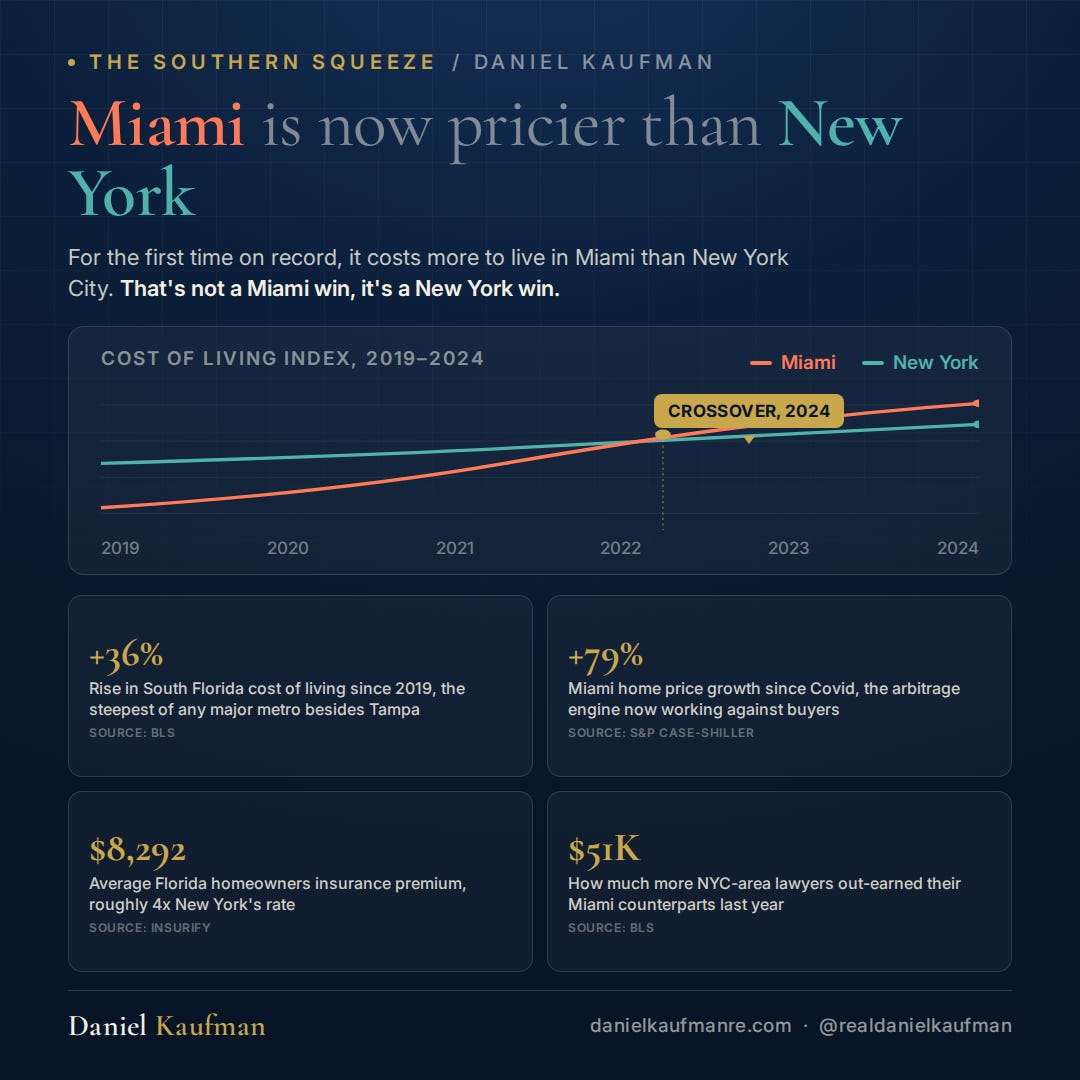
The trade that built “Wall Street South” was never really about Miami. It was about arbitrage. Move south, keep your income, pay less to live, pay less in taxes. That trade is closing, and closing trades don’t just stop working, they start working in reverse.
The numbers tell the story
South Florida’s cost of living is up 36% since 2019, per the Bureau of Labor Statistics, the steepest jump of any major metro outside Tampa. Total cost of living in Miami now tops New York’s, according to the Bureau of Economic Analysis’s 2024 comparison, with housing running roughly 5% higher across the Miami, Fort Lauderdale, Palm Beach metro.
I want to sit on that for a second. Housing was supposed to be the arbitrage. It’s now the thing erasing it.
Miami home prices are up 79% since Covid, per S&P Case Shiller. Buyers still get more physical space for their money, $357 a square foot in Miami versus $537 in New York, per Realtor.com. On paper that looks like the trade still works. It doesn’t, because the carrying costs eat the discount.
Florida homeowners insurance averaged $8,292 last year, per Insurify, roughly four times New York’s rate. Miami property taxes are up 62% since 2019, more than double the national average, per Attom. You can buy more square footage in Miami, but you’re renting it back every year through your insurance premium and your tax bill.
The squeeze doesn’t stop at the closing table
Daily costs are climbing too. Restaurant spend in Miami hit $94 per diner, up 4% year over year per OpenTable, against $79 in New York. Meanwhile wages haven’t kept pace. Professionals in Miami generally earn less than their New York counterparts doing the same work.
That gap holds even at the top of the income ladder. New York area lawyers out earned Miami lawyers by roughly $51,000 last year, per BLS data. Miami’s median household income sits about $1,000 below the national figure, per the Census Bureau. This isn’t a market where the middle is catching up. It’s a market where the middle is getting squeezed out of the trade entirely.
Why this is good for New York
Here’s my thesis, and it’s the reason I wrote this post. Miami getting more expensive doesn’t just hurt Miami, it actively helps New York.
The entire Wall Street South narrative depended on a cost gap wide enough to justify the disruption of moving a firm, a family, or a fund. Close that gap and you remove the primary reason to leave. New York doesn’t have to win on lifestyle, weather, or taxes anymore, it just has to hold still while Miami’s costs rise to meet it. Every point of that arbitrage that disappears is a point of leverage New York gets back without lifting a finger.
I think this is the part people are missing. They’re watching Miami’s growth headlines, the population numbers, the tower cranes, and reading it as Miami’s win. But growth built on a cost gap is only as durable as the cost gap. When the gap closes, the capital and the people who came for the gap don’t have a reason to stay that a spreadsheet would recognize. Some will stay for the weather and the lifestyle. Fewer will stay for the math.
What I’m watching
Headline rents get all the attention, but they’re not the real leading indicator here. I’m watching insurance renewals and property tax assessments. Those are the line items that move fastest and hit hardest, and they’re the ones quietly doing the work of closing this trade.
If the math in Miami only pencils for eight figure earners, that’s a much smaller pool of capital to underwrite a growth story against. A city can still be desirable at that price point. It just can’t be an arbitrage play anymore, and arbitrage was always the engine under “Wall Street South.”
Miami didn’t lose its appeal. It lost its discount. Those are two very different things, and only one of them was ever the reason people moved.
Daniel Kaufman is the founder and CEO of Kaufman & Company. Reach out at Daniel@kaufmanredev.com