
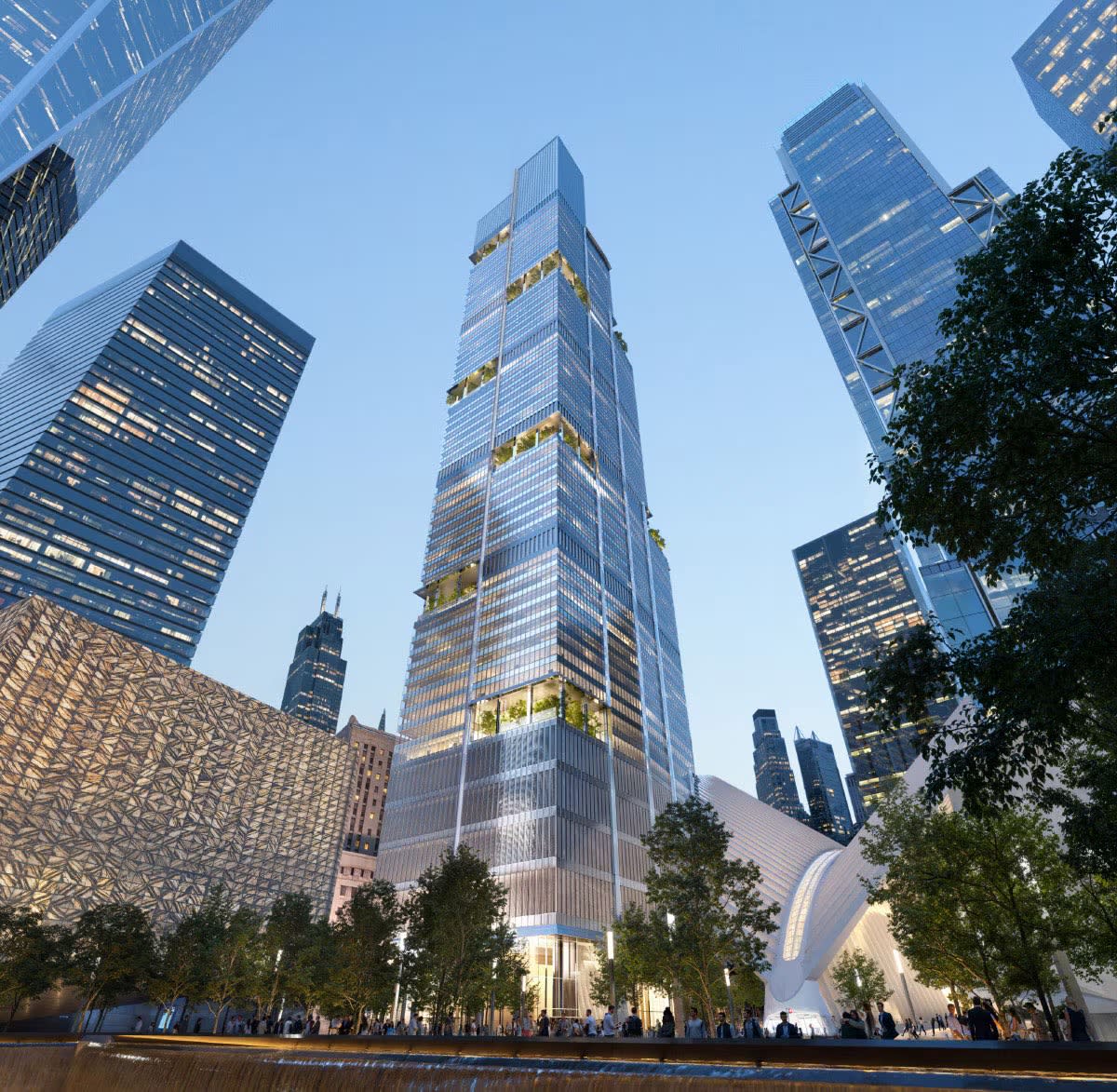
A 55-story, nearly 2-million-square-foot headquarters for 10,000 employees. In Lower Manhattan. Not Miami. Not Dallas. New York City.
You’ve heard the narrative. Corporate America is fleeing high-tax, high-cost blue states for the sunbelt. Companies are relocating to Florida and Texas. New York is dying. The talent is leaving. The office market is finished.
American Express didn’t get the memo.
This week, Amex announced it’s building a brand new global headquarters at 2 World Trade Center — a 55-story, 1,226-foot tower spanning nearly 2 million square feet, designed to accommodate up to 10,000 employees. They’re not leasing space in someone else’s building. They’re owning the whole thing. Construction starts this spring, with a move-in date of 2031.
Let that sink in for a second. One of the world’s largest financial services companies just made a multi-billion dollar, decades-long bet on New York City.
Why This Matters More Than the Headlines Suggest
The business media has spent the better part of five years breathlessly covering every corporate relocation to Miami or Austin. Goldman Sachs executives buy condos in Palm Beach. Citadel moves its headquarters to Brickell. Ken Griffin buys a lot of real estate in Florida. The narrative writes itself: finance is leaving New York.
Except the data has never fully supported the story, and deals like this one make that clearer than ever.
The financial sector, the technology sector, and the creative industries that cluster around them are not leaving New York. They’re consolidating in trophy assets in New York. JPMorgan Chase just opened its newly built global headquarters at 270 Park Avenue. Now American Express is building from the ground up at the World Trade Center. These are not the moves of industries in retreat. These are the moves of industries doubling down on the most talent-dense, infrastructure-rich urban environment in the Western Hemisphere.
There’s a reason for that, and it isn’t sentiment. It’s economics. You cannot replicate New York’s labor pool, its university system, its transit infrastructure, or its cultural density in Dallas or Miami — not in five years, probably not in twenty. When you are competing globally for the best financial analysts, software engineers, and creative professionals, geography still matters enormously. New York wins that competition in ways that no sunbelt city currently can.
The World Trade Center Story Is Also Worth Telling
This deal closes a chapter that has been two decades in the making.
Larry Silverstein — now 94 years old — took on the rebuilding of Lower Manhattan after September 11th as something close to a personal mission. He’s delivered 7 World Trade, 3 World Trade, and 4 World Trade. The Oculus opened. One World Trade became the tallest building in the Western Hemisphere. The Perelman Performing Arts Center opened in 2023. And 2 World Trade Center, the last office tower on the 16-acre campus, has sat unbuilt — waiting for the right anchor tenant to make the economics work.
American Express is that anchor. And with it, one of the most ambitious urban reconstruction projects in American history is finally complete.
Silverstein Properties CEO Lisa Silverstein put it plainly: “I can’t imagine a better partner to complete the World Trade Center campus than American Express, an iconic institution embodying the strength, resilience, and global significance of the project.”
The building itself is worth noting. Foster + Partners is the design architect. It will be fully electric, pursuing LEED certification, with more than an acre of outdoor terraces and gardens. It’s the kind of trophy asset that defines a skyline and signals to your workforce — and your competitors — that you’re building for the long term.
What This Means for Lower Manhattan Specifically
Lower Manhattan has been on a genuine transformation trajectory that doesn’t get nearly enough attention. Since 2001, its residential population has grown from 32,000 to over 70,000. The number of hotels has gone from six to over 40. The tenant base at the World Trade Center alone now includes Spotify, Uber, and Condé Nast alongside the financial incumbents. Office leasing volume in 2025 posted its strongest year since 2019.
This is not a dying neighborhood. This is a neighborhood that rebuilt itself from literal rubble and is now adding a 55-story, nearly 2-million-square-foot headquarters building for one of America’s most iconic financial brands.
The development will create over 2,000 union construction jobs during the build, contribute an estimated $5.9 billion to the New York City economy, and $6.3 billion to New York State overall. Those are real numbers, and they flow downstream — to subcontractors, to restaurants, to transit, to the local tax base.
The Takeaway for Investors and Developers
If you’ve been underweighting New York because of the relocation narrative, this is a good moment to revisit that thesis.
The flight-to-quality trend in commercial real estate is real, and New York is one of its primary beneficiaries. Well-capitalized tenants — the ones who can actually afford to build or lease trophy assets — are concentrating in the best buildings in the best markets. New York, Boston, and San Francisco are capturing that demand at the top of the market even as secondary and tertiary office assets continue to struggle everywhere.
The office market is bifurcating sharply. Class A trophy assets in gateway cities are performing. Everything else is not. That dynamic isn’t going to reverse anytime soon, and it creates real opportunity for investors and developers who understand which side of that divide they’re operating on.
American Express just told you where they think the future is. It’s at 200 Greenwich Street, Lower Manhattan, New York City.

Daniel Kaufman is a real estate developer and investor with 25+ years of experience operating nationally. He writes about real estate markets, investment trends, and development from the ground level.