
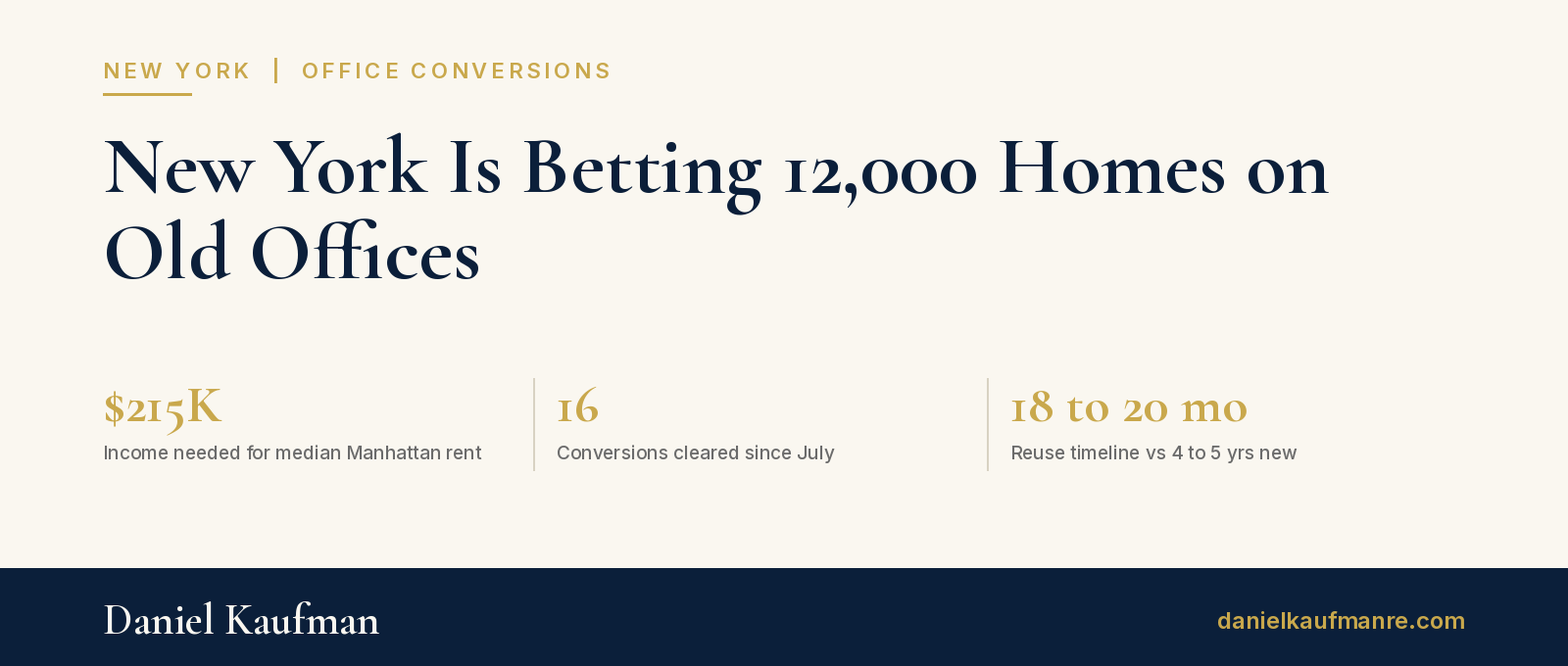
In July, two support columns gave way inside the former Pfizer headquarters in Manhattan, under floors that had just been added to the top of the building. Six floors sagged, nearby blocks closed, and the city’s busiest conversion pipeline went quiet. CRE Daily reported this morning that the pipeline is moving again. Buildings Commissioner Ahmed Tigani says the city has cleared 16 more conversions to start construction since the accident, and work has resumed at 222 Broadway and 750 Third Avenue.
That matters more than it sounds, and the reason sits in a different report that landed the same week.
Realtor.com’s latest New York City Rent Report puts Manhattan’s median asking rent at $5,375 a month in the third quarter, up 8.3% from a year earlier. Under the 30% rule, that takes about $215,000 a year in household income. Realtor.com notes the Census Bureau puts Manhattan’s median household income at $106,403. Citywide, the median asking rent hit a record $3,785, now 27.5% above pre pandemic levels, and rents for studios through two bedrooms rose 7.1% in a year.
This is the K shaped housing economy compressed into one borough. At the top, a Brooklyn broker told Realtor.com that wealthier clients are borrowing against their portfolios and skipping conventional mortgages entirely. At the bottom, renters are staying put because moving means a bigger rent check, and that frozen turnover squeezes the market further. The middle, the nurses, teachers, cooks and junior staff the city runs on, is being priced out of the place where the jobs are.
Why conversions are the fastest lever
The only durable answer to that math is more units, and in New York the binding constraint is not demand. It is time and land. Conversions shortcut both. CRE Daily points to a BH3 Management and Capstone Equities venture turning a never leased 24 story Brooklyn office tower into apartments in 18 to 20 months, against four to five years for a ground up building. The site is already assembled, the structure already stands, and comparable one bedrooms nearby rent for about $5,000. When the timeline is cut by more than half, the math can absorb a lot of cost.
The capital is showing up too. Northwind Group provided a $219 million construction loan for the 463,000 square foot conversion of 100 Wall Street, and its founder says the firm has funded two more with two Midtown loans in progress. The Mamdani administration is counting on conversions for up to 12,000 homes.
Where I see the opportunity
First, the Pfizer scare reset what diligence means, and the sponsors and lenders who take structure seriously will win. Adding new floors onto an old frame is where the risk concentrated. Projects that reuse the envelope without stacking new load should move through review faster and price better.
Second, the raw material is coming to market under pressure. CRE Daily counts $733.2 billion of commercial real estate debt maturing in 2027, and in September only 12.79% of maturing office CMBS loans paid off on time. Older towers in locations where office demand is not coming back will trade at prices that let a conversion pencil.
Where it breaks down
Rates and costs are the first problem. CRE Daily says higher rates, costlier construction and tighter lender scrutiny are already slowing deals, and its market snapshot had the 10 year Treasury at 4.999% at Tuesday’s close.
The second problem is that the office recovery is real at the top. Midtown availability is back near its March 2020 level, so owners of good buildings will keep leasing rather than convert. The candidates left are the harder ones, and as the CRE Daily piece notes, the easy towers will not last forever.
The third problem is the product. Conversions mostly deliver studios and one bedrooms at market rents near $5,000. That relieves pressure at the top of the K and filters down slowly. It does not house a household earning $106,000 unless incentives require income restricted units, and those incentives shape what gets built.
What I am watching
I am watching whether approvals catch back up to the first half pace, whether the 1,600 unit tower at the former Pfizer site restarts within weeks as MetroLoft expects, whether construction lenders keep writing checks with the 10 year near 5%, and how many of these projects include income restricted units.
The July collapse was a reason to tighten engineering, not to stop building. A city where the typical Manhattan renter needs twice the median income cannot afford a paused pipeline.
If you are weighing an adaptive reuse project or a stalled conversion and want a hard look at feasibility, structure and the capital stack before you commit, that is the work we do at Kaufman Real Estate & Consulting: https://www.kaufmanrealestateandconsulting.com
About the Author
I’m the founder and CEO of Kaufman & Company, a private investment and holding firm working across real estate development, venture investment, and infrastructure. My focus is workforce housing and employer-anchored development, including mountain resort communities through Oldivai.
Reach me at Daniel@kaufmanredev.com or find more at danielkaufmanre.com.
Sources
New York’s Office-to-Apartment Conversions Restart After the Pfizer Scare, CRE Daily, October 28, 2026, https://www.credaily.com/newsletters/national/issue/new-yorks-office-to-apartment-conversions-restart-after-the-pfizer-scare/
Manhattan Renters Now Need To Make $215K To Afford the Typical Apartment, Realtor.com, October 27, 2026, https://www.realtor.com/news/trends/nyc-rent-manhattan-income-required-q3-2026/