
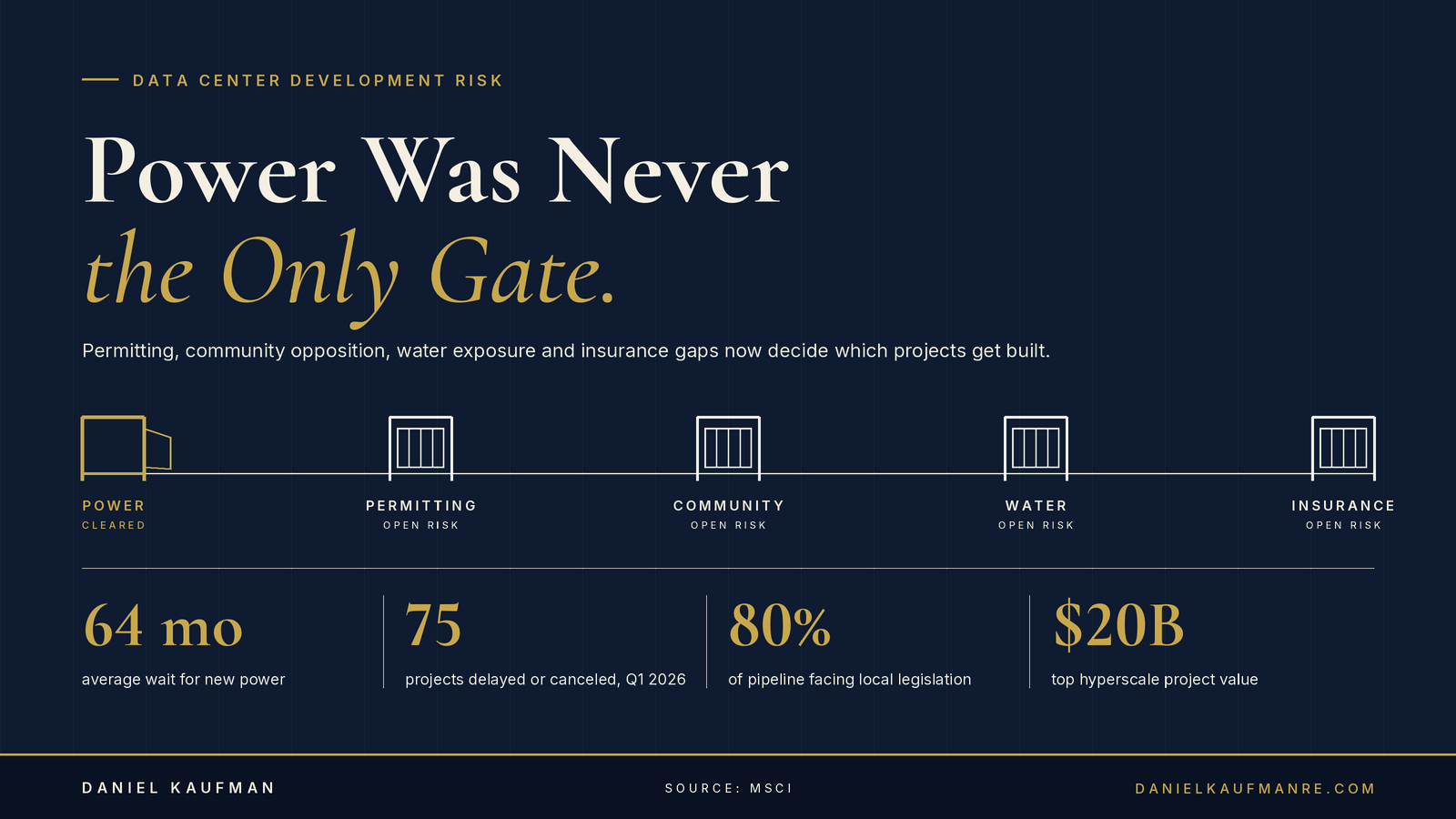
Everyone in this business talks about power like it’s the whole game. Get the megawatts, and the rest is paperwork.
MSCI’s new review of US data center development says otherwise, and it matches what I’ve seen on the ground. Power is the first gate. It is not the last one.
The scale changed faster than the system
MSCI estimates the AI buildout could require up to $5.2 trillion in data center investment by 2030, and 70% of the world’s data center capacity under construction sits in the US. When most of the global pipeline lands in one country, execution risk stops being a national story and becomes a county story.
The facilities themselves got enormous. The median data center went from 11 MW in 2016 to 130 MW by June of this year. Meanwhile, the average wait for new power in regions with data center development is 64 months. That’s more than five years of carrying costs before a single server turns on.
So developers are going around the grid: small modular reactors, long duration batteries, new gas plants. I understand the logic. But MSCI makes a point I’d underline twice. Going on site trades one risk for another. First of its kind technology can miss its commercial readiness dates, and conventional generation runs into the same shortage of transformers, switchgear and turbines everyone else is chasing. You didn’t escape the queue. You joined a different one.
The county commission is now the real gatekeeper
MSCI counted at least 75 US projects delayed or canceled in the first quarter of 2026 alone, equal to the total for all of 2025. More than half the projects in development sit in counties that have seen a prior withdrawal or passed data center specific rules. Roughly 80% of the pipeline is in jurisdictions with active or pending data center legislation, 14% face pending moratorium decisions, and another 12% sit in places with upcoming elections that could rewrite the rules.
What caught my attention is how the objections have shifted. A year ago, opposition talked in broad environmental terms. Now it’s specific: water use, zoning, what this does to my electric bill, what this does to the grid. Those are pocketbook questions, and pocketbook questions are much harder to answer with a glossy rendering and a jobs estimate.
I’ve sat in those hearings. Neighbors aren’t irrational. They’re looking at a windowless box the size of several football fields, a water draw they can’t picture, and a developer who won’t be around after the ribbon cutting. If you can’t answer those concerns directly, you don’t have a project. You have a land position.
Water is the risk nobody priced
MSCI identified 365 planned or under construction data centers near rivers and found 50 of them, about 14%, exposed to both water scarcity and low river flow, concentrated in Texas, Illinois, Oregon and Georgia. Securing power does nothing for you if your cooling plan depends on a river that runs thin in August.
Insurance didn’t scale with the projects
This is the one I’d watch most closely as a lender. Project values have gone from roughly $150 million to as much as $20 billion for a hyperscale campus, and the insurance market hasn’t kept pace. When coverage falls short, the gap doesn’t vanish. It lands on the developer and the lender, who end up holding catastrophe, outage and delay risk they never meant to underwrite.
What this means for underwriting
The lesson for investors and lenders is simple: stop treating power as the only gating item. Underwrite the site. Energy procurement, local relationships, water exposure, physical hazards and insurance all overlap, and a project that solves one of them can still die on another.
How we’re approaching it
I’m not writing this to pitch anything, but it would be incomplete to talk about these risks without saying how we think about them in our own work.
With ServerDomes, the design goes after several of these problems at once. Cooling uses a fraction of the water of a conventional facility, which takes the river question largely off the table. Power is planned behind the meter from day one rather than as a fallback. The modular build shortens the timeline and keeps the equipment list manageable. And the geodesic form changes the conversation in the hearing room. In Utah, when the community saw a dome instead of a big box, the permitting discussion changed.
Our micro data center project takes the opposite approach to the hyperscale trend: go small. Smaller loads can fit within existing grid capacity instead of waiting years in an interconnection queue. A smaller footprint is easier for a community to accept, easier to site away from stressed water basins, and easier to insure because the replacement value stays within what the market will actually cover.
Neither one makes risk disappear. Nothing does. But both start from the question MSCI is now asking everyone: not just can you get power, but can you get this built, here, with these neighbors.
The opportunity in this sector is real. The winners won’t be the ones with the biggest megawatt number in the press release. They’ll be the ones who underwrote every gate, not just the first one.
About the Author
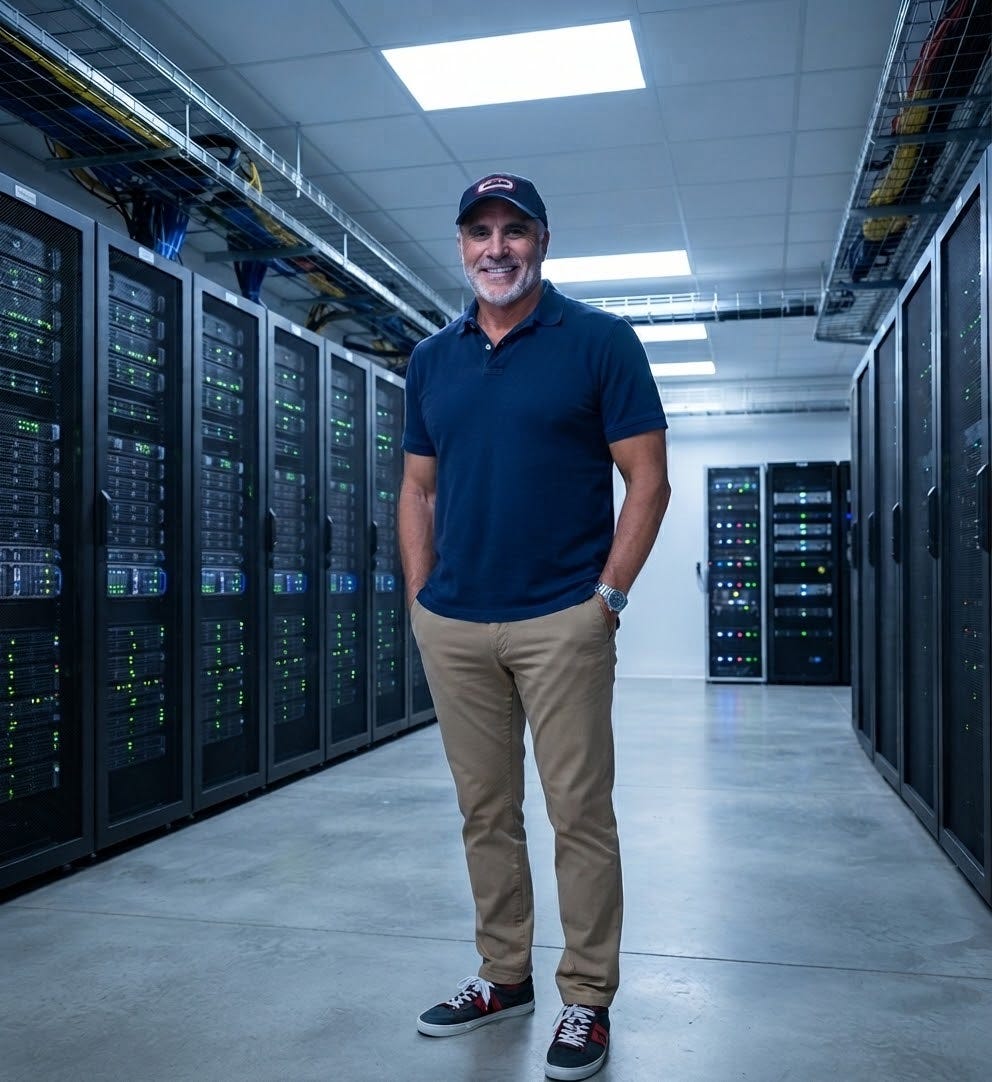
Daniel Kaufman is the founder and CEO of Kaufman & Company, a private investment and holding firm working across real estate development, venture investment and infrastructure. His work centers on workforce housing, employer anchored development, and infrastructure that communities can actually live alongside. He writes about housing, development and the markets behind them from an operator’s point of view.
Daniel@kaufmanredev.com danielkaufmanre.com linkedin.com/in/danielekaufman
Source: MSCI, US data center development risk review, 2026.