
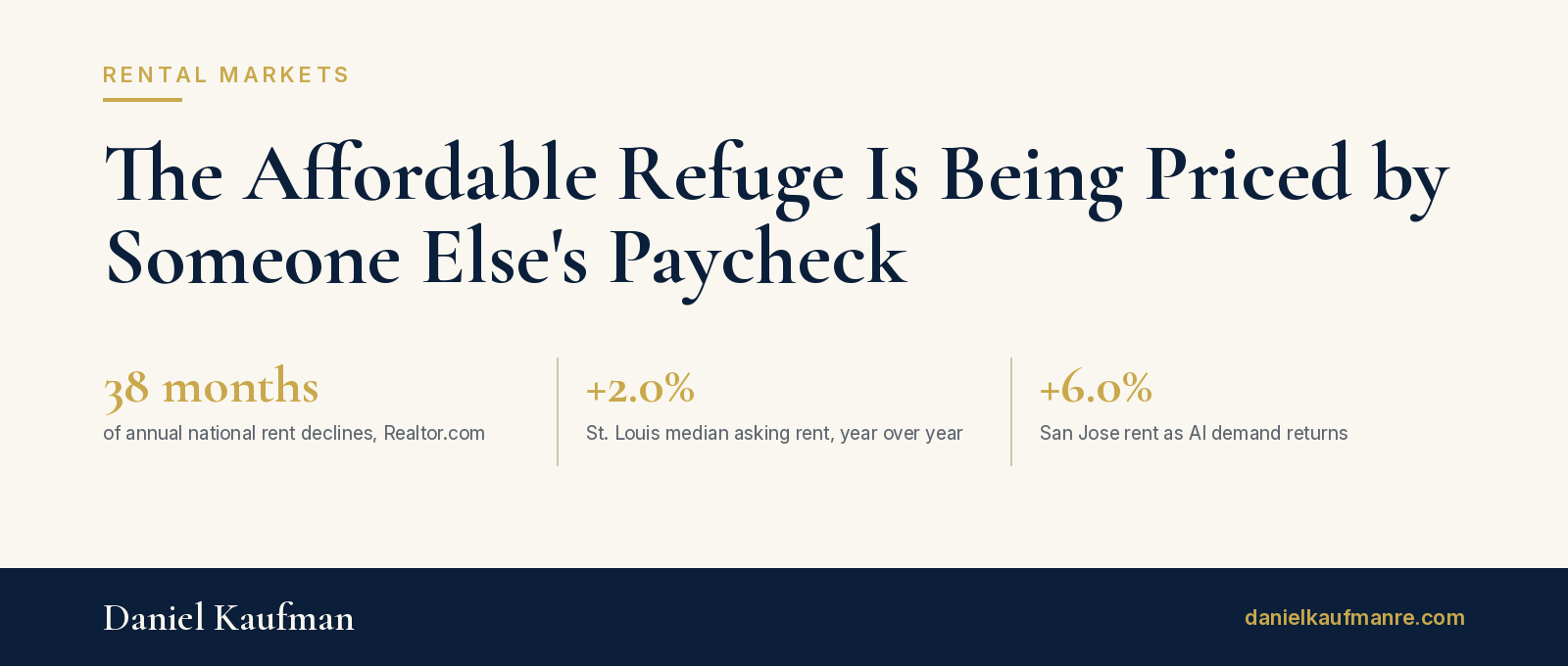
National rents are still falling. Realtor.com’s September 2026 rental report, published today, puts the median asking rent for zero to two bedroom units across the 50 largest metros at $1,694, down 0.4% from a year earlier. That is the 38th straight month of annual declines. If you stopped reading there, you would think renters finally hold the cards.
They don’t, at least not everywhere. The same report shows a group of metros long treated as affordability refuges moving the other way: St. Louis, Minneapolis, Riverside, Las Vegas and Virginia Beach. What ties them together is not a local hiring boom or a construction drought. It is imported demand.
Realtor.com found that nearly half of the out-of-market rental interest in St. Louis last quarter came from Chicago, where the median asking rent rose to a record $1,909. St. Louis rents rose 2% to $1,300. Minneapolis, which drew about a quarter of its outside interest from Chicago, rose 1.7% to $1,509. Roughly half of Riverside’s outside interest came from Los Angeles, as did about 31% of Las Vegas’s, and Virginia Beach drew around 31% of its outside interest from Washington, DC. Virginia Beach rents rose 1.7% to $1,539, still about $700 a month below DC.
Here is how I read it. The refuge is being priced by someone else’s paycheck. A household carrying a Chicago or Northern Virginia income looks at a $1,500 townhome and sees a bargain. The nurse, the warehouse supervisor and the teacher who already live there see a rent increase their own wages did not earn. That is the K shaped housing economy showing up inside a single metro. The upper leg imports its budget, and the lower leg absorbs the cost.
I want to be honest about the size of this. Riverside rose 0.2%. Las Vegas rose 0.9%. Nobody should call that a boom. But direction matters more than magnitude when the national number has been negative for more than three years. When cheap markets drift up while expensive ones drift down, the spread that made them a refuge is closing from both ends. Los Angeles is still at $2,851, down 1.1%, according to the same report.
The tech hubs are a separate story with the same lesson. Realtor.com reported San Jose rents up 6% to a record $3,565, with the share of listings offering concessions falling from 51.9% to 24.3% in a year. San Francisco rose 4.8%. Demand follows paychecks, and right now the paychecks are concentrated.
The outlier I would watch most closely is Detroit. Realtor.com said Detroit rents are still down 1% year over year, but the trend improved by 6.6 percentage points, helped by AI related investment, thinner rental inventory and renters arriving from New York, Chicago and DC. That is what an underpriced turnaround market looks like before the headline catches up: rents that are falling more slowly every month until they are not falling at all.
Where I see the opportunity. The winners are owners and builders of well run, mid priced rentals in established neighborhoods: townhomes, small multifamily and single family rentals near decent schools with an easy commute. The out-of-market renter is moving to save money, not to upgrade, so the opportunity is not in luxury. Product that lands near the local median, built on land bought at local prices, is where the spread lives.
Builders and lenders who can deliver attainable for-sale homes also win. Realtor.com described Virginia Beach renters doing the math on buying after repeated increases. When rents in a refuge market climb while the national rental market softens, the rent versus own decision tips, and entry level for-sale demand follows.
Where it breaks down. First, imported demand is fickle. If Chicago and Los Angeles keep softening, the push weakens and these metros lose the outside renter driving the increases. Underwriting a refuge market on rent growth that depends on another city staying expensive is underwriting someone else’s market.
Second, the locals carry the risk. Realtor.com cited a 2024 report from the Virginia Center for Housing Research and Housing Forward Virginia that found a shortage of rentals affordable to very low income households and pressure on moderately priced stock. When outsiders bid up the middle, the workforce gets pushed to the edge or out. That is exactly where employer anchored workforce housing earns its place.
Third, capital. CRE Daily’s market snapshot put the 10 year Treasury at 5.19% at the October 14 close. Expensive money makes it harder to build the supply that would relieve the pressure, which means the squeeze on locals can last longer than the inflow that caused it.
What I am watching next: whether the out-of-market share in these metros keeps climbing in the next two monthly reports, whether local wages in St. Louis and Minneapolis keep pace with rent, and whether Detroit crosses into positive annual rent growth. The national number says renters are winning. The metro data says it depends on whose paycheck sets the price.
We think about refuge markets, workforce housing and turnaround metros as one connected story across the Kaufman & Company platform. If you want to see how those pieces fit together, start at https://www.thekaufmanco.com
About the Author
I’m the founder and CEO of Kaufman & Company, a private investment and holding firm working across real estate development, venture investment, and infrastructure. My focus is workforce housing and employer-anchored development, including mountain resort communities through Oldivai.
Reach me at Daniel@kaufmanredev.com or find more at danielkaufmanre.com.
Sources
Rents in ‘Affordable Refuge’ Metros Are Getting Pricier. Here’s Why., Realtor.com, October 15, 2026, https://www.realtor.com/news/trends/fleeing-high-rent-in-major-cities-why-these-affordable-refuge-metros-are-getting-pricier/
Power Access Overtakes Land and Labor in US Site Selection (Market Snapshot), CRE Daily, October 15, 2026, https://www.credaily.com/newsletters/national/issue/power-access-overtakes-land-and-labor-in-us-site-selection/