
Tech workers left the Bay Area in droves, the Financial District emptied out, and every pundit had a “doom loop” headline ready to go. Meanwhile Miami, and Austin, and every low tax Sun Belt market pulled in the refugees. Ron DeSantis stood on stage with a map of San Francisco marked with human waste locations and called it a victory lap.
That story is over. The Economist just ran the numbers, and they tell a different one now.
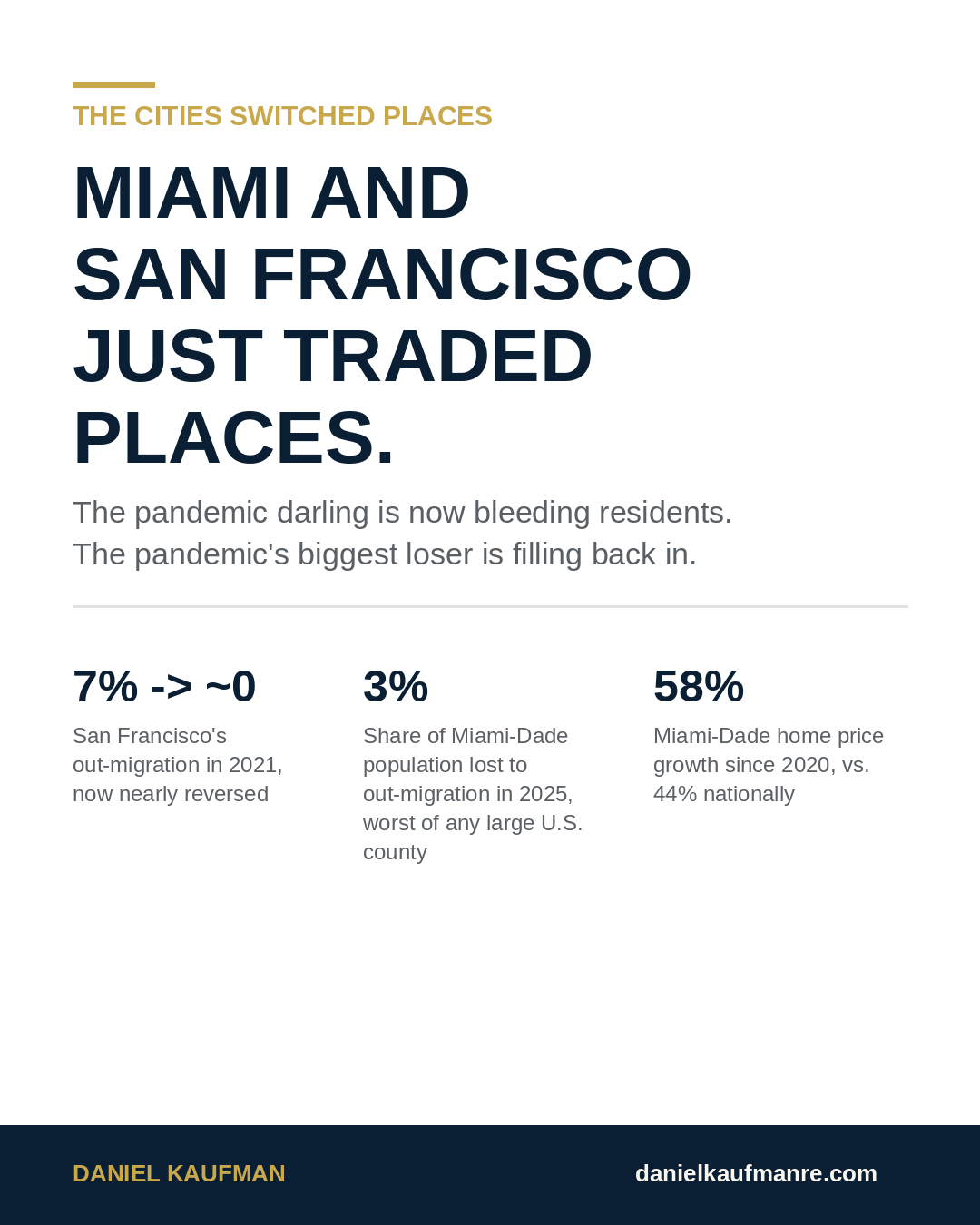
San Francisco lost close to 7% of its population to out migration in 2021. That exodus has slowed to a crawl. A political reckoning that started with the recall of a progressive DA in 2022 and continued with the election of Mayor Daniel Lurie in 2024 has the city focused on permitting speed and budget discipline instead of ideology. Layer the AI boom on top of that, with San Francisco and Silicon Valley absorbing two thirds of all AI related office leasing in the country’s six largest tech markets since 2019, and you get a downtown that’s filling back in.
Miami is running the reverse tape. Greater Miami lost the equivalent of 3% of its population to domestic out migration in 2025, the worst share of any large county in America. International migration into Miami Dade cut in half from 2023 to 2025. And here’s the part that matters most to me. Home prices in the county are up 58% since 2020, well ahead of the 44% national average. Miamians now spend a higher share of income on housing than residents of San Francisco or New York. The households leaving earned 40% less than the households replacing them.
I’ve been writing about this exact pattern for a while now under what I call the Southern Squeeze. Markets that won the pandemic migration race on the strength of low taxes and warm weather are now pricing out the very workforce that makes those markets function. Miami didn’t lose its appeal. It lost its accessibility. A city can be a magnet for capital and a trap for labor at the same time, and that’s precisely what’s happening on the ground there right now.
The uncomfortable truth in this piece is that San Francisco isn’t solving that problem either. It’s just further along in a different version of it. Home prices in Pacific Heights are up 14% in a single year. The tax data show new arrivals to the city earn about 25% less than the people who left, which sounds like progress until you realize the housing stock isn’t built for that gap. Miami and San Francisco are converging on the same failure mode from opposite directions, wealth concentrating at the top while the workforce that keeps the city running gets pushed further out.
This is the whole argument behind Oldivai and everything we’re building around workforce housing. It doesn’t matter whether a market is booming or busting, whether it’s the pandemic darling or the pandemic loser. If you don’t build for the people who staff the hospitals, teach the schools, and run the restaurants, the city eventually stops working for anyone, plutocrats included. Miami’s new mayor, Eileen Higgins, is talking about building housing near transit. That’s the right instinct. The question is whether it happens before the imbalance gets baked in the way it did in San Francisco.
Cities don’t stay winners or losers forever. But the ones that actually last figure out how to keep the middle in the picture. That’s the market I’m building for.

Daniel
Daniel@kaufmanredev.com www.danielkaufmanre.com