
Two pieces of commercial real estate news landed this week that look like they contradict each other. I think both are right, and the reason matters for anyone heading into 2027.
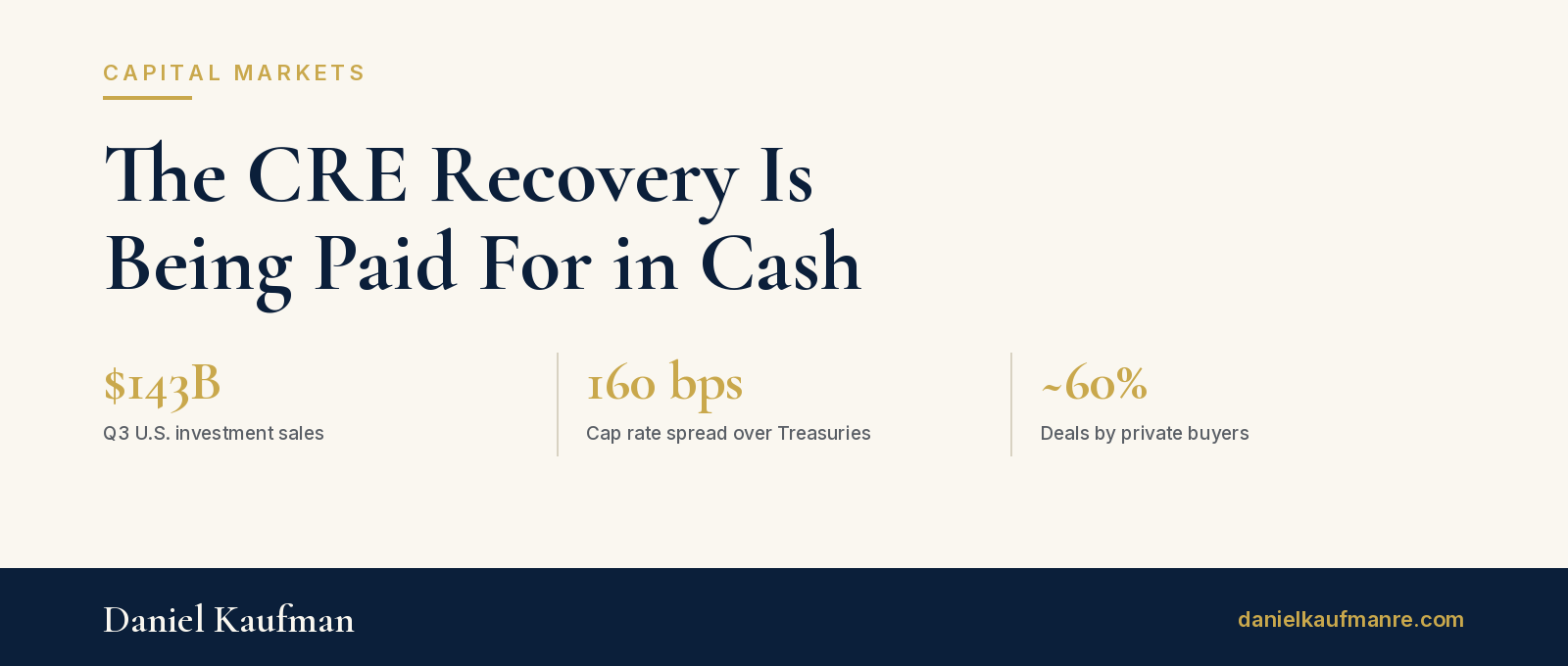
CRE Daily, citing Avison Young, reported that U.S. investment sales reached $143 billion in the third quarter, the strongest third quarter in four years, bringing year to date volume to $389.3 billion, up 17.9%. MSCI’s price index rose 0.9% from a year earlier, its best annual gain since December 2025.
In the same week, CRE Daily reported CBRE Research’s view that the average cap rate now sits only about 160 basis points above the 10 year Treasury. That is the thinnest spread on record and roughly half the long run norm of about 325 basis points. CBRE expects cap rates to rise at least 40 to 60 basis points, which it says implies value declines of 6% to 10%.
So which is it, recovery or repricing? The answer is in who is doing the buying.
According to the Avison Young data, private investors accounted for nearly 60% of transactions, targeting discounted assets and leaning on debt less than usual. That is the whole story to me. This is not a recovery financed by cheap money. It is a recovery financed by people who can write a large equity check and do not need a lender to agree with their valuation. CBRE notes the 10 year has held near or above 5% since September 10, and CRE Daily’s market snapshot had it at 5.024% at the October 28 close. At that level, positive leverage is hard to find. The buyers who win are the ones who do not need it.
JLL’s third quarter results point the same way. CRE Daily, citing Bisnow, reported that CEO Christian Ulbrich said very few capital markets deals are collapsing. They are taking longer, and price negotiations are tougher. His argument was that predictability matters more than the rate itself, and that investors handled 5% rates for years before. I agree with half of that. Investors can live with 5%. What they cannot live with is a 5% Treasury paired with a cap rate that was set when the Treasury was at 4%.
The sector split makes this sharper. Industrial sales jumped 41.5% to $113.3 billion and office sales rose 22.4%, with suburban office prices up 4.4% from a year earlier, per CRE Daily’s summary of the Avison Young and MSCI numbers. Multifamily still led every sector in total volume at $119.6 billion, but its sales grew just 3% and its values fell 4.6% from a year ago.
Now put that next to CBRE’s spread math. CBRE says multifamily and industrial carry the thinnest spreads, under 100 basis points, which makes them the most exposed if cap rates move. Industrial is trading at record values on a cushion that barely exists. Apartments have already taken a markdown, and CBRE still flags them as vulnerable, especially across the Sun Belt, where supply is heavy and loans are maturing. That is the Southern Squeeze showing up in the capital markets: the metros that built the most are the last ones the bid comes back to.
Where I see opportunity. The opening is for patient equity and for lenders. CBRE ranks CRE debt as the most compelling opportunity right now, and that matches what we see on the ground. When a bank will not size a loan to the old price, someone fills the gap, and that someone gets paid well for it. Discounted multifamily bought with modest leverage, at a basis that already reflects higher rates, is a very different trade than multifamily bought in 2021. Gateway markets are also pulling ahead. CRE Daily reported Chicago investment sales up 76.5%, Washington up 51.3%, and San Francisco up 30.9%, while supply heavy Denver and Phoenix lagged.
Where it breaks. The third quarter is a rear view mirror. Avison Young has already trimmed its full year sales forecast to $520 billion. JLL’s guidance implies flat to low single digit capital markets growth in the fourth quarter. CBRE expects activity to slow for roughly six months before recovering in the second half of 2027. If you bought industrial at a record value with meaningful leverage, a 50 basis point move in cap rates is not a rounding error. And CRE Daily notes that $733 billion of loans come due in 2027 as lenders grow less willing to extend. Every one of those maturities is a forced pricing event.
What I am watching. First, whether fourth quarter sales hold up once the summer momentum fades. Second, whether industrial cap rates start to move, since that is where pricing is hottest and the cushion is thinnest. Third, the share of deals closed by private buyers using low leverage. If that share keeps climbing, the recovery is real but narrow, and access to equity, not access to debt, is the competitive edge of this cycle.
Data over emotion: the headline says recovery, the spread says caution, and the buyer mix says both are true at the same time.
If the cost of debt is what stands between you and your next project, I wrote a free e-book on exactly that problem. The Capital You Don’t Have to Rent walks through ways to fund development without leaning on hard money, and you can get it at https://danielkaufmanre.com/capital.
About the Author
I’m the founder and CEO of Kaufman & Company, a private investment and holding firm working across real estate development, venture investment, and infrastructure. My focus is workforce housing and employer-anchored development, including mountain resort communities through Oldivai.
Reach me at Daniel@kaufmanredev.com or find more at danielkaufmanre.com.
Sources
CRE Sales Surge as Property Prices Rebound Despite Rising Rates, CRE Daily, October 29, 2026, https://www.credaily.com/newsletters/national/issue/cre-sales-surge-as-property-prices-rebound-despite-rising-rates/
CBRE: Cap Rates Could Rise 40 to 60 bps as 10 Year Tops 5%, CRE Daily, October 28, 2026, https://www.credaily.com/briefs/cbre-cap-rates-could-rise-40-60-bps-as-10-year-tops-5/
JLL Says Higher Rates Delay Deals but Aren’t Killing Them, CRE Daily, October 29, 2026, https://www.credaily.com/briefs/jll-says-higher-rates-delay-deals-but-arent-killing-them/