
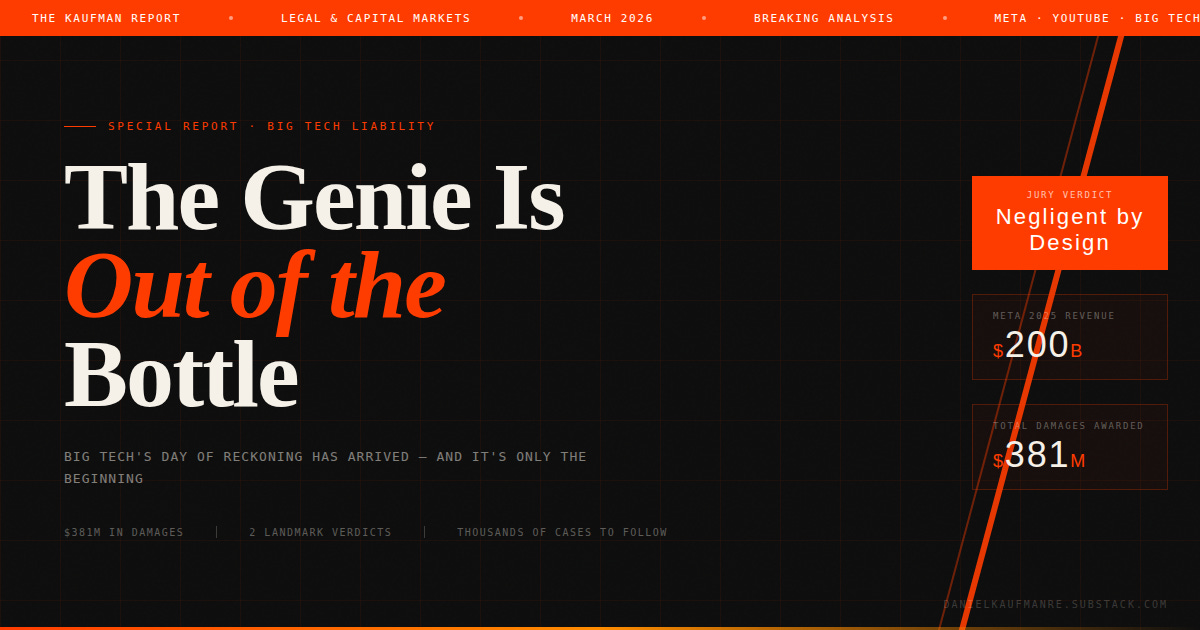
Two landmark legal rulings dropped last week. Both will have massive ramifications for years to come.
Last Thursday, a Los Angeles jury ruled that Meta and YouTube were negligent for designing addictive features — infinite scrolling, autoplay videos, beauty filters — that contributed to a then-teenage girl’s mental health struggles. Meta was found 70% responsible, YouTube 30%. Total damages: $6 million.
This came on the heels of a New Mexico jury finding Meta liable for $375 million after Attorney General Raúl Torrez alleged the platform’s features enabled predators and pedophiles to exploit children. A former Meta executive testified that, in their experience, 1 in 8 underage Instagram users received unwelcome outreach or harassment. Read that again. One in eight.
The predictable parade of politicians immediately materialized on cable news demanding that social media companies be reined in. Meta stock dropped 7%. Google dropped 2%. Both companies announced appeals.
Fine. Appeal away.
The Jury Has Spoken — Literally
Here’s what you need to understand about what just happened: a legal genie got out of the bottle, and it is not going back in.
Millions of families have been adversely affected by these platforms. Juries have now affirmed that the companies bear responsibility. The trial lawyers are sharpening their pencils in every state in the country. Attorneys general — elected officials who need wins — are going to line up to take a pound of flesh from the most unpopular companies in America.
Think about the jury math for a second. You’ve got a bajillion-dollar tech company on one side and a young woman with an eating disorder or depression on the other. That’s not a hard call. The money is a rounding error to Meta. To the family, it’s life-changing. Any public official who holds these companies accountable is going to look like a hero. Meta’s revenue in 2025 was $200 billion. YouTube’s exceeded $60 billion. They can afford to pay. And now they will.
The Damage Was Already Done
Even as the appeals are filed, I’ve seen the ads. You probably have too. Meta and YouTube are now advertising their new teen safety features. Better late than never, I suppose — except it isn’t better late. It’s an admission. Why did it take their feet being held to a legal fire to make these changes? That question will echo through every courtroom that follows. The newly adopted tweaks don’t soften the legal exposure. They deepen it.
I personally love that this tide has turned.
The data existed as early as 2017. These platforms were devastating for children — teenage girls in particular. Jonathan Haidt laid it out meticulously in The Anxious Generation, a book that has already driven policy changes in dozens of states. His reaction to last week’s verdicts was unambiguous:
“As of today, we are in a new world… Big Tech is harming kids on an industrial scale. For years, parents were told these harms were exaggerated, anecdotal, or simply the unavoidable cost of growing up online. Today, a jury affirmed what parents have long known… This is just the beginning.”
He’s right. Thousands of cases will follow. Meta, Snap, TikTok, YouTube — they’re all in the crosshairs.
The Real Cost
These companies made deliberate decisions years ago to maximize engagement and ignore the human cost. The algorithmic architecture wasn’t accidental — it was engineered. Infinite scroll was designed to be infinite. Autoplay was designed so you’d never stop. The beauty filters were designed to make teenage girls feel inadequate enough to keep coming back. This wasn’t negligence born of ignorance. It was a business model.
And that business model ran for years while a generation of kids paid the price.
Our leaders were asleep at the switch. The platforms got rich. And millions of children — their development, their self-image, their mental health — were collateral damage.
The companies are now starting to pay. It is far too late, and nowhere near enough. But it’s a start.
Maybe This Changes Everything
Here’s the outcome I’m actually rooting for: not just legal accountability, but a genuine behavioral shift. Maybe — finally — this marks the beginning of the end of the doom scroll. The manufactured outrage. The shamefests. The algorithmic amplification of division, negativity, and misinformation that has been monetized at industrial scale for over a decade.
Because that’s what these platforms actually sold. Not connection — division. Not community — comparison. Not information — engagement-maximizing chaos. The fake news, the pile-ons, the culture of shaming and canceling and turning neighbor against neighbor — it wasn’t a bug. It was the product.
If these verdicts start pulling people back into the real world — off their phones, off the feeds, into actual human contact and community — then the ripple effects of last week’s rulings will be far larger than any dollar figure awarded in any courtroom.
Put the phone down. Go outside. Talk to a person.
The algorithm isn’t your friend. It never was. A jury just said so.
The Kaufman Report cuts through the noise on real estate, capital markets, and the forces reshaping the economy. If someone forwarded this to you, subscribe below.