
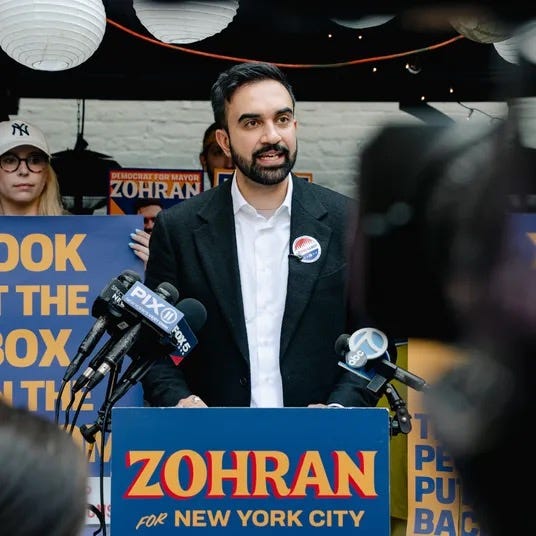
The Hard Part Starts Now
I met Zohran before his campaign began. We sat down, and my impression was straightforward, he’s a good person who wants good things for people. He’s newly married, energetic, and genuinely sincere. In a political environment where cynicism feels like the default setting, that alone is refreshing.
He’s smart, too, adaptable, curious, and far less rigid than many ideologues I’ve met. Some candidates start from fixed beliefs and end up stuck there; Zohran doesn’t strike me that way. He learns fast, he listens, and he connects with people naturally. That ability to meet people where they are explains a lot about how he won.
The Appeal of a New Generation
Big picture, I agree with his core message: making New York City more affordable.
Rent is spiraling out of reach. I hear it from young people I work with all the time, one friend in hospitality is paying nearly $4,000 for an apartment that would’ve cost $1,500 a generation ago. Free childcare, cheaper housing, and a city that feels livable for working families are deeply worthy goals.
Having a young, dynamic, optimistic mayor who shows up in every neighborhood and brings energy to the job is a huge upgrade on multiple fronts. That’s part of why he won. When the choice is between a 67-year-old scandal-tarnished retread and the next generation, the city chose the future.
But liking Zohran and believing in his intentions doesn’t mean ignoring what’s ahead. Some of his challenges are within his control. Some aren’t.
The Limits of Vision
Much of his economic agenda will be tough to implement. Raising taxes on the wealthy, for example, would require the state legislature’s approval, and Governor Hochul has already said no. Maybe she changes her tune next year, but I doubt it.
Free buses sound great, but I worry about unintended consequences. When something becomes free, it changes who uses it and how. City-run grocery stores are another example, well-intentioned, but risky. If the goal is to fight food insecurity, vouchers for existing stores might do more good than competing with them.
I love the idea of a mayor who wants to make the city work better for working families. That’s a win. But the truth is, the mayor’s ability to truly make New York affordable is limited. A lot of people, Zohran included, will find that frustrating.
Nervous Markets
In the business community, nerves are high. A self-described socialist in City Hall makes some CEOs and investors skittish. It’s not that they’re villains, it’s that they’re rational actors. If taxes or regulation tilt too far, they’ll relocate to Florida or Texas without hesitation.
If I were advising Zohran, I’d tell him to get in front of every major business leader in the city and say, “You might not always get what you want, but you’ll have a direct line to me.” That small step could go a long way.
He also faces skepticism about experience. He’s 34 and hasn’t run large systems before. His success will depend on the people he surrounds himself with. Keeping Police Commissioner Jessica Tisch or recruiting administrators like Maria Torres-Springer would signal stability and competence, two things markets respect.
Policing, Hate, and Reality
Zohran is right that law enforcement needs support from mental-health professionals. But morale in the NYPD is low, and too many officers are leaving for suburban departments. I’d argue the city needs more officers, not fewer. That will be a cultural stretch for him.
On hate crimes, his commitment to tackling antisemitism is important, last year, there were 345 anti-Jewish hate crimes in New York, compared to 78 targeting LGBTQ people and 43 targeting Muslims. Still, I was uneasy with his past academic defense of the phrase “Globalize the Intifada.” Words matter. For many Jews, that phrase invokes fear and violence.
Antisemitism is real and rising. Some hateful people will feel emboldened by his victory. That’s not Zohran’s fault, but it will become his problem.
The Weight of the Job
I don’t doubt that Zohran entered public service to help people, a rare motive these days. But being mayor of New York often turns good intentions into hard lessons. Adams, de Blasio, Bloomberg, Giuliani, it’s not a job that ends well for anyone.
The stakes are enormous. Eight million people packed into five boroughs, under enormous economic pressure, in an age of political polarization and instant outrage. It doesn’t take much to light the fuse.
Imagine a crisis: ICE raids, National Guard deployment, protests, counter-protests, rising antisemitism, market exits, and headlines that make the city feel on the brink. It’s not hard to envision how good intentions could be swept away by events.
A Hope, and a Warning
Let’s stipulate: Zohran is a good person. He’s in this for the right reasons. But this era rewards outrage, not nuance. Doing what feels morally right can still fuel chaos.
Winning the race might actually have been the easy part. Governing, balancing ideals with the gravity of reality, is the hard part.
I hope he succeeds. New York needs him to. But he’ll need to grow fast, build bridges quickly, and realize that leadership isn’t just about vision. It’s about resilience when the world refuses to cooperate.
Subscribe for more essays on urban policy, economics, and leadership: danielkaufmanre.substack.com