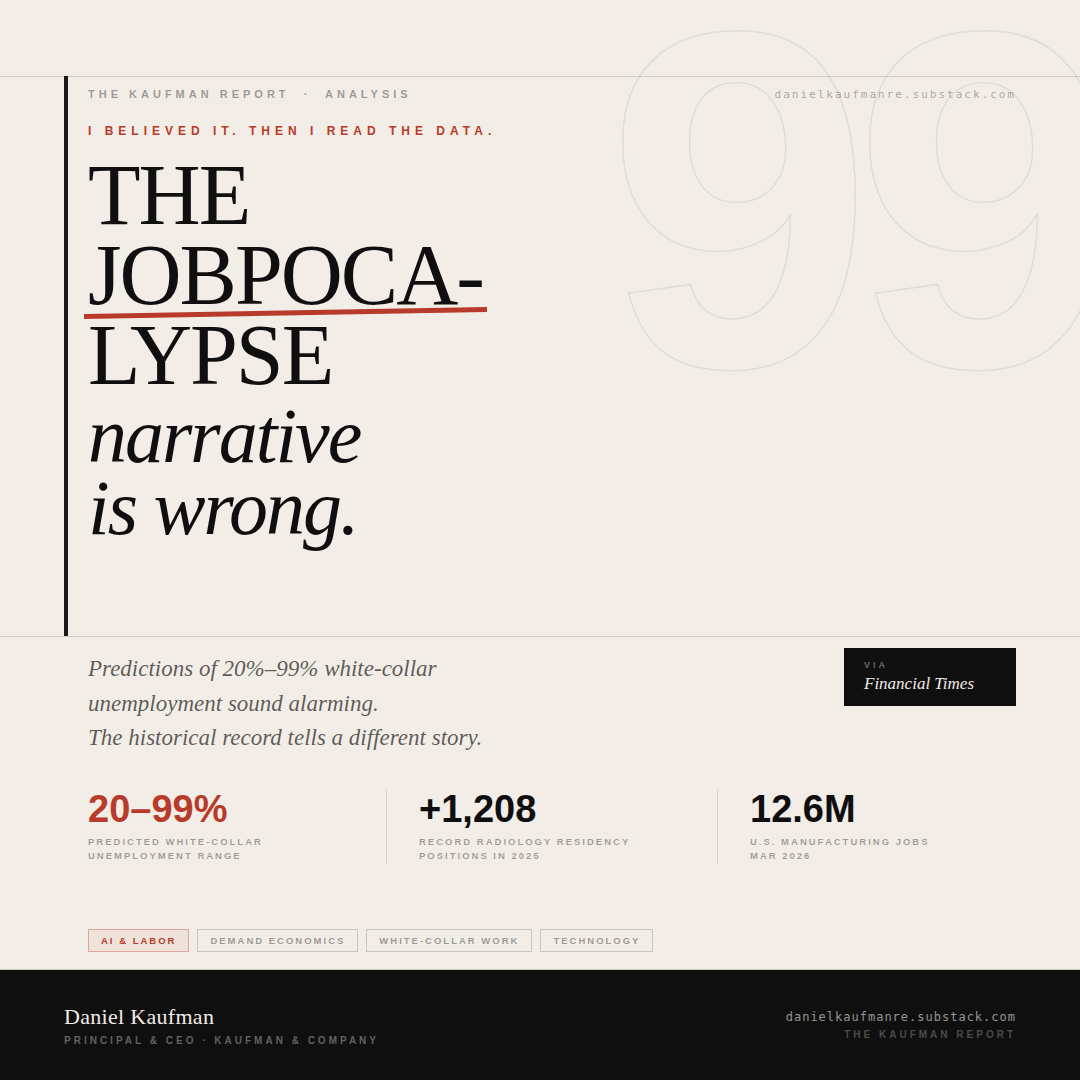
Every few months, someone with a credential and a microphone predicts that generative AI is about to wipe out white-collar employment. Dario Amodei. Vinod Khosla. Dr. Roman Yampolskiy. The estimates range from 20% unemployment to 99%. The word “jobpocalypse” has entered the vocabulary of serious people.
For a while, I was buying it. I’m in the business of reading markets, and the AI productivity gains I was seeing in my own operations were real enough that the displacement argument felt credible. If the tools could do this much this fast, the labor math seemed inevitable.
Then I actually sat down with the data. And then I read John Burn-Murdoch’s piece in the Financial Times.
I came out the other side a lot less certain about the narrative — and a lot more interested in the history.
The demand variable
The argument for mass displacement goes roughly like this: AI can perform tasks that humans currently get paid to do, therefore humans will stop getting paid to do them. It sounds logical. It’s also historically incomplete.
Burn-Murdoch’s central point is one that deserves more attention: whether a machine can perform a task is only the starting question. What actually determines employment outcomes is demand — and demand has a way of expanding in ways that models don’t anticipate.
Software development is the clearest example. Efficiency gains from better tools lowered the cost of building software. Lower costs didn’t reduce the number of developers. They fueled an explosion in software consumption, which required more developers than existed before the efficiency gains. The sector didn’t shrink. It scaled.
The same pattern has played out across professional services. Accountants, architects, advertising creatives — all made significantly more productive by technology, none of them disappearing. In most cases, demand grew faster than productivity did. The tools made the work more accessible, which expanded the market for the work.
The radiology case
Healthcare is the example I find most instructive, because AI in diagnostic imaging isn’t a theoretical future — it’s happening now. Systems exist that can outperform human radiologists on specific tasks. And yet: in 2025, the National Resident Matching Program reported a record 1,208 positions offered in U.S. diagnostic radiology residency programs. The specialty still pays an average of $520,000 annually. It remains the second-highest-paid medical specialty in the country.
Regulatory frameworks, insurance structures, and liability considerations create floors that pure automation logic doesn’t account for. The technology can do the task. The system isn’t built to let it.
When displacement does happen
Manufacturing tells the other side of the story. U.S. manufacturing employment peaked at 19.5 million in July 1979. By March 2026, it had fallen to 12.6 million. Automation and global competition drove that decline — and demand didn’t expand fast enough to compensate.
The difference between manufacturing and software, or manufacturing and radiology, isn’t the sophistication of the technology applied. It’s whether consumption grew alongside productivity. In manufacturing, it didn’t. The jobs left and didn’t come back in equivalent form.
The lesson isn’t that AI won’t displace anyone. It’s that displacement is sector-specific, demand-dependent, and shaped by regulatory and structural forces that vary enormously across industries.
The second-order effects are where it gets interesting
The history of technological disruption is full of indirect consequences that nobody predicted at the onset.
ATMs didn’t immediately eliminate bank tellers. Tellers weathered that first wave — only to face steeper declines later when smartphones made physical branches largely unnecessary. The disruption was delayed and came from a direction nobody anticipated.
The internet didn’t automate newsrooms. It collapsed the advertising model that funded them. Journalists weren’t replaced by machines — they were replaced by economics.
Spreadsheets reduced demand for bookkeeping and accounting clerks while increasing opportunities for higher-skilled financial analysts. The same tool that eliminated one category of work elevated another.
This last pattern matters for how we think about AI specifically. The assumption driving most jobpocalypse predictions is that top earners — the highly credentialed, high-complexity workers — face the greatest displacement risk because AI is eating into cognitive work. But history suggests the opposite may be more likely: AI augments the high-skill workers and displaces the more routine roles within the same field.
What I’m watching
I run a real estate development and investment platform. I use AI tools daily — for research, analysis, drafting, diligence. They’ve made my team more productive. They haven’t made my team smaller. They’ve shifted what we spend time on.
That’s the pattern I expect to see broadly. Not mass unemployment. A reorganization of how work gets done, which roles carry premium value, and which tasks get automated into the background. The winners in that reorganization will be people and organizations that adapt faster than the market prices the change.
I was ready to accept the jobpocalypse story. The tools are real, the pace is real, and the disruption is real. But the data doesn’t support the conclusion that disruption equals displacement at scale — and the historical record makes a pretty strong case that it rarely does.
The real question isn’t whether AI can do your job. It’s whether the demand for what you produce expands or contracts as the cost of producing it falls. That question doesn’t have a universal answer — and anyone telling you it does isn’t paying close enough attention to the data.
— Daniel Kaufman