
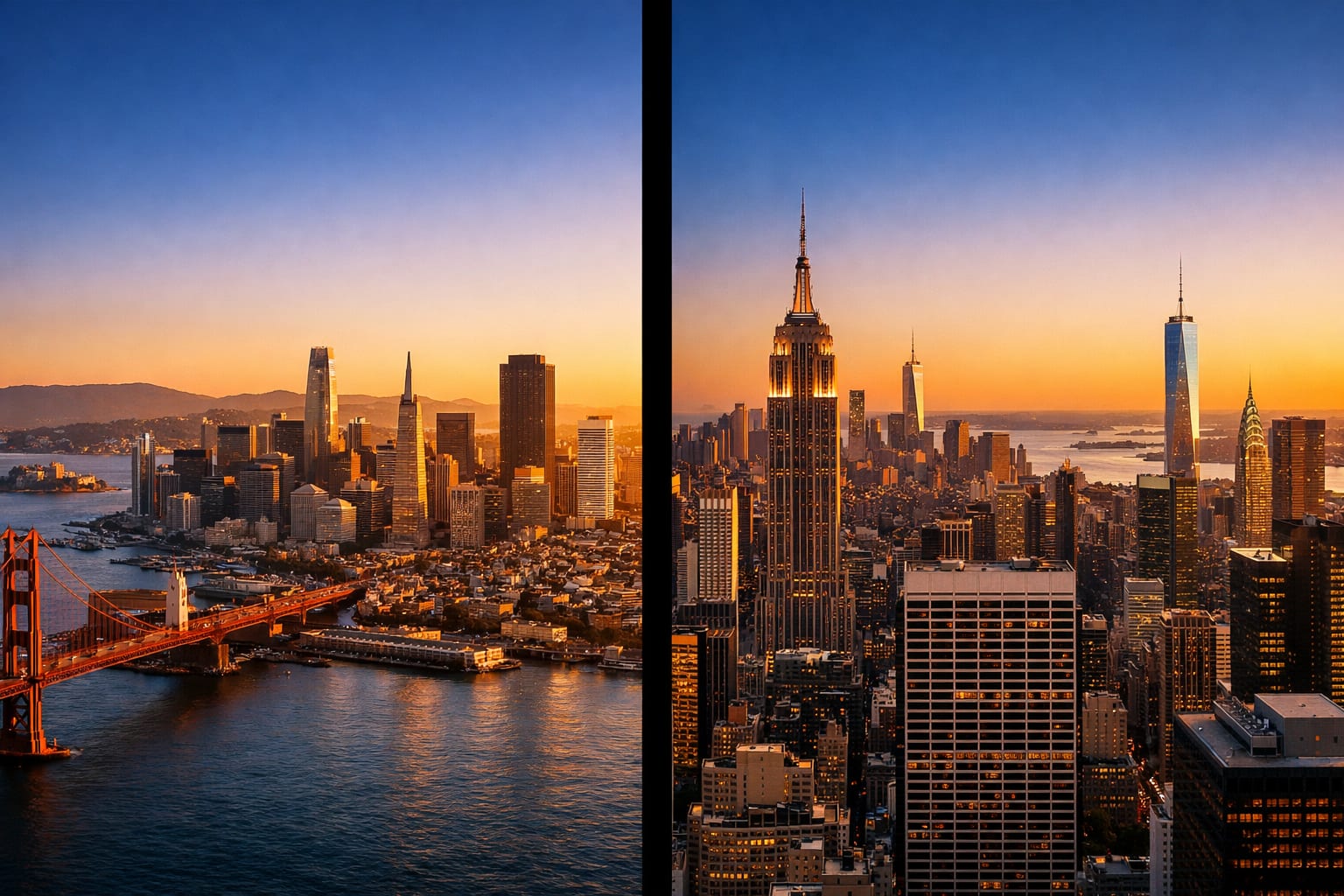
The Wall Street Journal just published another breathless piece about how the wealthy are fleeing America’s great cities and “the stickiness is gone.” They’ve been saying this for 30 years. They keep being wrong.
The headline practically writes itself: What Is a City When Its Wealthiest Leave? The WSJ published it yesterday. The subtext is familiar: billionaires are bolting for Miami and Austin and Palm Beach, and the great American city is in terminal decline. Real estate professionals are wringing their hands. Twitter is full of hot takes about New York being “finished.”
I’ve been in this business for 25 years. I have heard this exact story cycle through at least a half dozen times. And every single time, the obituary writers have been wrong.
Let me walk you through the record.
The Permanent Cycle of “Death” Narratives
After 9/11, New York was supposedly done. The office market would never recover. Who would want to work downtown? Then came one of the greatest real estate bull runs in the city’s history.
After the 2008 financial crisis, San Francisco’s tech-driven economy was overheated and fragile. The city would hollow out. Instead, the next decade brought the most explosive wealth creation the Bay Area had ever seen, turning neighborhoods like SoMa and Mission Bay into some of the most valuable commercial real estate on earth.
After COVID, the narrative hit a fever pitch. Every major outlet ran the same story: remote work had permanently killed the urban core. San Francisco was “empty.” New York was “over.” The smart money was going to Austin, Miami, Boise, and Nashville. The Wall Street Journal, the New York Times, Bloomberg — they all ran versions of this piece approximately once a month from 2020 through 2022.
And then? Rents in Manhattan hit all-time highs. San Francisco’s office market stabilized. Boston never really blinked. Chicago’s core held together. The migration wave to Sun Belt cities was real, but it was largely driven by middle-income households chasing affordability — not the talent, capital, or institutional infrastructure that actually drives economic output.
Why the Media Gets This Wrong, Every Time
The answer is simple: headlines are an attention business, and decline narratives generate clicks. “New York Is Resilient and Probably Fine” does not go viral. “The Death of San Francisco” absolutely does.
There is also a selection bias problem. When a hedge fund manager announces he’s moving his family office to Miami, that is a quotable, photogenic, easily narrated event. When 200 engineers quietly choose to stay in the Bay Area because that’s where their network, their venture firm, and their deal flow are, nobody writes a story about it. Non-events don’t have press releases.
The result is a systematically distorted picture of urban migration — one that overweights visible departures and undercounts invisible retention.
What Miami and Dallas Actually Are
Let me be direct about something that gets lost in all the boosterism: Miami and Dallas are excellent cities. They have genuine momentum. They have lower taxes, better housing affordability, and legitimate quality of life advantages. I am not here to bury them.
But they are not San Francisco. They are not New York. And they will not be, in our investing lifetimes.
Here’s why. The great legacy cities — New York, San Francisco, Boston, Los Angeles, Chicago — are not just collections of wealthy residents. They are ecosystems. They are the accumulated result of generations of institutional density: universities, hospitals, law firms, investment banks, venture capital networks, research labs, media companies, cultural institutions, and the informal human networks that connect all of those things to each other.
You cannot move an ecosystem. You can move a person. You can even move a company. But you cannot pick up MIT and put it in Dallas. You cannot relocate the concentration of biotech talent that has built up around Kendall Square in Cambridge over 40 years. You cannot manufacture the kind of deal-flow density that exists in a two-mile radius in SoMa or on Sand Hill Road.
This is what economists call agglomeration — and it is the most durable force in urban economics. Talent clusters around talent. Capital follows talent. Institutions follow capital. And the whole system becomes self-reinforcing in ways that take generations to build and are extraordinarily resistant to disruption.
The billionaire who moves to Miami still flies to New York for his board meetings. His kids still go to school in Manhattan. His family office still maintains offices in Midtown. The “move” is often a tax optimization strategy, not a genuine relocation of economic activity.
The Talent Is Not Leaving
The single most important variable in any city’s long-term economic health is not its tax rate. It’s not even its cost of living. It is the quality and concentration of its human capital.
And on that metric, the legacy cities are not losing. Not even close.
The top universities in the country are still in Boston, New York, Chicago, Los Angeles, and the Bay Area. The law firms that handle the most complex transactions are still in New York. The venture capital firms that write the largest checks are still overwhelmingly concentrated in San Francisco. The best hospitals, the best research institutions, the best cultural assets — they are all in the cities that the media keeps declaring dead.
When a company like Goldman Sachs opens an office in Dallas or when a tech firm sets up a satellite location in Miami, that is a diversification of operations, not a replacement. The headquarters, the decision-makers, the senior talent — they stay put, because that’s where their networks are, and networks are everything.
The people who actually move to Miami permanently are, with exceptions, either retirees, remote workers whose companies don’t require proximity, or wealthy individuals optimizing their tax burden. None of those categories represents the kind of productive, connected, institution-building talent that drives long-term economic output.
A Word on the WSJ Piece Specifically
The WSJ article raises a genuinely interesting question buried under the clickbait framing: what happens to city services when high earners leave, even partially? New York City, for example, relies on a remarkably small number of very high-income earners for a disproportionate share of its tax revenue. San Francisco has the same dynamic.
This is a real fiscal governance challenge. I won’t pretend it isn’t.
But the implication — that this dynamic will cause a death spiral, that “the stickiness is gone” forever — is where the analysis goes off the rails. Cities have faced fiscal stress before. New York literally went bankrupt in 1975. It came back. It always comes back, because the underlying asset — the ecosystem, the density, the talent, the institutions — doesn’t disappear just because a few high-profile names announced they’re buying a condo in Coconut Grove.
The stickiness isn’t gone. It’s embedded in the fabric of the place itself. It’s the reason a 23-year-old Stanford grad still moves to San Francisco instead of Phoenix. It’s the reason a junior associate at Sullivan & Cromwell is not relocating to Austin. It’s the reason the best restaurants, the best cultural programming, the most interesting human capital in the country is still concentrated in the same five or six places it always has been.
What This Means for Investors
If you’ve been sitting on the sidelines of gateway market real estate because you read too many “city is dead” articles, this is your moment of reckoning.
The fundamentals in constrained supply markets — New York, San Francisco, Boston, Los Angeles — are as strong as they have been in years. Rents are at or near all-time highs in most submarkets. Construction pipelines are thin, because the development environment in those cities is punishing. Institutional capital is rotating back in.
Meanwhile, the Sun Belt markets that attracted enormous capital flows during the pandemic boom are now dealing with overbuilding, softening rents, and the realization that population growth alone doesn’t create the kind of economic density that sustains premium valuations.
I have said this before and I will keep saying it: the best opportunities are often in the markets that the media has declared dead. Because that’s where the mispricing is. That’s where the crowd has overcorrected, where the narrative has run so far ahead of the fundamentals that real assets are trading at discounts to replacement cost in the most productive urban economies in the world.
The WSJ will write this piece again in five years. The city they’re eulogizing will still be standing. And the investors who ignored the headlines and focused on the fundamentals will have done very well.
They always do.

Daniel Kaufman is the principal of Kaufman & Company, a real estate development and investment firm with projects in California, Vermont, and Maine. He publishes The Kaufman Report on Substack.