
If you follow the mainstream real estate narrative, you would think nobody wants to build apartments anymore.
Interest rates are too high. Construction costs are too high. Banks aren’t lending. Insurance is expensive. Deals don’t pencil. Developers are sitting on their hands waiting for the Fed to save them.
There is truth in all of that.
But there is another story developing underneath the headlines.
Multifamily development isn’t disappearing. It is moving.
And that distinction matters enormously if you are trying to figure out where the next cycle of opportunity will come from.
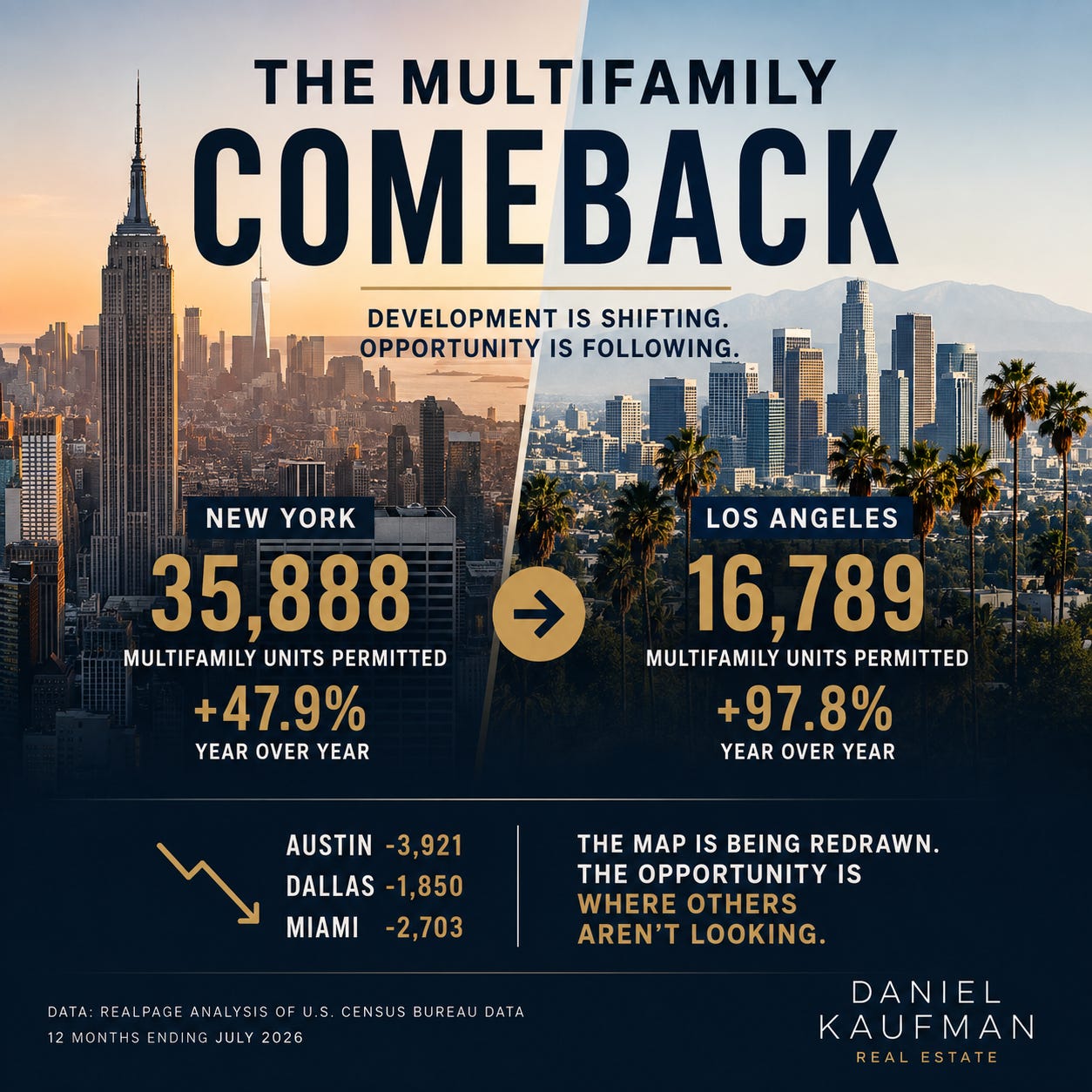
According to the latest U.S. Census Bureau permitting data analyzed by RealPage, New York permitted 35,888 multifamily units during the 12 months ending in July.
That’s up 47.9% year over year.
Los Angeles permitted 16,789 units.
That’s up 97.8%.
Yes, Los Angeles.
The same Los Angeles that has become shorthand in much of the real estate industry for regulatory dysfunction, high construction costs, expensive land and a difficult entitlement environment.
Meanwhile, some of the markets developers couldn’t build fast enough in a few years ago are hitting the brakes.
Austin is down 3,921 units year over year.
Orlando is down 2,835.
Miami is down 2,703.
Dallas and Houston each permitted roughly 1,850 fewer units than a year earlier.
The map is changing.
And I think investors who continue looking at real estate through the rearview mirror are going to miss what comes next.
The Sun Belt Trade Got Crowded
For most of the last cycle, the development thesis was relatively straightforward.
Follow population growth.
Follow jobs.
Follow business migration.
Follow people leaving expensive coastal cities for Texas, Florida, Arizona and the Carolinas.
Developers did exactly that.
So did institutional capital.
So did lenders.
And eventually, everybody discovered the same markets.
That’s how good investment theses become crowded trades.
Austin may be the clearest example.
The market became one of America’s great growth stories. Developers responded with enormous amounts of housing. RealPage data now shows Austin’s annual multifamily permitting has fallen dramatically from its previous peak.
That’s not because Austin suddenly became a bad city.
It’s because real estate is cyclical.
Capital responds to opportunity. Development responds to capital. Supply eventually responds to development.
Then the economics change.
The same dynamic has played out across parts of Florida and Texas.
Markets that couldn’t get enough apartments several years ago spent the last few years absorbing a historic wave of them.
Now developers are reacting.
Meanwhile, Look at the Coasts
This is where things get interesting.
The conventional narrative says people left New York and California.
Therefore, you shouldn’t build there.
But real estate doesn’t work in slogans.
New York is now the largest multifamily permitting market in the country.
Its 35,888 permitted units are spread across Brooklyn, the Bronx, Queens and Manhattan.
Los Angeles is different.
Approximately 12,724 of the metro division’s 16,789 permitted units are concentrated within the City of Los Angeles itself.
That tells me something.
Developers aren’t abandoning expensive coastal markets.
They’re selectively returning to them.
Why?
Because barriers to entry can eventually become barriers to competition.
Land constraints matter.
Entitlement difficulty matters.
Construction costs matter.
Political complexity matters.
But so does replacement cost.
And so does the simple fact that millions of people still need somewhere to live.
The markets that are hardest to build in can become extremely interesting when everybody else decides they are too hard.
This Is Contrary to the Narrative. That’s the Point.
I have spent enough time in real estate to know that the best opportunities rarely arrive with universal agreement.
By the time everybody agrees a market is attractive, the opportunity is usually already priced accordingly.
A few years ago, virtually every institutional presentation seemed to contain some version of the same map.
Arrows pointed toward Texas, Florida, Arizona and the Southeast.
Capital followed those arrows.
Development followed the capital.
Supply followed development.
Now we’re beginning to see the other side of that trade.
And simultaneously, markets that investors spent years writing off are starting to show renewed development activity.
That’s not something I view as contradictory.
That’s the cycle doing what cycles do.
The National Numbers Matter Too
There is another piece of this story that shouldn’t be ignored.
America’s apartment supply wave is already slowing.
Roughly 340,200 apartments were delivered nationally during the year ending in the second quarter of 2026, according to RealPage.
That was the first time in three years annual supply fell below the decade norm.
More importantly, annual deliveries have now declined for six consecutive quarters after peaking near 588,000 units in late 2024.
At the same time, apartment demand remains resilient.
More than 187,000 units were absorbed nationally during the second quarter alone.
Occupancy reached 95.5% in July.
And national effective asking rents finally returned to positive annual growth.
None of those numbers suggest an apartment market without demand.
They suggest a market working through the tail end of an extraordinary supply cycle.
And development decisions being made today aren’t really about 2026.
They’re about 2028, 2029 and 2030.
That’s where I think the opportunity becomes much more interesting.
So Where Are the Opportunities?
I’m not suggesting everyone should suddenly start buying land in Los Angeles and New York.
That would be replacing one simplistic investment thesis with another.
The opportunity is more nuanced.
First, look at markets where today’s supply problem may become tomorrow’s supply shortage.
If permitting, starts and construction pipelines continue declining in certain high-growth markets, today’s oversupply can eventually become tomorrow’s undersupply.
Austin is worth watching for exactly that reason.
A market can be overbuilt and still have excellent long-term fundamentals.
Timing matters.
Basis matters even more.
Second, look at high-barrier coastal markets where housing demand remains structurally stronger than the development environment.
New York, Los Angeles, San Jose and portions of the West Coast deserve another look.
Not every project works.
Most probably won’t.
But where zoning, density, land basis, financing and construction costs align, barriers to entry can protect the projects that actually get built.
Third, look for distress created by yesterday’s assumptions.
This may be one of the more compelling opportunities of the next several years.
Projects were bought and financed based on assumptions made when money was cheap, rents were accelerating and cap rates were compressing.
Some of those assumptions no longer work.
That creates opportunities in land.
It creates opportunities in partially entitled projects.
It creates opportunities in stalled developments.
It creates opportunities in recapitalizations.
And eventually, it creates opportunities to acquire assets below replacement cost.
I would much rather inherit someone else’s entitlement work at the right basis than pay them for the optimism they had three years ago.
Fourth, follow supply, not headlines.
Population growth matters.
Job growth matters.
Household formation matters.
But none of those statistics should be viewed independently of supply.
A market growing 3% with enormous new supply can be less attractive than a market growing 1% where virtually nothing can get built.
Real estate happens at the intersection of demand, supply and basis.
You need all three.
What We’re Looking For
Our development and investment thesis isn’t based on chasing whichever market topped last year’s rankings.
We’re looking for dislocations.
Markets where perception and fundamentals have separated.
Markets where development has become difficult enough that future supply may be constrained.
Markets where existing developers or landowners are under pressure.
Markets where projects can be acquired or recapitalized at a basis that makes sense under today’s financing environment, not yesterday’s.
And markets where housing demand is durable enough to survive the inevitable economic cycles between acquisition and stabilization.
That is a very different exercise from asking which cities have the highest population growth.
It requires underwriting.
It requires patience.
And sometimes it requires being willing to invest where the prevailing narrative says you shouldn’t.
Los Angeles Is a Good Example
I know firsthand how difficult it can be to develop housing in Los Angeles.
That difficulty is real.
But so is the housing shortage.
So is the cost of replacement.
So are the barriers facing new competitors.
And so is the demand for housing in one of the largest economic centers in the world.
When Los Angeles multifamily permitting increases nearly 98% in a year, I pay attention.
Not because every one of those projects will get financed or built.
Permits are not completions.
But because developers are voting with something much more meaningful than opinions.
They’re voting with capital, time and entitlement risk.
The Next Cycle Won’t Look Like the Last One
That’s probably the most important takeaway.
The winners of the next real estate cycle aren’t necessarily going to be the winners of the last one.
The development map is already being redrawn.
Some Sun Belt markets are digesting supply.
Some coastal markets are seeing development return.
National deliveries are falling.
Demand is holding up.
And projects that were underwritten during the era of cheap money are being forced to confront today’s capital markets.
That’s not a reason to sit on the sidelines.
That’s where opportunity comes from.
Real estate investing gets interesting when the consensus breaks down.
Right now, the consensus still says development is dead, the coasts are broken and everybody moved south.
The actual numbers are telling us something considerably more complicated.
And considerably more interesting.
The apartment development cycle isn’t ending.
It’s rotating.
The question isn’t whether apartments will continue to be built.
The question is who recognizes where the economics are moving before everyone else does.
That’s the part I’m paying attention to.

Daniel Kaufman is a real estate developer and investor focused on housing, build-to-rent, mixed-use development and opportunistic real estate investments across the United States.