
I have spent more than 25 years on job sites, in lender meetings, and across the table from general contractors, and I can tell you the current cost environment is not a blip. It is a structural repricing of what it costs to build in America, and owners who treat it like a temporary squall are going to get caught in open water.
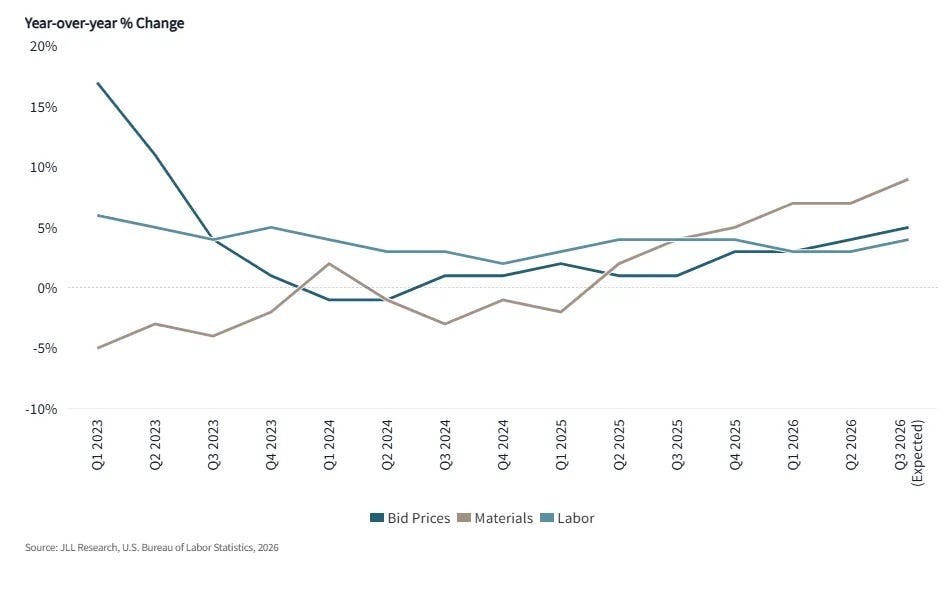
JLL’s 2026 Construction Perspective midyear update puts numbers to what I have been seeing in my own bids and buyouts all year. Final construction costs are up roughly 5 percent year over year, with more escalation expected in the back half of 2026. That is the headline. The story underneath it is more interesting, and more actionable.
The data center effect is real, and it is coming for your subs
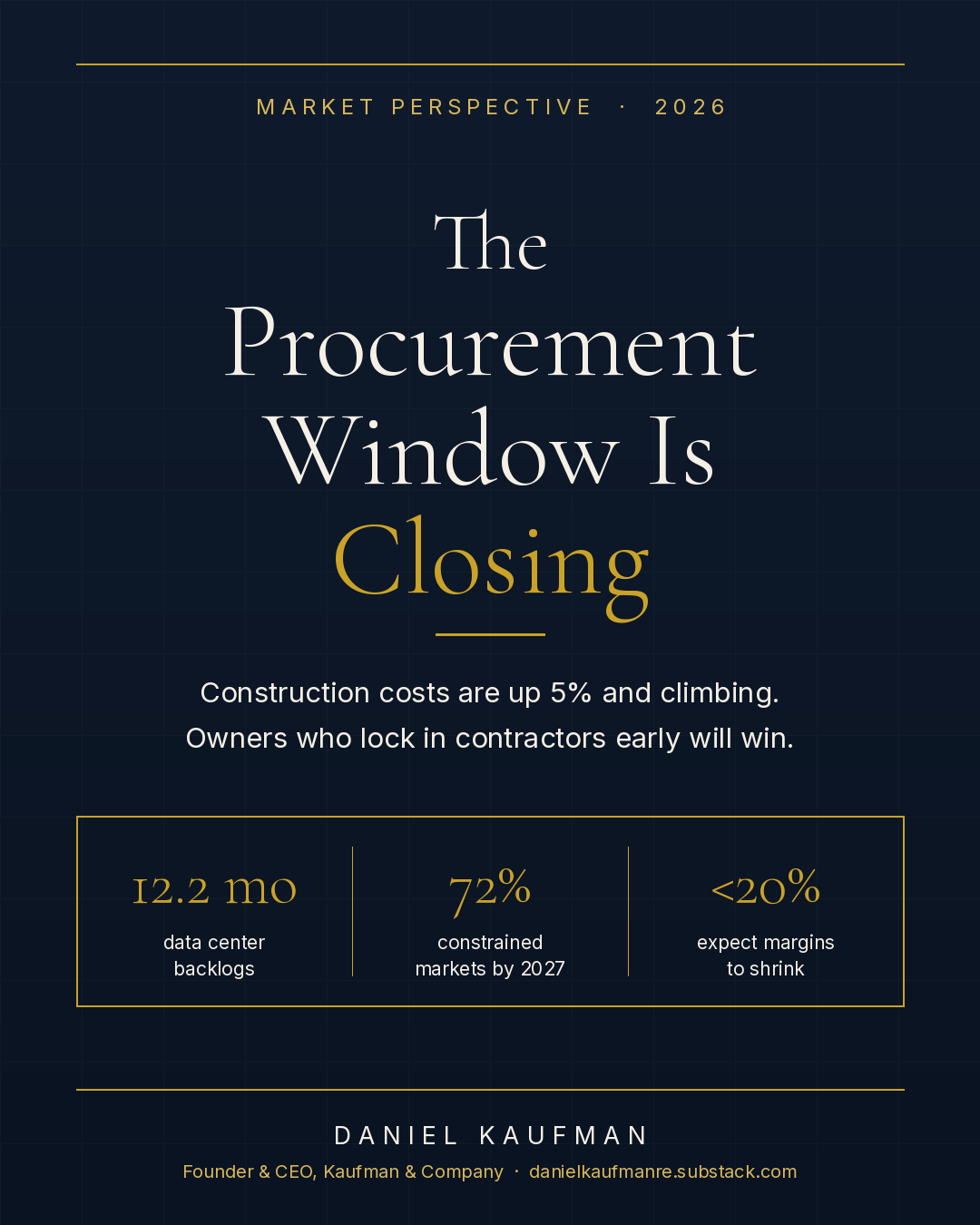
Here is the stat that should stop every developer in their tracks. Contractors carrying data center work now sit on 12.2 months of backlog. Contractors without data center exposure carry 8.3 months. That four month gap is AI demand pulling labor, subcontractors, and schedule capacity out of the general market.
If you are building multifamily, workforce housing, or mixed use in a market with heavy data center development, you are not just competing with other apartment developers for trades anymore. You are competing with hyperscalers who have effectively unlimited budgets and board mandates to move fast. Your electrician has options. Price accordingly.
Meanwhile, spending growth across traditional commercial sectors, office, industrial, mixed use, is running below 1 percent in real terms. That soft demand is the one thing keeping a lid on pricing in those sectors, and it will not last. The window to secure favorable pricing is open, but it is narrowing.
Tariffs and labor are stacking on top
Trade policy is adding weight to the pile. Expanded Section 232 tariffs now cover a broader set of construction products, and the tariffs on steel, aluminum, and copper are still in place. Anyone underwriting a project with a meaningful structural or MEP package needs to carry real contingency for material escalation, not the token 3 percent line item that made lenders comfortable in 2021.
Then there is labor, which is the problem I worry about most because it does not resolve with a policy change. Construction employment grew just 0.6 percent, against a historical average of 2.7 percent. JLL estimates 61 percent of U.S. metro markets are labor supply constrained today, rising to 72 percent by 2027. And here is the part that matters for anyone modeling multi year pipelines: skilled construction labor does not relocate easily. A framing crew in Nashville does not solve your problem in Salt Lake. These shortages are local, sticky, and long term.
Contractors have pricing power, and they know it
The most telling data point in the whole report is this one. Fewer than 20 percent of contractors expect their profit margins to shrink. Read that again. In an environment of rising input costs, contractors are confident they can pass every dollar of escalation into their bids rather than absorb it.
That is what pricing power looks like. And when your counterparty has pricing power, the only leverage you have left is timing.
What I am doing about it
I will tell you how this is playing out in my own shop. On active projects, we are moving to lock GMP contracts earlier in design than I would have considered comfortable five years ago. Yes, you give up some scope flexibility. In this market, certainty is worth more than optionality.
On the buyout side, we are pushing to secure long lead trades, electrical, mechanical, structural steel, as early as the drawings allow, and in some cases before. We are also underwriting escalation honestly. If your pro forma still assumes costs revert to pre 2026 levels, you are not underwriting, you are hoping.
The owners who win the next 24 months will be the ones who treat contractor relationships like the strategic assets they are, who commit early, and who build escalation and schedule risk into the deal at the term sheet stage rather than discovering it at buyout.
The procurement window is closing. Move while it is still open.

Daniel Kaufman is the Founder and CEO of Kaufman & Company, a private investment and holding firm with more than $2 billion in project value across real estate development, private credit, and infrastructure. He has spent 25 plus years building, lending, and investing across the Mountain West, Texas, Florida, Vermont, and the Northeast.