
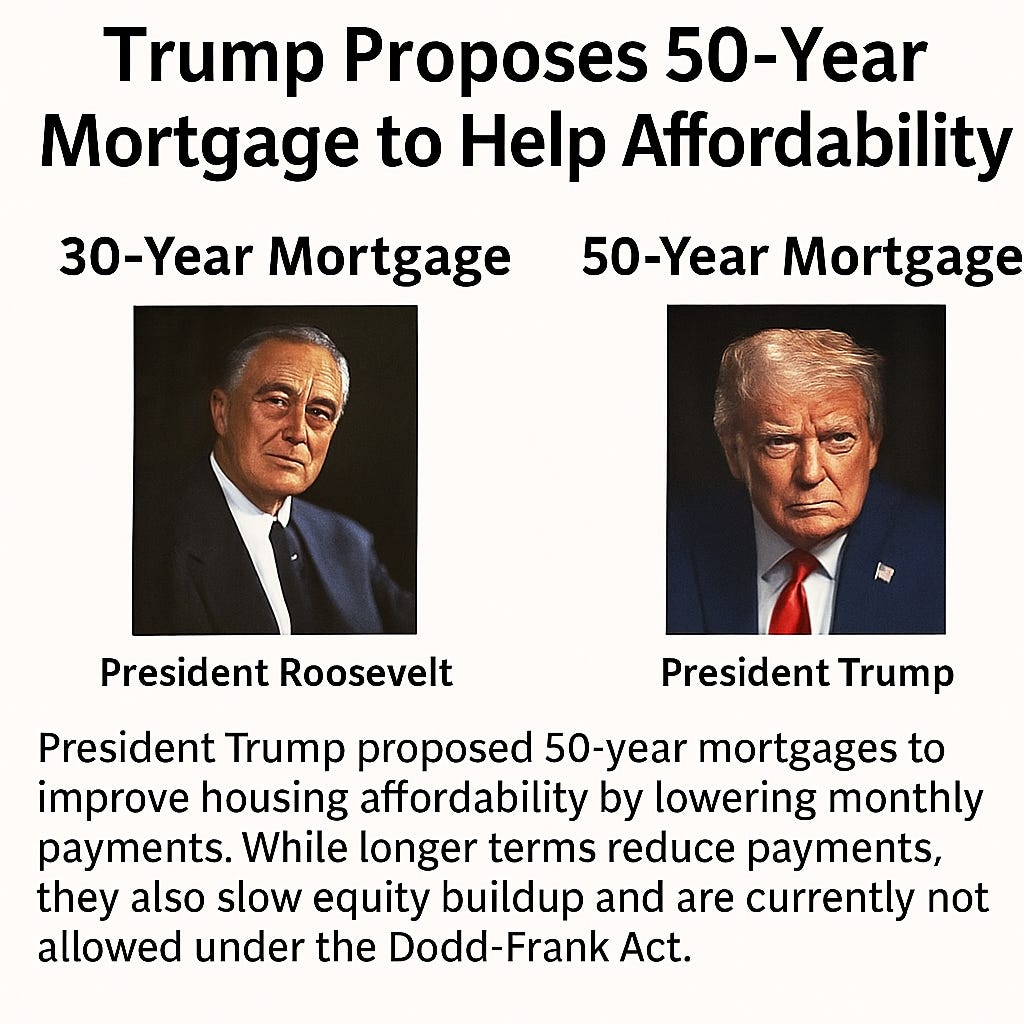
President Trump’s latest housing proposal — a 50-year fixed-rate mortgage — has stirred the real estate world. The concept, designed to ease the affordability crisis by lowering monthly payments, sounds like a breakthrough. But beneath the headline lies a complex mix of math, law, and unintended consequences.
Let’s unpack it.
The Promise: Lower Payments, Longer Terms
The idea is simple: stretch the amortization period from 30 to 50 years, and you reduce monthly payments. At a 6.575% rate and 20% down, Fannie Mae’s calculator shows how it would play out:
$300,000 loan: $1,529 (30-yr) → $1,366 (50-yr)
$400,000 loan: $2,038 (30-yr) → $1,822 (50-yr)
$500,000 loan: $2,548 (30-yr) → $2,277 (50-yr)
On paper, it looks like relief. But the savings flatten fast, especially between 40 and 50 years. And while the payment drops, so does the pace of equity buildup — meaning homeowners will own less of their homes for much longer.
The Catch: It’s Not (Yet) Legal
Here’s where it gets tricky. After the Great Financial Crisis, Congress passed the Dodd-Frank Act, which set stricter rules for mortgage underwriting. Under its Qualified Mortgage (QM) guidelines, lenders can’t issue loans beyond a 30-year term.
So unless the law changes, a 50-year mortgage could only exist in the non-QM market — where higher interest rates offset the risk. That would undercut much of the affordability benefit.
The Market Impact: Demand Without Supply
We can’t talk affordability without talking supply. Extending amortization periods doesn’t build more homes, and it doesn’t fix construction bottlenecks, zoning barriers, or labor shortages — the real drivers of housing cost inflation. It just allows buyers to borrow more and bid higher.
That’s why analysts like Logan Mohtashami have criticized the idea, arguing it subsidizes demand instead of addressing the structural imbalance. He’s right — unless the country can build faster and cheaper, new financing tools won’t solve the problem. They’ll just inflate the same limited inventory.
My Take: Creative Thinking, Wrong Tool
As a developer, I’ll never discourage creative thinking in housing policy. We need innovation — both in construction and finance — to make homes attainable again. But this particular tool feels misaligned with the root issue.
If Washington wants to make a real dent in affordability, we need to focus on supply-side innovation: modular construction, adaptive reuse, and streamlined permitting. We need to make it easier and faster to build workforce and middle-income housing — not just stretch the debt horizon another 20 years.
A 50-year mortgage might sound like progress. But it risks becoming a Band-Aid on a broken system, where the real cure lies in how, not how long, we build.